Aiden Makes Screen Capture On Demand for Faster Agent Actions
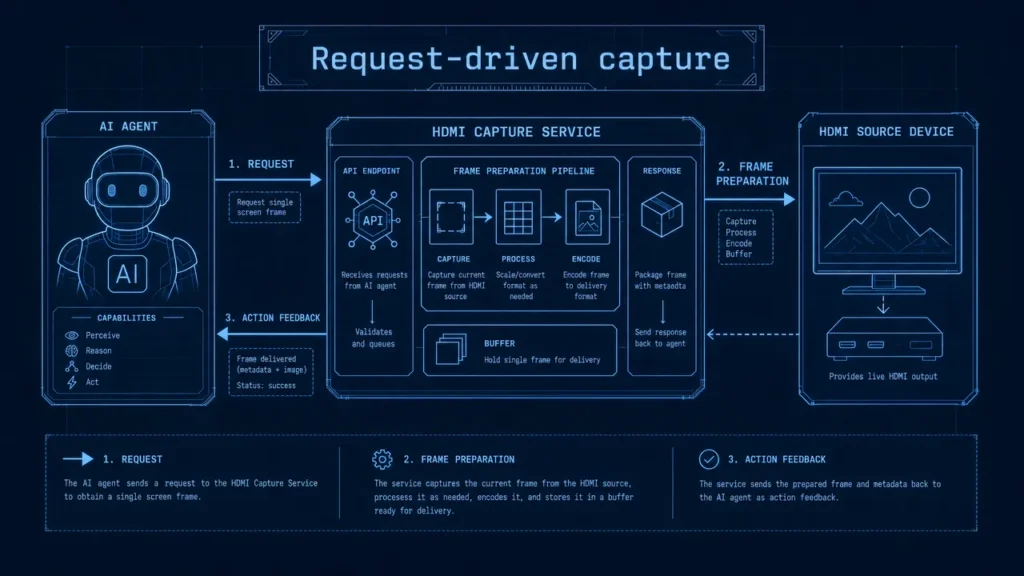
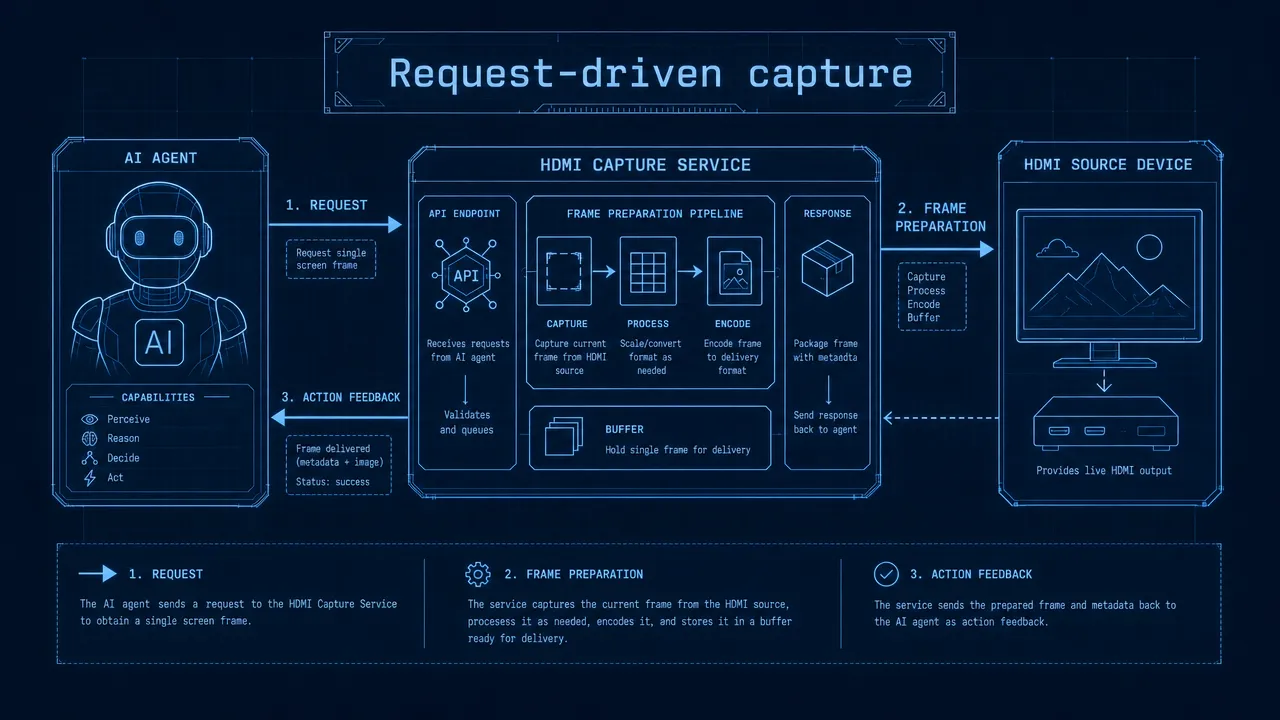
Major Update: Aiden firmware now moves screenshot capture from continuous frame reads to request-driven capture, so the Agent can request a current view when visual context is needed instead of keeping the capture path busy while idle. For vision and device-automation developers, this means less idle frame work and a clearer connection between an Agent action and the screen image used to inform it.
How on-demand screenshots for AI agents align capture with Agent actions
The previous continuous-read approach could keep the capture path active even when the Agent had no immediate visual decision to make. That creates background work during intervals where the next action does not depend on a new screen image.
With this update, the Agent requests a frame at the point it needs one. When it needs to inspect an interface, verify the result of an input, or obtain context for the next decision, it can ask the capture service for a current view. When no image is needed, the capture path does not have to remain occupied by continuous screenshot reads.
This request-driven model makes on-demand screenshots for AI agents more deliberate in Aiden’s firmware. You can structure an automation flow around explicit visual checkpoints rather than treating capture as a continuously maintained default. Aiden captures the target display through its HDMI capture path, while the Agent uses screen context to guide device actions.
Reusing on-demand screenshots for AI agents in capture sequences
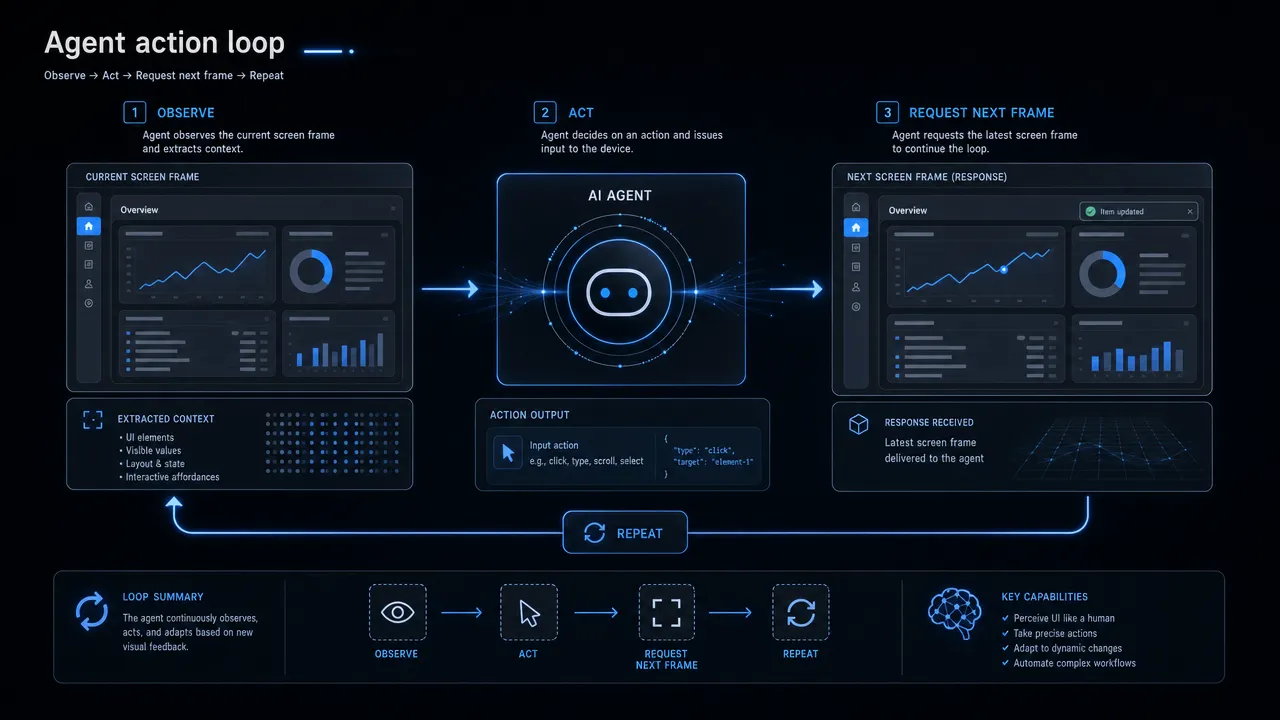
A single action may need more than one screenshot. The Agent might observe an interface, send an input, and then inspect the resulting screen state as part of an ongoing sequence.
For continuous screenshot tasks, the capture service can reuse capture state instead of treating every requested image as an entirely separate capture session. This is an important distinction for workflows that repeatedly observe a changing interface. You can retain a request-driven design without forcing the service to discard useful capture state between closely related frame requests.
The update also introduces configurable persistent STREAMON. When that behavior fits the task, the stream state can remain persistent for a sequence of captures. Combined with capture-state reuse, this gives Aiden a more suitable capture path for repeated observation while preserving the practical benefit of letting the Agent remain idle between unrelated visual needs.
This work is not a claim that every capture task should keep a persistent stream. It provides configuration and reuse behavior for cases where repeated screenshots are part of the same Agent workflow.
Preparing the requested frame before it moves downstream
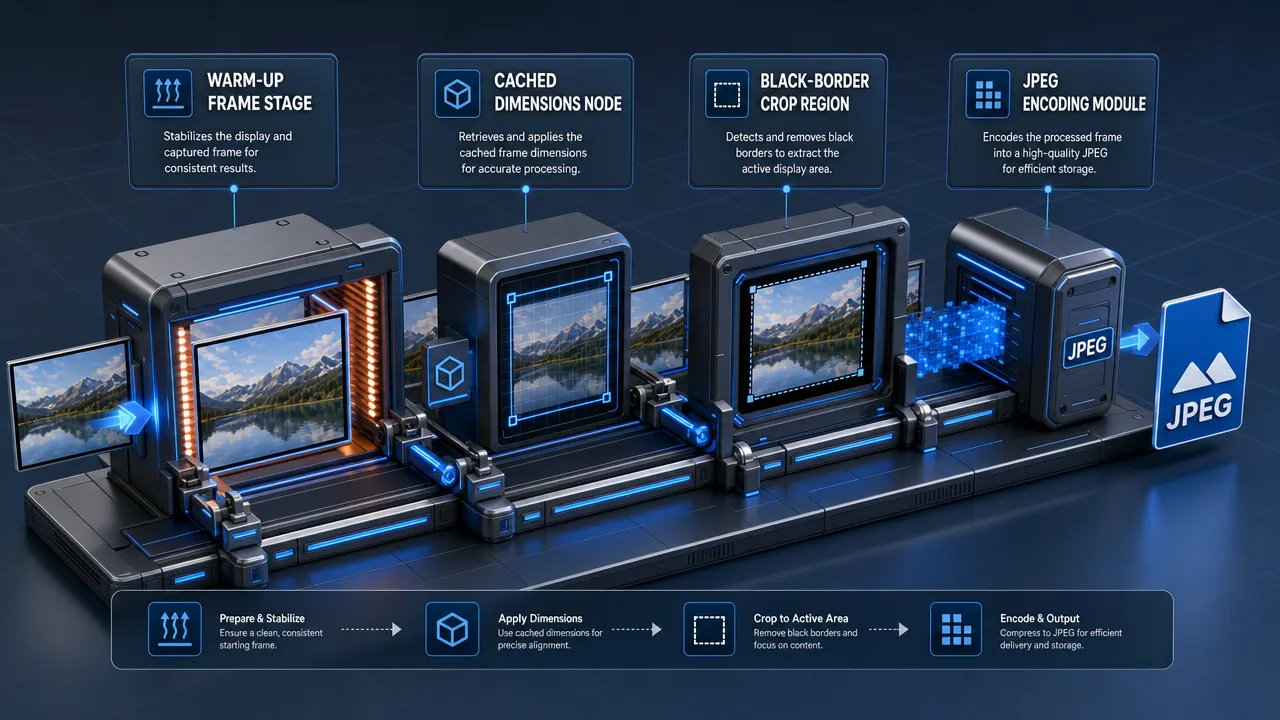
The merged changes also improve how a requested image is handled inside the capture pipeline. Aiden now adds warm-up frames, cached screen dimensions, black-border cropping, and hardware JPEG encoding.
Warm-up frames support the updated capture behavior before the requested image is passed onward. Cached screen dimensions let the capture flow reuse known dimension information rather than repeatedly obtaining it within each capture path. These are focused firmware improvements that support lower-friction handling of requested frames without making unsupported performance claims.
Black-border cropping is especially practical for visual reasoning and UI automation. When cropping is applied, the capture service can remove black borders before the image reaches the next stage. You receive a frame focused more closely on the captured screen content, rather than passing those borders to the downstream model or logic.
Hardware JPEG encoding is also part of the updated pipeline. It expands the encoding path available to the firmware, but it does not imply that every frame uses hardware JPEG encoding. The key change is more explicit control over when a frame is captured, how state is retained across a sequence, and how the resulting image is prepared.
Audited Aiden firmware changes
These changes were merged in PR #521 and PR #559. Together, they establish request-driven capture as the central behavior and add the supporting controls needed for repeated screenshot tasks and frame preparation.
For developers building visual automation around Aiden, on-demand screenshots for AI agents provide a simpler operating model: the Agent asks for visual context when it needs it, capture state can be reused during an active sequence, and black borders can be cropped before the image is passed on. The result is a firmware path that better matches how device actions and visual checks occur in practice.
Follow the Aiden firmware repository for ongoing work, and join the Aiden community on Discord to discuss the update.
Related posts
AI Agent Memory for Long-Running Device Tasks
Improve AI agent long task reliability with persistent memory for oversized tool outputs. Explore Aiden Firmware’s update now.
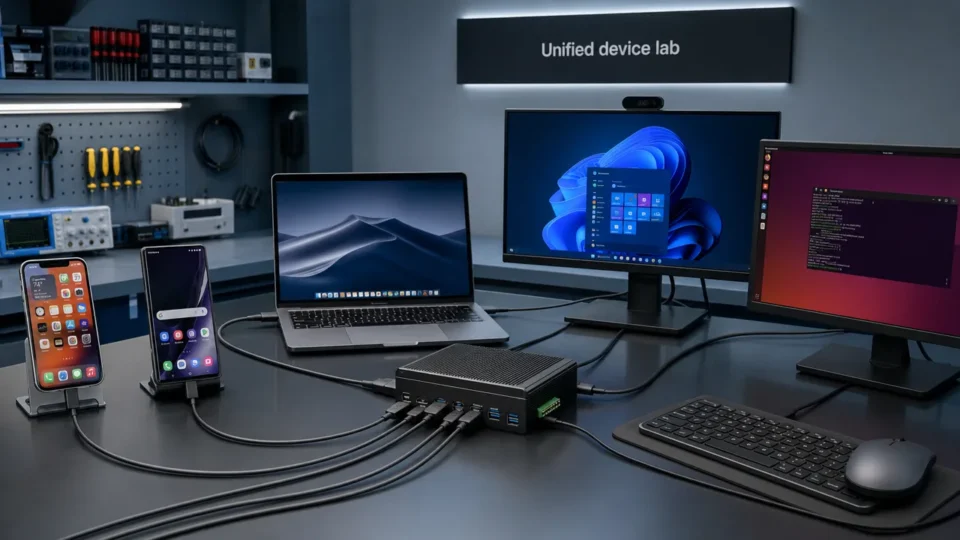
Unified Device Control Across iPhone, Android, and Desktop
Control iPhone, Android, macOS, Windows, and Linux with Aiden’s cross-platform device control. Explore the new firmware update today.
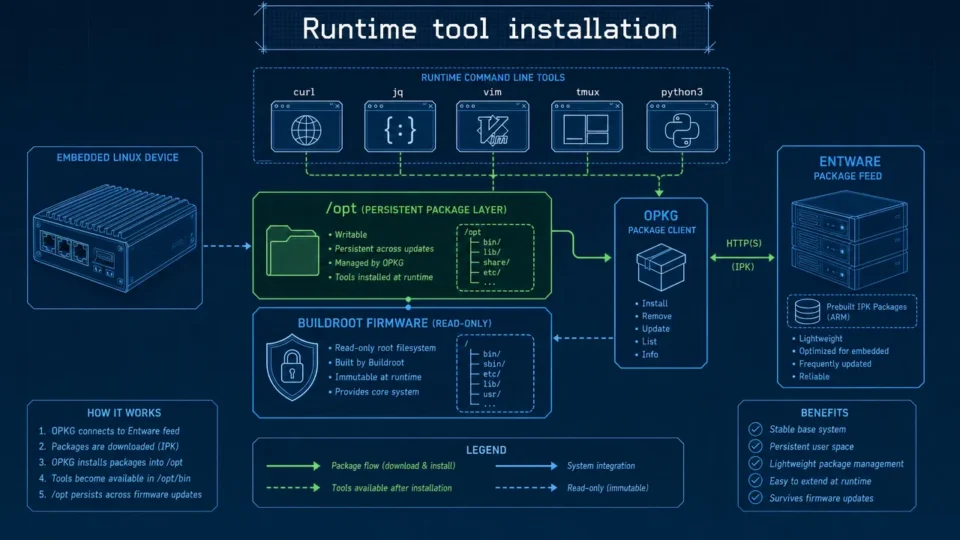
Embedded Package Management Without Rebuilding Firmware
Embedded package management in Aiden Firmware uses OPKG and Entware to install approved tools at runtime while keeping Buildroot stable.