AI Agent Memory for Long-Running Device Tasks

AI agent memory is the information an agent preserves or retrieves so it can continue a task without treating every step as a fresh start. For long-running device tasks, that memory must be separated from the model’s active context, the conversation transcript, the task’s execution state and the device’s current screen.
Those distinctions matter because an agent can remember the goal and still act on the wrong interface. It can preserve a conversation and still forget which action already succeeded. It can retrieve a useful procedure and still need a fresh screenshot before using it.
Reliable continuity therefore depends on more than “giving the model more context.” The system needs the right information in the right layer—and a way to verify the external world before it resumes.
Key point: Memory can describe what the agent previously observed or attempted. It cannot prove what the device displays now.
Why Long-Running Agents Need More Than Model Context
A model context window is a bounded working area for one inference. It may contain instructions, recent messages, tool results, screenshots and retrieved memory. As a task grows, all of those items compete for the same input budget.
Simply carrying every prior event forward is not a durable strategy. Long tool outputs and repeated screenshots can crowd out the original goal. Old observations can become misleading. A conversation can remain readable to a person while no longer giving the agent a precise record of completed steps, pending approvals or external side effects.
Long-running agents need several complementary mechanisms:
- a focused active context for the next decision;
- a recoverable session history;
- explicit task state for progress and approvals;
- persistent memory for information worth reusing;
- execution evidence for audit and later learning; and
- fresh observation of the device before consequential actions.
The last item is essential for device-use agents. A smartphone or computer can change while the agent is waiting, compacting context, calling a tool or handing control to a person. The current screen is part of the environment, not a durable memory record.
Context vs Memory vs Task State
These terms are often used interchangeably, but they solve different problems.
| Layer | What it contains | Typical lifetime | What it is for |
|---|---|---|---|
| Model context | Instructions and evidence included in the current model request | One inference or active run | Making the next decision |
| Conversation history | User and agent turns, tool exchanges and compressed session summaries | One active session; sometimes archived afterward | Preserving conversational continuity |
| Persistent memory | Selected preferences, rules, facts or reusable procedures | Across sessions until expired, changed or removed | Recalling information that remains useful |
| Task state | Goal, completed steps, pending work, outputs, approvals and errors | The life of a task | Continuing execution without repeating work |
| Device state | What the external interface displays and accepts now | Changes continuously | Grounding the next device action |
| Recovery state | Checkpoints, artifacts, errors and continuation information | Until recovery is complete or abandoned | Resuming after interruption or context loss |
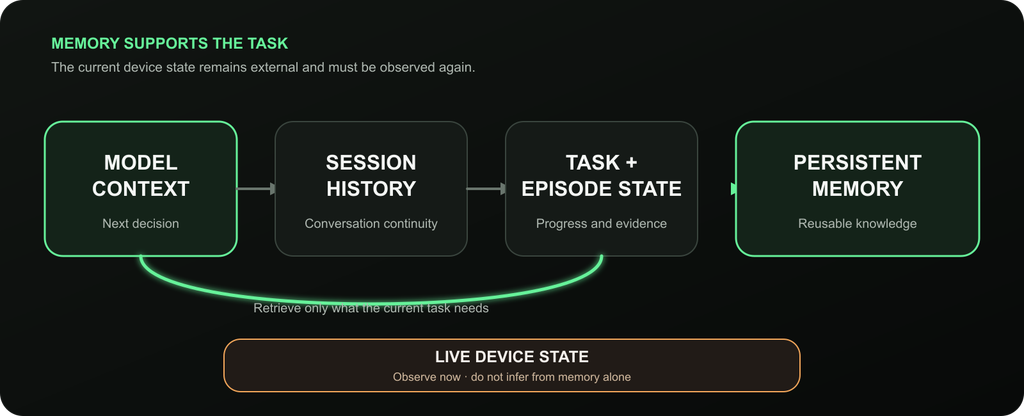
The live device remains outside the memory stack. The agent must observe it again before relying on an old screen state.
Model context is not automatically memory. Persistent storage is not automatically useful context. Task state is not the same as a user preference. Device state is not safe to infer from any of them.
Keeping the layers separate makes retrieval and recovery more precise. Instead of loading everything, the runtime can assemble the minimum evidence needed for the current decision.
What an Agent Needs to Remember
The useful memory for a long task is usually structured around continuity rather than volume.
Goal and scope
The agent needs the original objective, success condition and any boundaries the user set. Without that anchor, summarization can preserve recent activity while losing the reason for the work.
Completed steps
A record of confirmed progress helps prevent duplicate research, repeated file processing or repeated device actions. “Attempted” and “completed” should remain different states.
Current screen or last observation
The last observed screen can help explain where the task paused, but it should be timestamped or otherwise treated as historical evidence. It must not replace a fresh observation when the agent resumes.
Previous actions and results
Tool inputs, tool results, errors and external side effects help the agent determine what already happened. Large raw results may be kept as retrievable artifacts while concise findings remain in active context.
Constraints
Task-specific rules—such as allowed apps, prohibited actions, deadlines or required approval points—should remain available throughout the run.
User preferences where appropriate
Stable preferences may belong in long-term memory when the user has explicitly saved them or the product’s policy supports that use. Temporary task instructions should not silently become permanent profile data.
Failures and retries
The system should distinguish the original failure, recovery attempts and their outcomes. Otherwise an agent may repeat the same failing action or mistake a retry for new work.
Approval state
For a human-in-the-loop task, the record should show whether an action is awaiting approval, approved, rejected or superseded. An approval for one action should not be generalized to a different recipient, amount or operation.
Context Compaction
Context compaction reduces the amount of historical material carried into future model requests. It usually retains recent events, summarizes older content and preserves a path back to detailed evidence when that evidence may still matter.
Good compaction protects the original task, important decisions, unresolved questions, completed work and references to saved artifacts. It removes repetition and bulky data that does not need to remain in every request.
Compaction is lossy by design. A summary may omit a detail that later becomes important. That is why a compacted summary should not be the only copy of task evidence. The system may need retrievable chunks, artifacts, logs or episode records outside the active prompt.
It is also important to separate local compaction from provider-managed context features. A provider may shorten or chain requests, but the agent runtime still needs its own authoritative task and session records for audit, recovery and cross-provider behavior.
Persistent Memory
Persistent memory stores information that should remain available beyond the immediate context or session. Useful categories can include:
- user-saved preferences and rules;
- stable facts relevant to future work;
- reusable procedures;
- device or application knowledge;
- recurring failures and recovery guidance; and
- time-bounded information that should expire.
Persistence should be selective. Saving every screen, message and notification forever creates retrieval noise, privacy risk and stale guidance. A mature memory system needs scope, provenance, revision handling, expiration and a way to forget or dispute information.
Retrieval matters as much as storage. Memory that is injected into every prompt can crowd out current evidence. On-demand recall lets the agent retrieve a small set of applicable records only when the task depends on them.
Persistent memory also has a privacy boundary. What is stored locally, what is sent to a configured model provider and how long records remain available depend on the implementation. Aiden’s separate data-storage explainer owns that privacy question; this article focuses on the functional memory layers.
Task / Episode Memory
Task state describes the work that is still in progress. An episode records evidence about what occurred during a run.
That evidence may include:
- the user goal;
- tool calls and results;
- structured errors;
- screenshots or references to screenshot artifacts;
- user corrections;
- recalled memory records; and
- the recorded outcome.
Episodes are useful for audit and later consolidation because they preserve more than a polished summary. A background process can assess whether the task actually succeeded and extract a reusable procedure, navigation path, calibration fact, failure guard or device fact when the evidence supports it.
Not every episode should become long-term memory. A one-off conversation or transient screen may have no reusable value. Automatic learning should also avoid converting task evidence into a user preference without a clear policy or explicit user action.
This separation reduces a common failure: turning everything that happened once into a rule for what should happen next time.
Recovery After Interruption
Recovery state helps an agent continue after a context limit, restart, tool failure, human handoff or other interruption. It should make “resume” a decision based on evidence, not an automatic replay.
A practical recovery sequence is:
- Restore the task goal and applicable constraints.
- Load the latest confirmed task checkpoint and relevant artifacts.
- Identify incomplete, failed and potentially completed actions.
- Observe the current device or external system again.
- Reconcile saved task state with the live environment.
- Ask for clarification or approval when the next action remains uncertain.
- Resume from a verified point—or stop without repeating a consequential action.
This is especially important after human intervention. A person may have entered a password, dismissed a prompt or navigated to a different screen. The agent should verify the new state rather than treating “done” as sufficient evidence by itself.
Recovery does not guarantee exactly-once execution. A network request or external tool may complete even if its response never reaches the agent. Checkpoints and idempotent operations can reduce duplicate work, but the system still needs to identify actions whose effects cannot be safely repeated.
Device State Is Not Memory
A stored screenshot is a record of a past screen. A remembered app path is a reusable hypothesis. Neither is the device’s current state.
The interface can change because of:
- a person taking over;
- a delayed network response;
- a notification or pop-up;
- an app or operating-system update;
- a session timeout;
- navigation caused by another process; or
- an action that succeeded even though its result was not returned.
For that reason, device actions should be grounded in current observation. Memory can tell the agent what to look for and which procedure previously worked. A fresh screenshot or tool result must confirm whether that knowledge still applies.
This distinction is central to a mobile AI agent. Device memory can improve navigation and recovery, but reliable operation still follows a closed loop: observe, interpret, act and verify.
How Aiden’s Current Runtime Handles Memory
Aiden’s current public documentation describes a filesystem-backed memory architecture with separate session, long-term, device and episode layers.
Session history and compaction
The active session stores recent conversation events in a hot window. When configured thresholds are reached, older events can be written into retrievable chunks and summarized, while recent events remain available to the model. The root task input can be pinned so the original objective does not depend entirely on summary quality.
Closed sessions are archived as logs. The current documentation states that archived sessions are not automatically restored, injected into prompts or searched by active-session chunk recall.
Long-term memory
Long-term memory stores explicitly saved user preferences, rules, facts and procedures. Aiden exposes tools to save and forget these records, and its profile is rebuilt from that store. Expiration can prevent old records from being recalled after their useful lifetime.
Device memory
Device memory stores reusable knowledge about devices, apps, navigation, procedures, calibration, failures and facts. It is not injected into every request. The agent calls recall_device_memory when the current task materially depends on saved device or interface knowledge.
Task episodes
The runtime records task episodes containing execution evidence such as tool calls, results, errors, corrections and screenshot references. After the foreground task, a background worker can assess completed episodes and propose reusable device memory when the evidence meets the relevant admission rules.
Automatic episode learning writes Device Memory, not user profile or preference records. This preserves an important boundary between observed device behavior and personal long-term memory.
Current-state boundary
Aiden’s context-lifecycle documentation explicitly treats runtime context as request-local rather than durable memory and states that device actions must rely on current tool observations or screenshots, not stale remembered state alone.
The detailed implementation is documented in Aiden’s Agent Context Lifecycle, Session Memory Compaction and Memory Plane references.
Failure Modes
| Failure mode | What goes wrong | Better control |
|---|---|---|
| Stale memory | A previously correct rule no longer matches the app or device | Add scope, revision, expiry and current-state verification |
| Hallucinated prior state | The agent claims a step happened without supporting evidence | Preserve tool results and distinguish belief from confirmed outcome |
| Duplicated actions | Recovery repeats work whose effect already occurred | Track action identity, result state and whether repetition is safe |
| Context truncation | The original goal or a critical constraint disappears | Pin the root objective and retain retrievable evidence outside the prompt |
| Task drift | Recent activity replaces the user’s actual goal | Reconcile each plan update with the goal and completion condition |
| Retrieval noise | Too many weak memories obscure current evidence | Use scoped, bounded, on-demand recall |
| Memory conflict | Two records give incompatible guidance | Condition, revise or quarantine disputed records instead of choosing silently |
Memory improves continuity only when its limits remain visible. A system that retrieves an old procedure confidently but ignores the current screen is less reliable than one that remembers less and verifies more.
FAQ
What Is AI Agent Memory?
AI agent memory is selected information stored or retrieved to support future decisions. It may include session summaries, user-saved preferences, reusable device knowledge, task checkpoints or execution evidence. It is broader than the model’s active context window.
What Is the Difference Between Context and Memory in an AI Agent?
Context is the information included in the current model request. Memory is information preserved outside that request and retrieved when useful. A memory record becomes context only when the runtime loads it into the active request.
How Do AI Agents Remember Long-Running Tasks?
They combine conversation history, explicit task state, saved artifacts, checkpoints and episode records. Reliable systems also track which steps are confirmed, pending or unsafe to repeat.
How Does Context Compaction Help an AI Agent?
Context compaction summarizes older material and retains a smaller recent working set so the next model request fits within a bounded context window. It should preserve references to detailed evidence because summaries can omit information.
Can an AI Agent Resume a Device Task From Memory Alone?
It should not. Memory can restore the goal and prior progress, but the agent should observe the current device state before acting. The interface may have changed during the interruption.
Is Conversation History the Same as Persistent Memory?
No. Conversation history records a session’s exchanges. Persistent memory stores selected information intended for later reuse across tasks or sessions. Archived conversation logs may exist without being active or recallable memory.
Long-running device agents do not need one giant memory. They need clear boundaries between active context, session history, task evidence, persistent knowledge and the live environment. When those layers are separated, the agent can recover useful continuity without confusing what it remembers with what is true now.
Related posts
How Aiden controls a phone with no API, no jailbreak, and no app
Phone control with no API no jailbreak no app: learn a visual automation method using consent, external input, audit logs, and safeguards.

Unified Device Control Across iPhone, Android, and Desktop
Control iPhone, Android, macOS, Windows, and Linux with Aiden’s cross-platform device control. Explore the new firmware update today.

Aiden Adds a Self-Knowledge Skill for Clearer Agent Boundaries
Aiden self-knowledge skill documents firmware boundaries, routing, setup, verification, and recovery guidance for grounded Agent answers.