How Aiden Agents Survive Running Out of Context Mid-Task
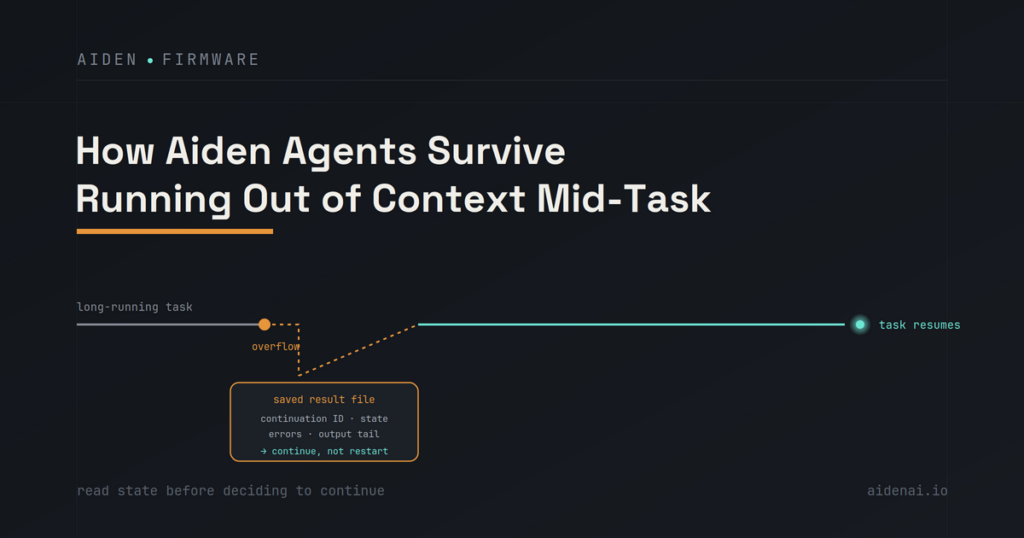
Aiden agents can survive running out of context mid-task by compressing context or switching sessions, then inspecting saved recovery information before deciding whether to continue. This shipped firmware work helps preserve task continuity when a provider context limit or oversized tool result interrupts an active task. It does not create unlimited context, and it does not guarantee that every interrupted task can safely finish.
For long-running agent tasks, the problem is not simply that a prompt becomes too large. The agent can lose the practical record of what it already observed, processed, attempted, or completed. A blind restart may repeat research, reprocess files, or attempt a device action without knowing whether the earlier action succeeded.
That is especially important for a physical AI agent such as Aiden, which is designed for user-directed interaction with real smartphone and computer interfaces. A context error does not prove that the external device state stayed unchanged. The next step needs evidence.
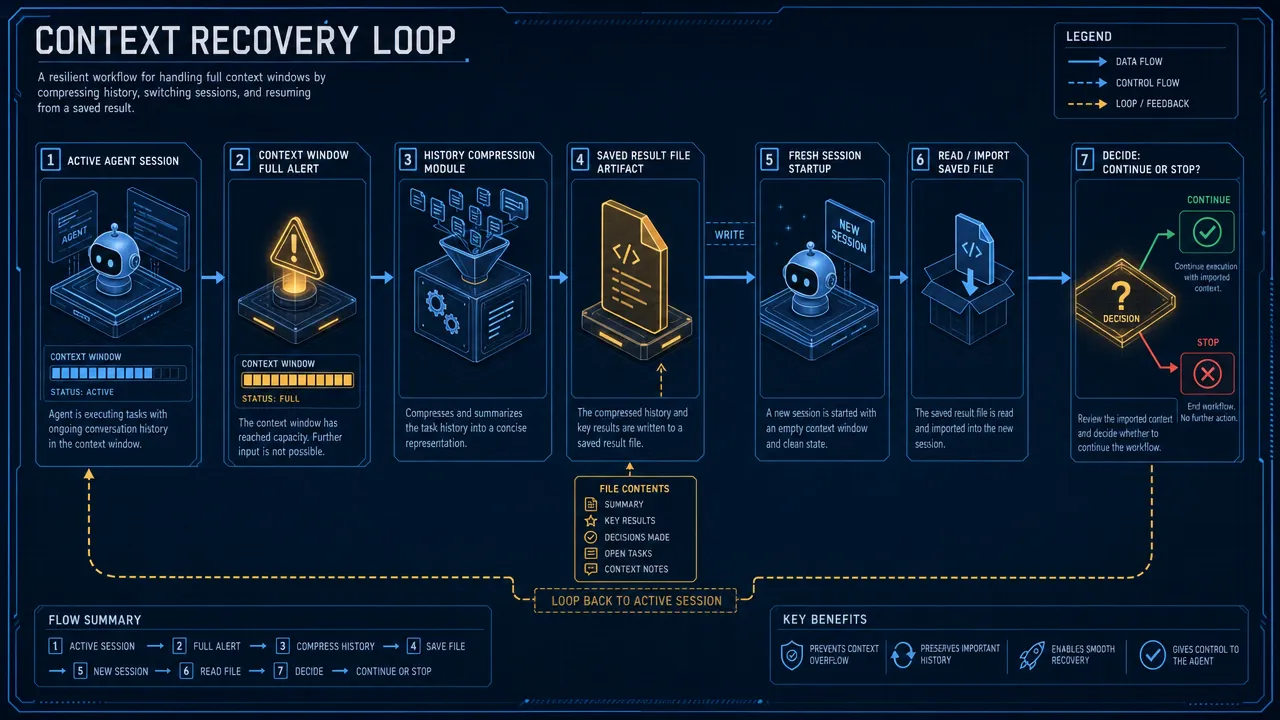
Why Aiden agents context management protects task continuity after an overflow
AI agent context window limits are a normal constraint of provider-based model requests. A context window has to hold relevant instructions, recent messages, tool outputs, observations, and room for the next response. Long tasks can exceed that bounded capacity even when the original user request was short.
An oversized tool result creates the same operational issue. A research tool may return lengthy source material. A file-processing tool may return a large extraction, directory listing, or log. Desktop automation can accumulate detailed interface observations across many screens. Once that material no longer fits in the active request, the agent needs a controlled context overflow solution.
Without one, two poor outcomes are common:
- The task stops with no practical path to resume.
- The agent starts over with incomplete history and silently repeats work.
The second outcome is often more concerning. Consider a few realistic cases:
| Workflow | What may be lost after an overflow | Risk of a blind restart |
|---|---|---|
| Long-running research | Reviewed sources, notes, open questions, draft progress | Duplicate collection work or missing prior conclusions |
| File processing | Completed items, failed items, batch position, output locations | Reprocessing files or creating duplicate outputs |
| Desktop automation | Last observed screen, dialog state, completed milestones | Acting on a stale assumption about the interface |
| Customer-service workflow | Case history, recorded actions, pending questions | Repeating a note, request, or follow-up |
| Device operation task | Navigation progress, last known screen state, verification status | Reattempting an action that may already have occurred |
This is where agent memory management needs a precise definition. Active context management keeps the current model request within a finite budget. Broader memory management can also include persisted state, files, retrieval systems, and structured records. Context compression is not the same as a complete, permanent memory of every task detail.
Aiden’s approach focuses on a bounded failure mode: running out of context mid-task because of a provider limit or oversized tool result. Rather than treating the interruption as proof that nothing happened, it creates a recovery path based on saved evidence.
Aiden agents context management ships compression, session switching, and saved recovery
Aiden shipped context-management infrastructure during the week of August 10-16, 2026. The work includes context compression, session switching, and recovery from saved result files when a task reaches a provider limit or receives an oversized tool result.
The relevant shipped firmware changes are documented in Aiden firmware PR #497, Aiden firmware PR #498, and Aiden firmware PR #530.
| Shipped behavior | What it does | Why it matters | Boundary |
|---|---|---|---|
| Context compression | Reduces active material when the context cannot continue as-is | Retains a smaller, decision-relevant representation of the task | Compression can omit detail |
| Session switching | Moves the task to a refreshed interaction or session | Gives the task a path forward when the previous session is no longer viable | A new session still needs preserved task information |
| Saved result-file recovery | Reads a persisted recovery artifact after a context event | Provides continuity outside the active provider request | Saved state may be incomplete or stale |
| Conditional continuation | Uses recovered information before choosing a next step | Reduces blind repetition of potentially completed work | It cannot prove every external action succeeded |
The implementation context is practical infrastructure work: Go, HTTP and LLM provider APIs, message serialization, file persistence, and a Python evaluation framework. Those layers matter because a reliable recovery path must do more than shorten a prompt. It must handle provider-facing limits, preserve task artifacts, and test whether resumed behavior is justified.
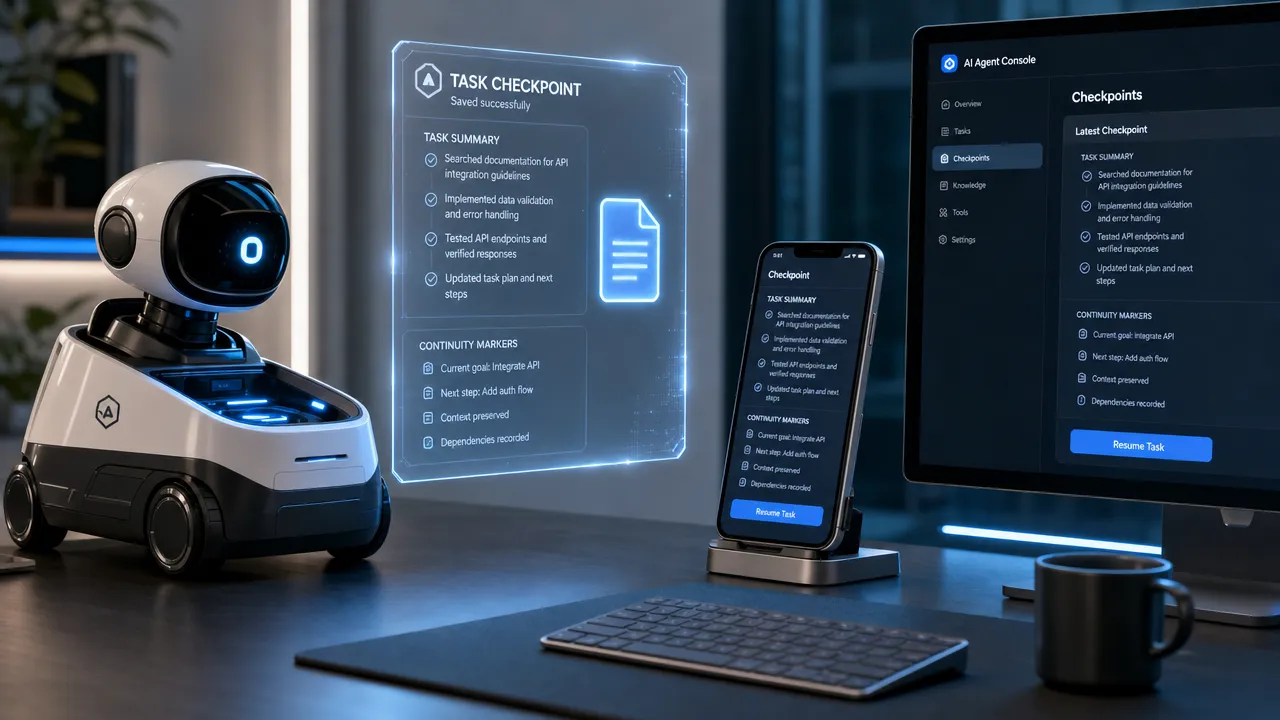
How Aiden agents context management reads state before a continuation decision
The important design choice is recovery-first. When a context event occurs, Aiden does not simply assume that the right response is to repeat the previous action.
Instead, its saved-result-file recovery path reads four pieces of evidence before deciding whether to continue:
- Continuation ID: Connects the recovery attempt to the relevant prior execution or continuation chain.
- Saved state: Provides recorded information about progress, completed work, pending work, or the current task phase.
- Saved errors: Helps distinguish a context-limit event from another issue that could make continuation questionable.
- Previous output tail: Offers recent clues about what the agent was doing immediately before the interruption.
The output tail is useful but limited. It can show the most recent attempted step, a partial completion signal, or an error message. It is not a complete execution history. Likewise, saved state supports a better decision, but it is not proof that every change in an external system or device interface was completed.
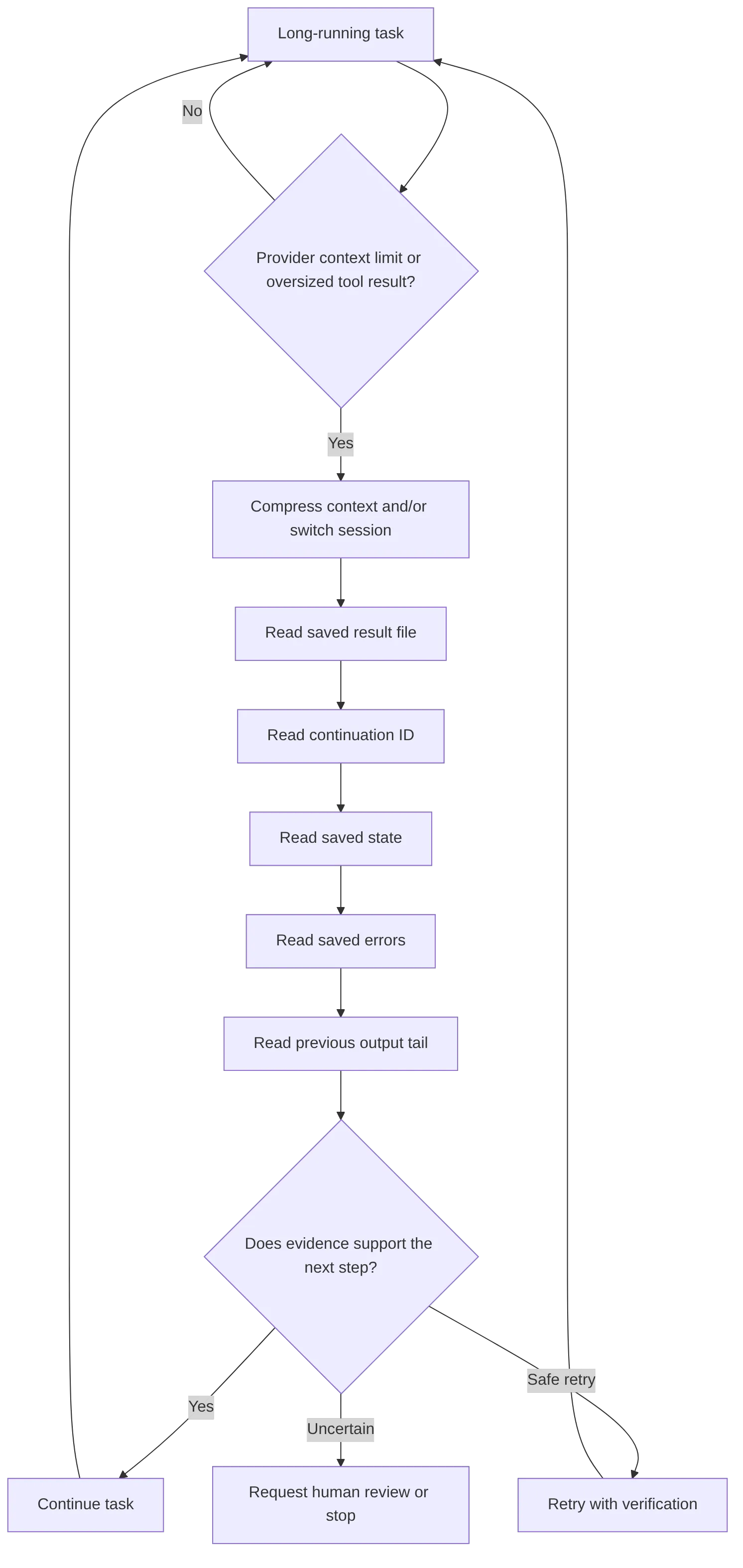
This mid-task context recovery pattern makes "continue" a decision rather than a default. For example, a research workflow can use saved progress to avoid collecting the same sources again. A batch file task can distinguish completed items from work that remains. A desktop task can preserve its plan while still checking whether the visible application state matches the recorded checkpoint.
That distinction matters for AI agent task continuity. A saved record can say what the agent believed happened. A fresh observation can show what the device or interface currently displays. For real-device work, both forms of evidence may be necessary.
Aiden agents context management extends reliability for real-device tasks
A useful reliability framework for real-device AI agents is observe, interpret, act, and verify. This is a conceptual framework, not a claim about a specific named Aiden architecture.
- Observe: Read the current screen, task artifact, or tool result.
- Interpret: Determine the goal, current state, and uncertainty.
- Act: Take an action within the user’s directed scope.
- Verify: Check the visible or recorded result before progressing.
Context recovery adds a continuity check to that loop. When the active session cannot continue, the agent should inspect its persisted execution evidence before choosing the next action. For smartphone and computer interface tasks, it should also re-observe the current interface where relevant.
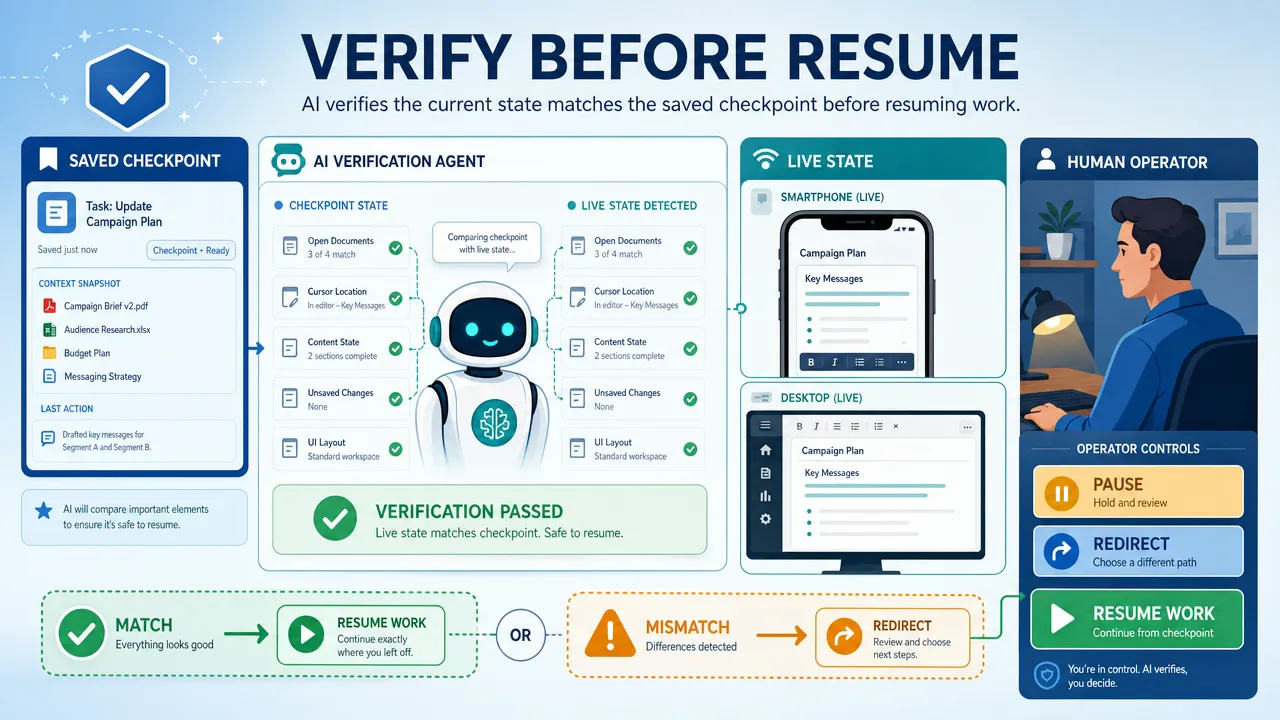
This is relevant across several classes of long-running agent tasks:
- Research: Preserve source lists, reviewed material, open questions, and drafting progress so an overflow does not force a redundant restart.
- File processing: Record completed and failed items, positions, errors, and output artifacts before processing the next batch.
- Desktop automation: Retain milestones and expected application state, then verify the actual screen after a session handoff.
- Customer-service workflows: Preserve case context and recorded work while keeping human review available for unclear or consequential decisions.
- Device-operation tasks: Keep track of navigation and last known screen conditions, but do not substitute saved state for a current screen observation.
This approach supports autonomous agent reliability in a measured sense: it can reduce avoidable duplicate work and make uncertainty more visible. It does not remove the need for testing, verification, interruption, redirection, or confirmation.
For actions with meaningful consequences, human-in-the-loop AI remains important. Users should be able to stop a task, redirect it, inspect what happened, and confirm an uncertain next step.
Aiden agents context management has clear limits and testing requirements
Aiden’s shipped context-management work addresses specific context-overflow conditions. It is not a universal recovery layer for every kind of failure.
Compression can lose nuance or source detail. A saved result file can be missing, stale, partial, corrupted, or unable to capture an external side effect. Provider outages, network issues, tool failures, changed data, authentication problems, and unexpected device screens can still interrupt a task.
Developers evaluating a context overflow solution should test recovery behavior deliberately:
| Test area | What to validate |
|---|---|
| Provider-limit recovery | Confirm that continuation ID, state, errors, and output tail are read before continuation |
| Oversized tool outputs | Confirm that recovery does not blindly discard critical task information |
| Malformed saved files | Confirm safe stop, reporting, or review behavior when persisted data cannot be trusted |
| Partial completion | Test tasks where one step completed before the next step triggered an interruption |
| Duplicate-action risk | Distinguish completed, partially completed, and unstarted work where possible |
| Session handoff | Confirm that a fresh session receives bounded, relevant continuation information |
| Changed device state | Change the visible interface between checkpoint and resume, then require fresh observation |
| Human controls | Test pause, interruption, redirection, review, and confirmation paths |
Checkpoint-and-resume behavior should be understood as controlled recovery, not as literal continuation of untouched process memory. General durable-execution guidance from LangGraph similarly emphasizes persisted workflow progress and replay-aware resumption. Provider context windows also remain finite, as explained in OpenAI’s conversation-state documentation.
The practical outcome is disciplined: Aiden agents context management can preserve useful task evidence and reduce blind restarts after a known overflow condition. It cannot establish exactly-once execution, unlimited context, or error-free completion.
FAQ: Aiden agents context management
What happens when an AI agent runs out of context mid-task?
The active model request can no longer fit the history, observations, tool outputs, and expected response needed to proceed. The task may stop unless the runtime can compress context, switch sessions, and recover relevant saved state.
Is context compression the same as agent memory management?
No. Context compression reduces active working material so it can fit in a bounded request. Agent memory management is broader and may include saved files, structured workflow state, retrieval systems, and longer-lived task records.
How does session switching help long-running agent tasks?
Session switching can provide a fresh interaction when the previous one has reached its usable limit. It only preserves continuity when the new session receives relevant, bounded task information rather than starting without state.
What does Aiden inspect before continuing after a context event?
Aiden’s verified recovery path reads the continuation ID, saved state, any errors, and the tail of the previous output from a saved result file before deciding whether to continue.
Does Aiden agents context management provide unlimited context?
No. Provider limits still exist. This is a graceful recovery mechanism for provider context limits and oversized tool results, not a way to eliminate finite context windows.
Why does this matter for a real-device AI agent?
A device task has state outside the model, including the current smartphone or computer interface. Saved task evidence helps preserve continuity, but the agent may still need to observe the current screen and seek human confirmation when the next action is uncertain.
Aiden’s firmware work turns a common failure mode from "start over without knowing what happened" into a more careful recovery decision based on persisted evidence. That is meaningful infrastructure for AI agent task continuity, especially when a task spans research, files, desktop workflows, or real device interfaces.
Join the Aiden Discord community to discuss physical AI agents, real-device automation, and the engineering behind Aiden. Aiden engineers are active in the community and ready to answer technical questions.
Explore, follow, and star the Aiden firmware repository on GitHub. For reproducible bugs, compatibility findings, documentation gaps, feature requests, or technical proposals, open a meaningful Issue and help build a better physical AI agent.
Related posts
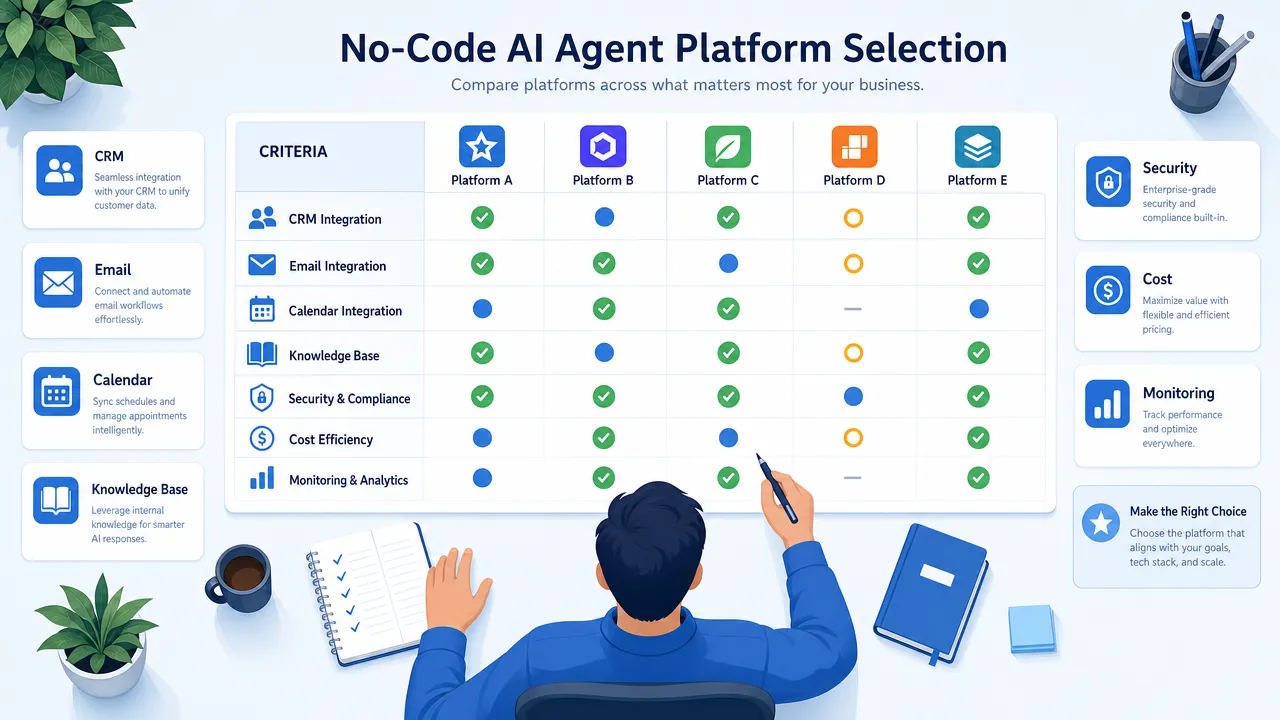
How to Build an AI Agent for Your Business Without Writing Code in 2026
Build AI agent business no code 2026 with a workflow-first framework for data access, approvals, risk controls, and ROI tracking.
What Can an AI Agent Actually Do on Your Phone? 12 Real Tasks
Explore 12 AI agent on your phone tasks for 2026, from scheduling to safe automation—learn what works and try smarter workflows.
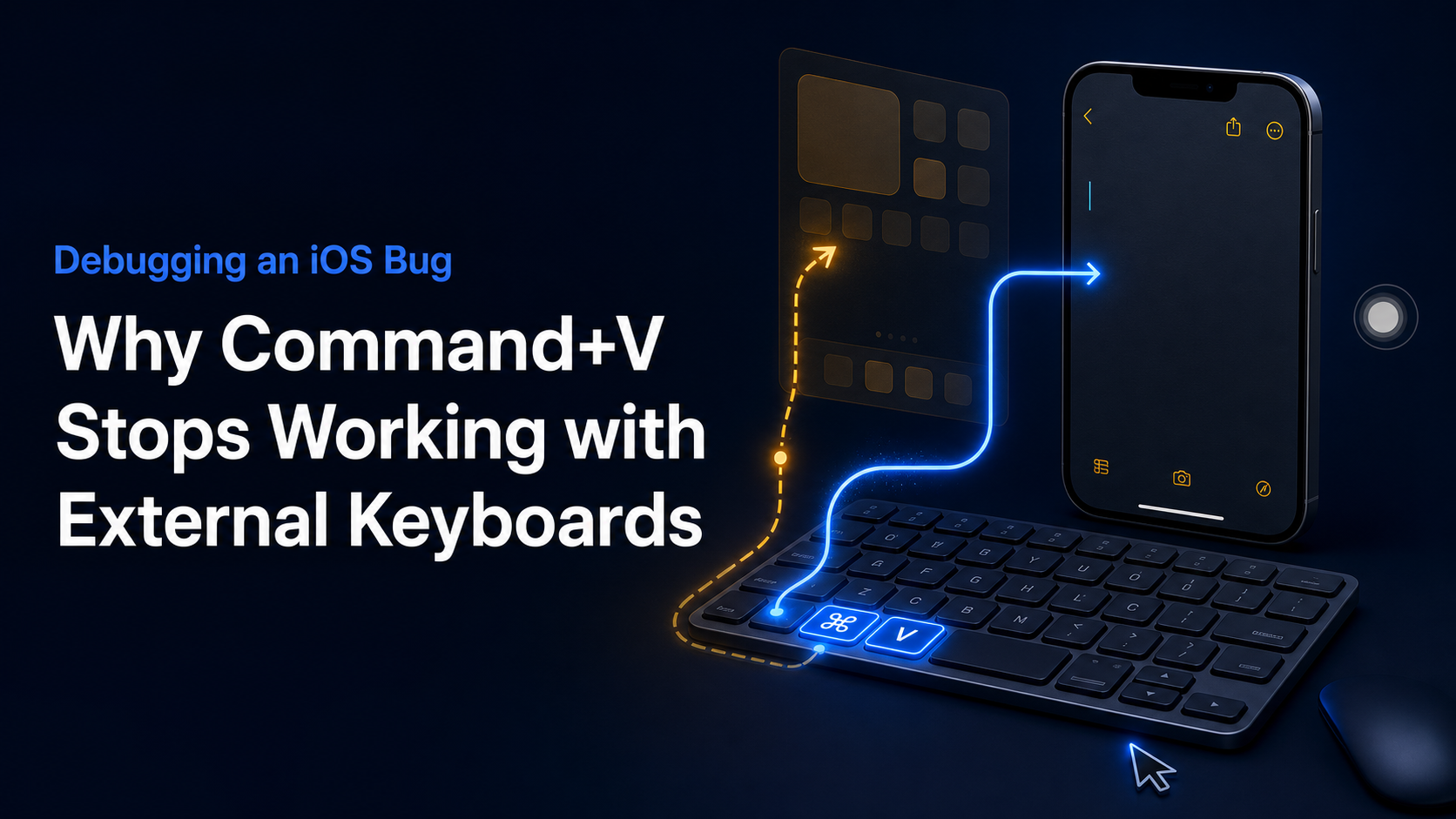
Debugging an iOS Bug: Why Command+V Stops Working with External Keyboards
Fix iOS external keyboard modifier keys that fail with AssistiveTouch pointer input. Explore Aiden’s HID workaround—read the case study.