Aiden vs. Plaud Note: Two Different Bets on Small AI Hardware
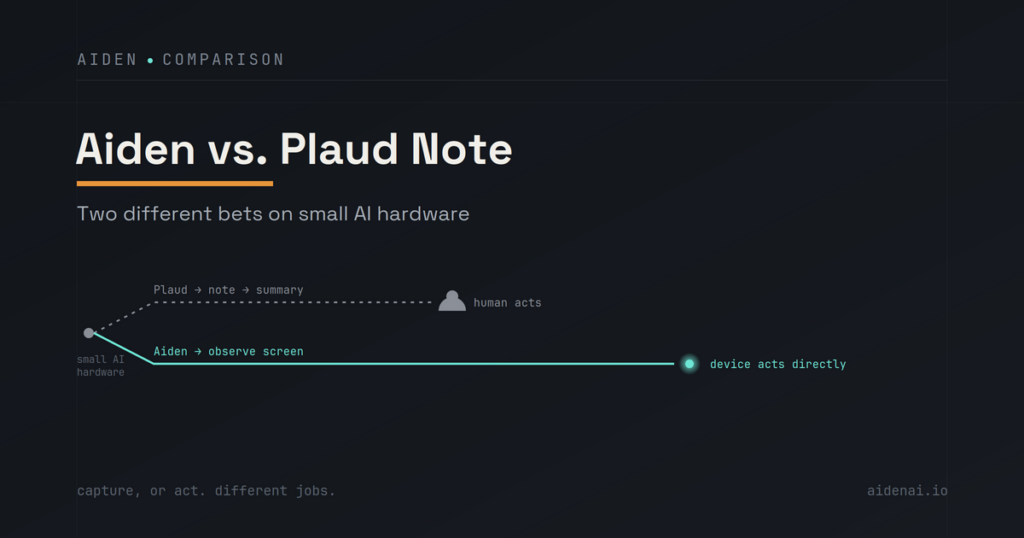
Plaud and Aiden represent adjacent bets on small AI hardware: Plaud turns conversations into structured material for people to review, while Aiden is being developed to support user-directed interaction with real phone and computer interfaces.
Plaud deserves genuine credit as a commercial proof point for focused AI productivity hardware. Its Note family shows that a compact device with a clear job can reduce everyday busywork: record a meeting or call, create a transcript, generate a summary, and give the user a useful record.
The Aiden vs Plaud Note comparison is therefore not a contest between better and worse devices. It is a comparison of workflow endpoints. Plaud ends at, "Here is what happened." Aiden’s development direction concerns, "Help me take the next user-directed step in the interface where the work happens."
Why small AI hardware can solve adjacent productivity problems
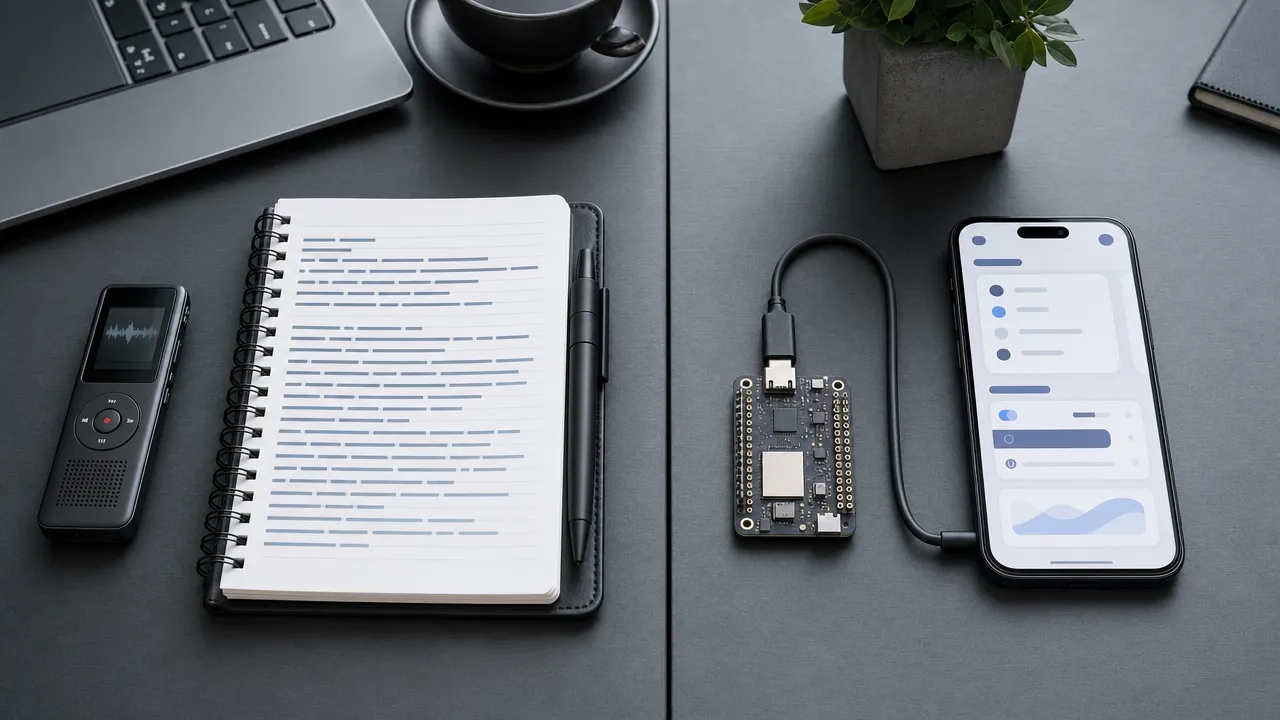
Small AI hardware is a broad category, not a single product type. A compact AI note device, an AI voice recorder, and a physical mobile AI agent can all reduce manual work, even when they tackle different parts of the same workflow.
Plaud’s purpose is focused and clear. Its devices record meetings and calls, then use cloud AI to produce transcripts, summaries, and structured outputs. The Plaud Note family includes the Note, Note Pro, NotePin, and NotePin S. Client-provided verified grounding describes card-sized Note models that magnetically attach to a phone and wearable, pin-shaped NotePin models.
The same grounding lists Plaud Note at approximately $159, Note Pro at approximately $179 to $189, NotePin at approximately $159 to $179, and NotePin S at approximately $179. It also identifies up to 30 hours of continuous recording, 64GB of local storage, cloud transcription in 112 languages, and summaries built from more than 10,000 templates. The Starter plan includes 300 minutes per month, while paid tiers provide additional capacity.
Those details matter because they show Plaud’s strength: it addresses the information-capture problem with a mature, purpose-built workflow. A professional can preserve a conversation, recover important details, and start from a structured summary instead of reconstructing a meeting from memory.
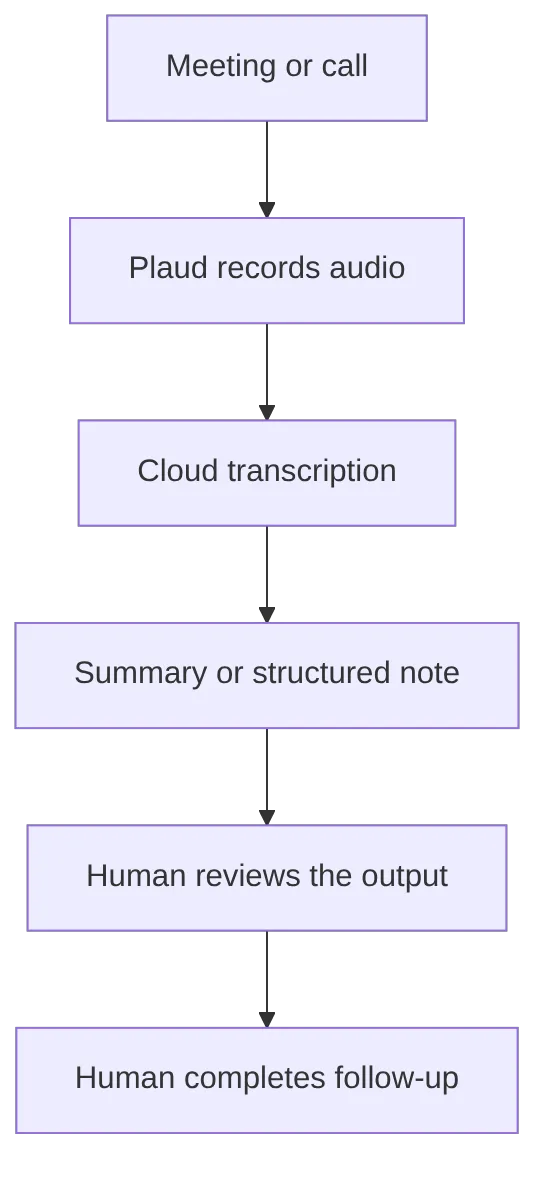
Plaud does not operate apps or independently take downstream actions. That is not a limitation disguised as a flaw. It is the product boundary. The device creates an artifact that a person can evaluate, correct, and use.
Aiden addresses a later point in the workflow. Aiden is a physical mobile AI agent device being developed to help users direct work through the interfaces they already use. Its aim is not to replace recording, transcription, or note-taking. It is to explore the operational gap between deciding what should happen next and interacting with the relevant phone or computer interface.
Small AI hardware comparison: Capture information versus act in an interface
The most useful AI hardware comparison starts with a simple question: where does the workflow end?
Plaud ends with a transcript, summary, or structured note. The human still reads it, determines what matters, and performs the next step. Aiden’s intended direction is different: after the user gives direction, the agent can interpret relevant visible interface context and support an interaction on a connected device, while keeping the person involved.
| Comparison point | Plaud Note ecosystem | Aiden development direction |
|---|---|---|
| Primary job | Capture spoken information and turn it into usable notes | Support user-directed interaction with visible phone and computer interfaces |
| Typical starting point | A meeting, interview, conversation, or call | A user-approved task that needs interface interaction |
| Main output | Transcript, summary, task list, or template-based note | A proposed or directed interface step |
| Human role | Review the output and complete follow-up manually | Direct, observe, interrupt, redirect, or confirm as appropriate |
| Processing model | Cloud-based transcription and summarization | Current firmware uses a user-configured multimodal model in a dev-board context |
| App operation | Does not operate apps or take actions | Real-device interaction is the development direction, not a verified broad consumer capability |
| Maturity described in available materials | Established capture-to-summary workflow | Active development-board and open-source firmware work |
This difference is why "Aiden vs Plaud Note" should not be treated as a replacement decision. A portable AI device for voice capture and a physical mobile AI agent can be relevant in the same professional routine without doing the same job.
For example, someone may record a meeting with an AI voice recorder, review a summary, decide on a follow-up, and then carry out that follow-up in a work application. Plaud is designed for the first part. Aiden is being developed around the second part. No integration or compatibility between the two is publicly verified, so it would be inaccurate to imply that they exchange data or work together directly.
How small AI hardware creates different engineering tradeoffs
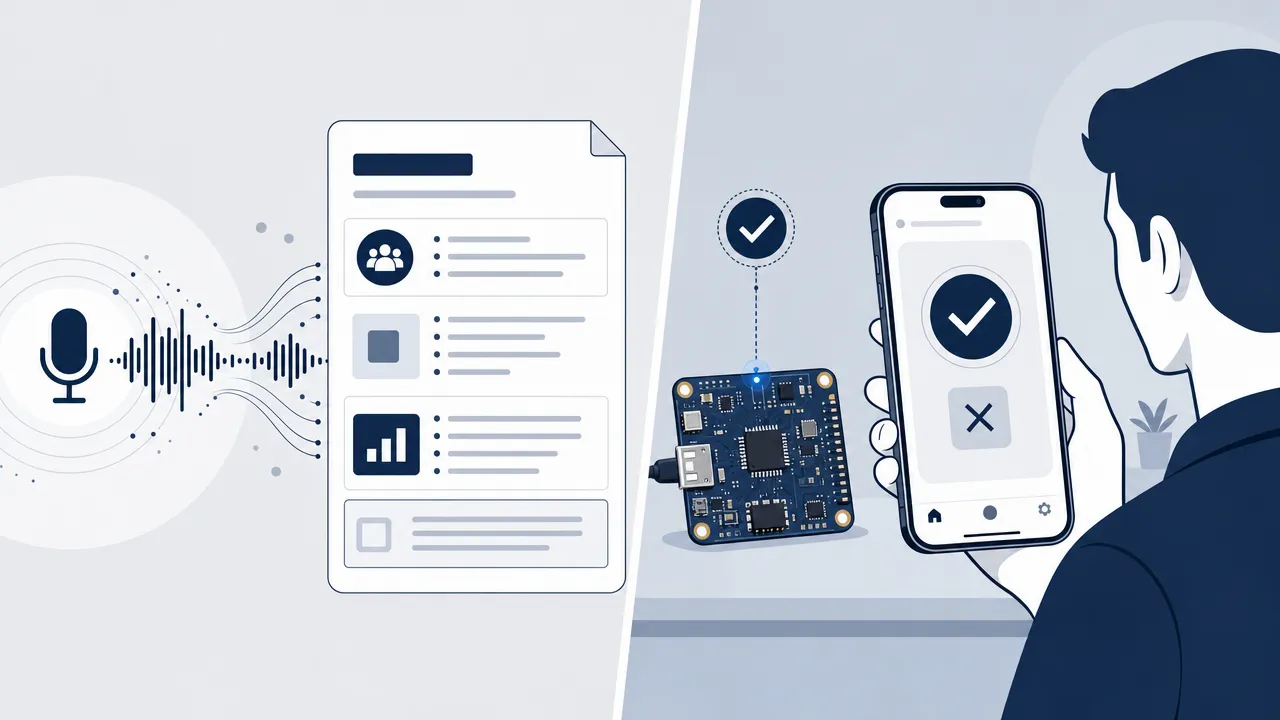
Plaud’s cloud workflow solves a bounded problem: capture audio, transcribe it, summarize it, and organize the result into a useful format. Accuracy and summary quality still matter, but the final operational decision remains with the person reading the note.
Aiden’s real-device interaction direction introduces a different technical challenge. Interfaces change. Buttons move. Screens may be incomplete or ambiguous. A user’s instruction may need clarification. A system that interacts with a real interface also needs meaningful ways for users to observe what is happening, stop it, change direction, and confirm consequential steps.
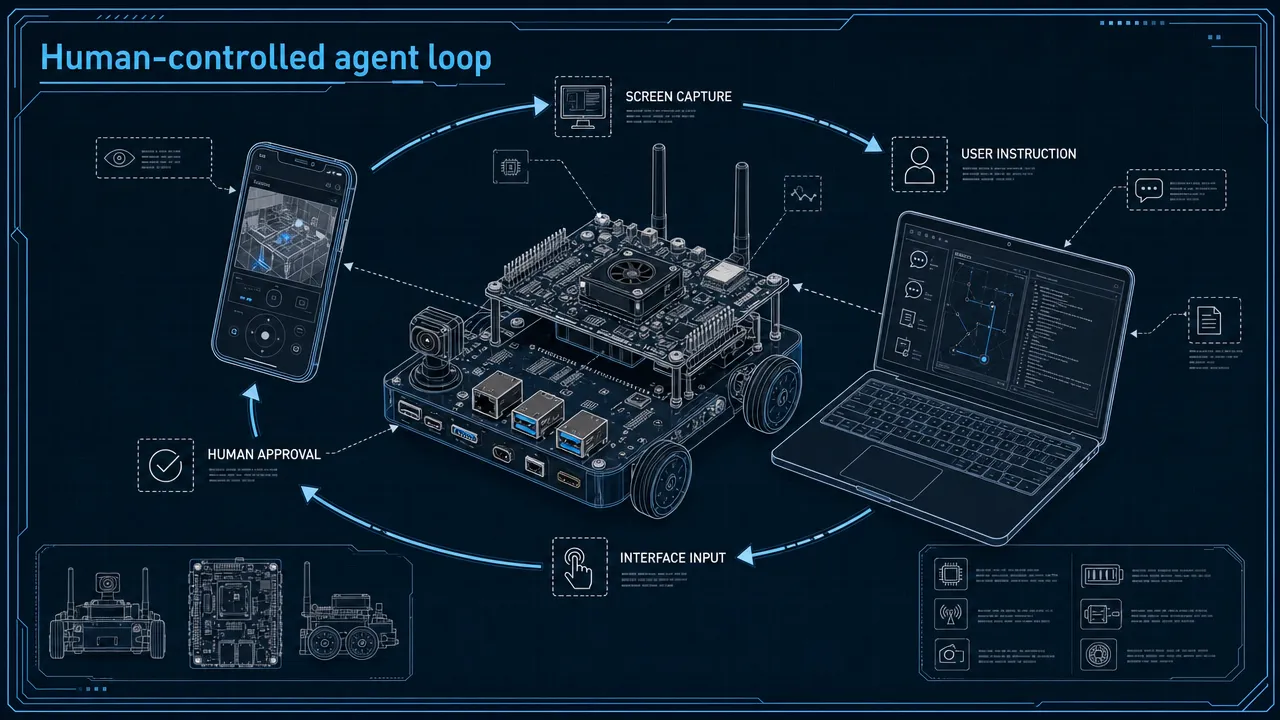
The current Aiden firmware documents a development-board approach that captures a target display through HDMI and sends input through USB HID. In practical terms, the board can use screen context as part of the interaction loop and send keyboard, pointer, or touch-style input through the connected device path.
That mechanism is useful for developers because it avoids framing the agent as a chat-only tool or a single-app automation layer. It also does not establish broad task coverage, production reliability, named app support, consumer availability, or a general ability to complete every workflow. Those claims are not publicly verified in the reviewed sources.

This is where human-in-the-loop AI becomes more than a slogan. When an agent interacts with an interface, human control should remain visible. The user needs a practical path to correct misunderstandings and retain responsibility for decisions that matter.
Plaud and Aiden therefore carry different tradeoffs:
- Plaud offers a focused and mature cloud transcription and summarization workflow.
- Aiden explores a technically harder problem: reliable, user-directed interaction with changing real-device interfaces.
- Plaud’s output is designed for human review and action.
- Aiden’s development direction places user visibility, interruption, redirection, and confirmation at the center of the interaction loop.
Aiden remains in a development-board-stage context. It should be understood as an active technical direction, not as a confirmed mass-market consumer product.
Choosing small AI hardware for the bottleneck you have
The right choice depends less on the label "AI device" and more on the manual step that consumes time.
Choose an AI note device workflow when spoken information is the bottleneck. This is the appropriate category when you need to preserve meeting details, search a conversation later, produce a structured recap, or turn a call into a record that someone can review.
Choose a real-device AI agent direction when the bottleneck comes after a decision has already been made. Developers and technically literate early adopters may be interested in how a physical AI agent handles screen context, changing interfaces, user correction, input boundaries, and evaluation on connected devices.
| Your main bottleneck | Relevant workflow | Important caveat |
|---|---|---|
| Remembering what was said | AI note device or AI voice recorder | The user still reviews the result and decides what to do |
| Structuring a meeting into follow-ups | Cloud transcription and templates | A note is not the same as completing the follow-up |
| Exploring interface-level agent behavior | Physical mobile AI agent development direction | Broad production readiness is not publicly verified |
| Evaluating agent control and recovery | Human-in-the-loop AI workflow | Testing, interruption, and confirmation design remain essential |
The distinction also clarifies why Plaud and Aiden are not direct competitors. Plaud offers a clear answer to the capture problem. Aiden is investigating an operational interaction layer after the user has identified the next step.
For builders, Aiden’s open-source firmware provides a concrete technical artifact to examine. It is especially relevant for work on interface observability, USB HID control, configurable models, repeatable testing, and failure recovery. Developers should treat reproducible tests and transparent limits as seriously as impressive demos.
Why small AI hardware matters beyond the device itself
Small AI hardware matters because it can make a specific workflow easier without asking users to abandon the devices and applications they already depend on.
Plaud demonstrates the value of a focused capture device. Its commercial success is evidence that people will use compact AI productivity hardware when the purpose is obvious and the output is useful. The device is not trying to become every productivity tool. It captures what happened and gives the user material to act on.
Aiden takes a different bet. Its value proposition is not that transcription is unimportant or that a summary should automatically become a decision. Instead, it focuses on the next friction point: how a user can direct an agent to help interact with existing interfaces while remaining able to supervise the process.
That distinction is important for the emerging small AI device category. The most credible products may not be the ones that claim to do everything. They may be the ones that identify exactly where human effort is still required, define a narrow role, and remain honest about their boundaries.
Plaud’s cloud transcription is mature. Aiden’s screen-interaction approach is harder and still in a dev-board stage. Both perspectives can coexist: one reduces the work of capturing and organizing information, while the other explores how a user can direct the next step across real interfaces.
FAQ: Small AI hardware and Aiden vs Plaud Note
What is the difference between Aiden and Plaud Note?
Plaud is an AI note device ecosystem that records conversations and creates cloud transcripts, summaries, and structured outputs. Aiden is a physical mobile AI agent device being developed for user-directed interaction with connected phone and computer interfaces. Plaud ends with information for a person to review. Aiden’s direction concerns the next operational interface step.
Is Plaud Note an AI agent?
Plaud Note is more accurately described as an AI note device or AI voice recorder. Its role is to record, transcribe, summarize, and structure spoken information for human review. It does not operate apps or independently take actions.
Does Plaud Note take actions in apps?
No. Based on the client-provided verified grounding, Plaud produces notes, transcripts, and summaries that a person reads and acts on. It does not operate apps or complete downstream actions.
What does a physical AI agent mean in practice?
A physical AI agent combines a physical device with agent software intended to perceive relevant device context and support user-directed interaction. The current Aiden development board uses HDMI capture for screen context and USB HID for keyboard, pointer, and touch-style input. This is a development direction, not proof of broad consumer-ready capability.
Is Aiden available as a consumer product today?
Aiden remains in a development-board-stage context. Consumer availability, shipping details, pricing, purchase options, broad app compatibility, and reliability metrics are not publicly verified in the reviewed sources.
Can an AI note device replace a physical AI agent?
They address different stages of work. An AI note device helps capture and organize what was said. A physical AI agent direction concerns user-directed interaction with an interface after a person has decided what to do. Neither role makes the other unnecessary.
Why does human control matter for AI productivity hardware?
Real interfaces can change, context can be incomplete, and instructions can be ambiguous. Human control gives users the ability to observe progress, interrupt an interaction, redirect the agent, and confirm steps when appropriate.
Plaud has shown the practical value of a focused AI note device. Aiden is exploring a harder, different question: how can a person direct work through the interfaces they already use without losing visibility and control?
Related posts
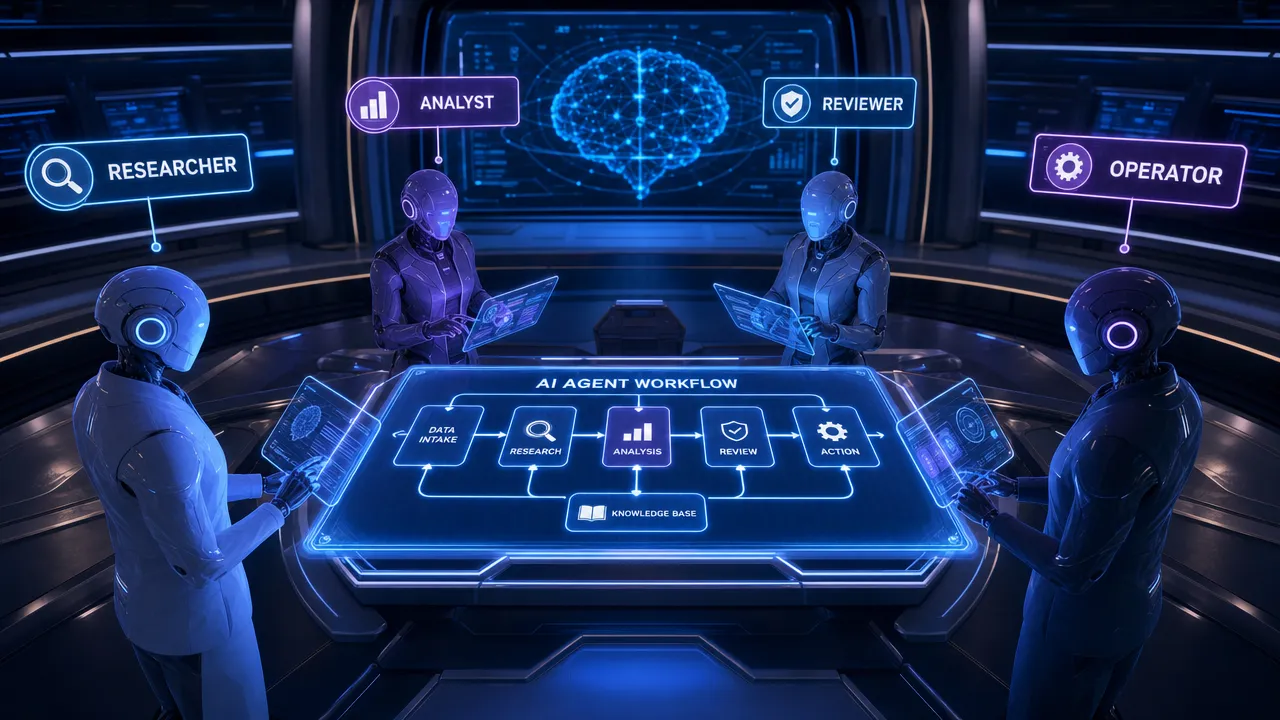
Why CrewAI beats LangChain for multi-agent work
CrewAI vs LangChain compared by workflow shape, showing when role-based agents beat graph orchestration for multi-agent systems.
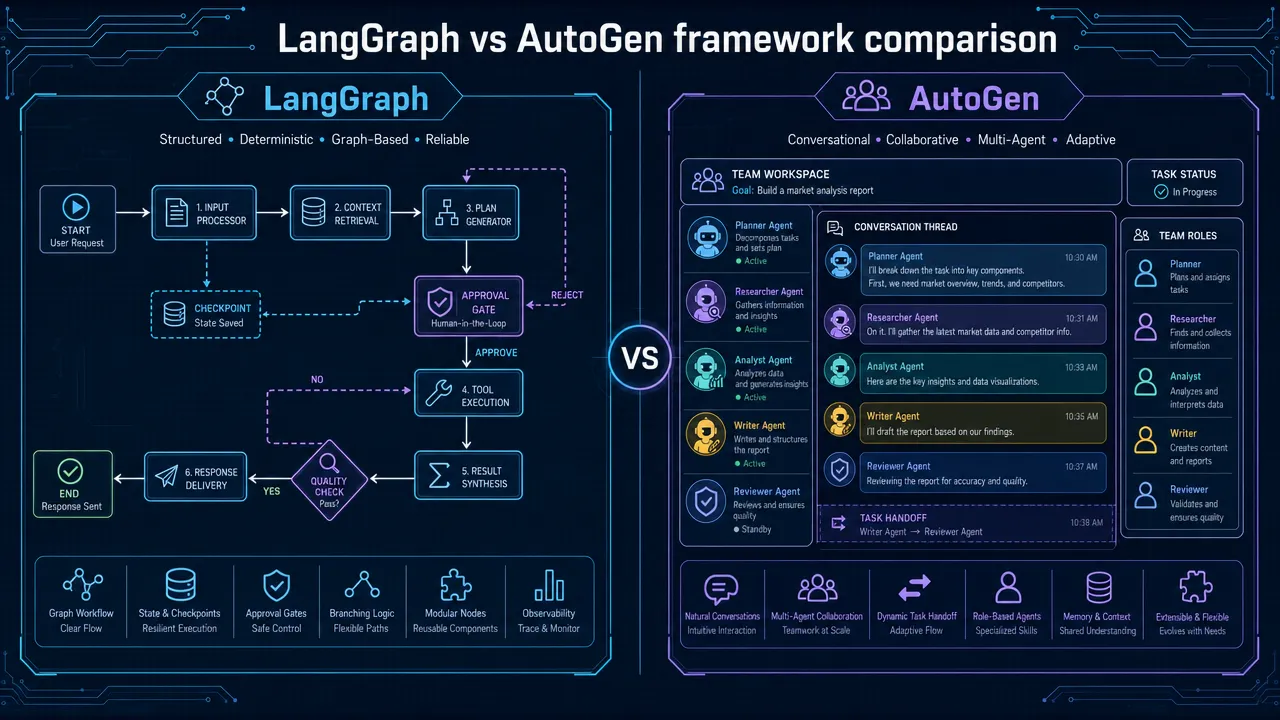
LangGraph vs AutoGen: Which AI Agent Framework Handles Complex Workflows in 2026?
LangGraph vs AutoGen comparison: assess state, checkpoints, human review, and collaboration to choose the right AI agent framework
Claude vs GPT-5 for Business Automation
Business automation AI comparison of Claude vs GPT-5 using workflow fit, governance, tools, and agent evaluation criteria for ROI.