LangGraph vs AutoGen: Which AI Agent Framework Handles Complex Workflows in 2026?
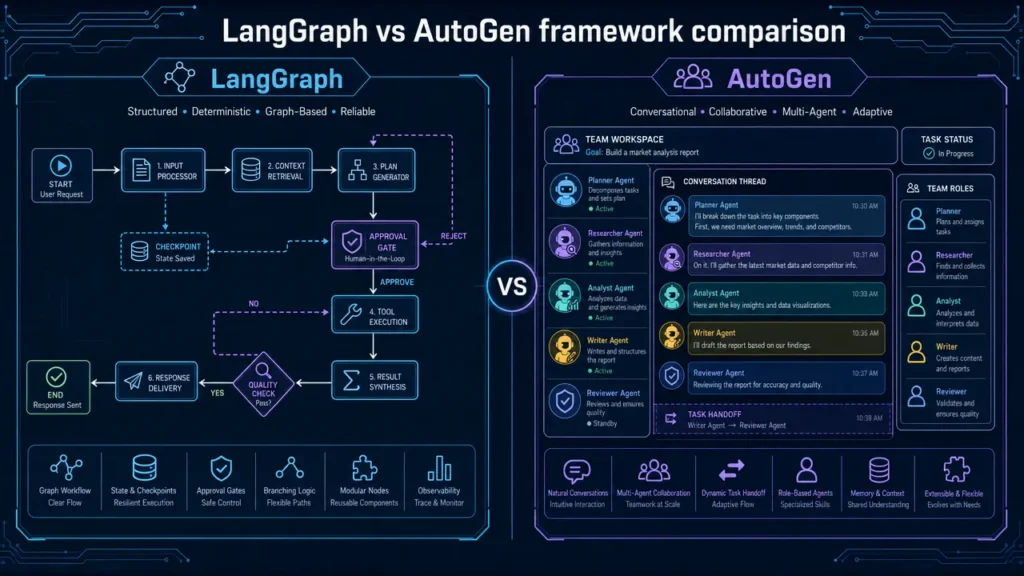
Most teams comparing LangGraph vs AutoGen in 2026 are asking the wrong question. They want to know which framework is better. The more useful question is which one matches how their system actually fails.
LangGraph vs AutoGen in 2026: LangGraph is the stronger default for complex, stateful, production-oriented workflows that need checkpoints, deterministic routing, and human approval gates. AutoGen is the better fit for conversational multi-agent collaboration, research prototypes, and agent teams that debate, delegate, and revise through messages.
For teams comparing LangGraph vs AutoGen, the real decision is not which framework is more popular. It is whether the system needs graph-based control, durable state, checkpoints, and human approval gates, or whether it needs flexible agents that talk, delegate, revise, and collaborate through messages. That distinction matters for AI agent framework comparison work, especially when the goal is reliable LLM workflow automation rather than a demo.
Why LangGraph vs AutoGen usually comes down to control, state, and collaboration
The simplest answer is this: choose LangGraph when complex workflows need deterministic agent orchestration, persistent state, resumability, and human review; choose AutoGen when multi-agent workflows depend on dynamic conversation, critique, delegation, and collaboration.
LangGraph is built around graphs. Developers define nodes, edges, conditional routes, and shared state. That structure makes it easier to reason about what happens next, why it happens, and how the workflow can recover after interruption. For a stateful agent framework, those qualities are central.
AutoGen is built around agents, messages, teams, and event-driven interaction. Microsoft describes AutoGen as a framework for creating multi-agent AI applications that can act autonomously or work with humans. Its current architecture includes AutoGen Core, AgentChat, Extensions, and Studio, as described in the official AutoGen documentation.
Here is the practical distinction:
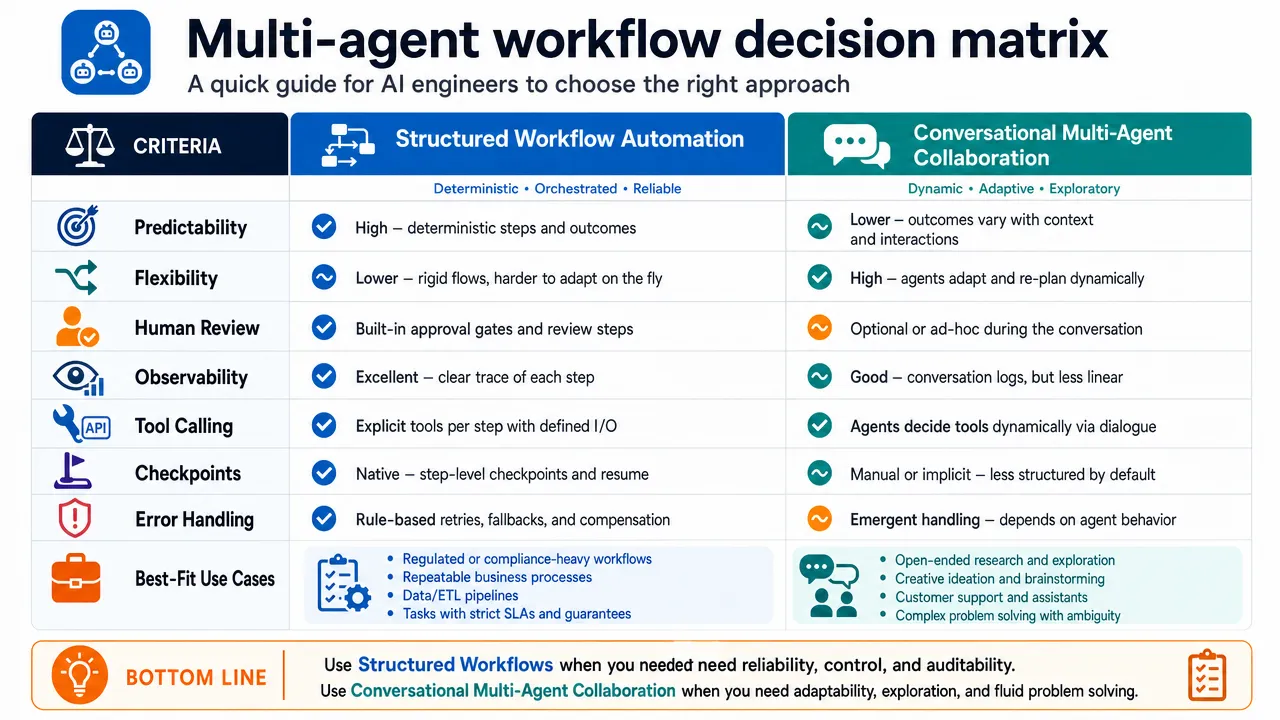
| Decision factor | LangGraph is usually stronger when… | AutoGen is usually stronger when… |
|---|---|---|
| Workflow shape | The process has defined steps, branches, loops, and checkpoints | The process depends on agents discussing, reviewing, and adapting |
| State | State must be explicit, inspectable, and resumable | Conversation history and team state are enough for the use case |
| Human review | The system needs approval gates or state edits before continuing | A human participates naturally in the conversation |
| Multi-agent workflows | Agents need controlled routing and auditability | Agents need flexible collaboration |
| Production fit | Reliability, recovery, and orchestration control are primary | Prototyping, research, and collaborative agent behavior are primary |
| Learning curve | The team can invest in graph and state modeling | The team wants to start quickly with conversational agents |
For 2026 planning, that makes LangGraph the more conservative choice for complex workflows where failures, approvals, and auditability are serious engineering concerns. AutoGen remains compelling when the complexity comes less from workflow control and more from agent-to-agent reasoning.
LangGraph vs AutoGen architecture: Graph orchestration compared with agent conversation
LangGraph and AutoGen solve overlapping problems, but they encourage different mental models.
LangGraph treats an agentic application like a graph. A node can be a model call, a tool call, a retrieval step, a validation step, a human review point, or another agent. Edges define where execution goes next. Conditional routing decides what happens based on the current state.
That model is powerful for agent orchestration because it makes the workflow visible. Engineers can define where memory is updated, where tools are called, where a human must approve output, and where execution should resume after failure.
AutoGen treats an agentic application like a team. In AgentChat, multiple agents can work together toward a goal. The AutoGen Teams tutorial describes teams as groups of agents that collaborate and maintain state during a task. Common patterns include round-robin discussion, selector-based routing, swarm-like behavior, and more specialized multi-agent coordination.
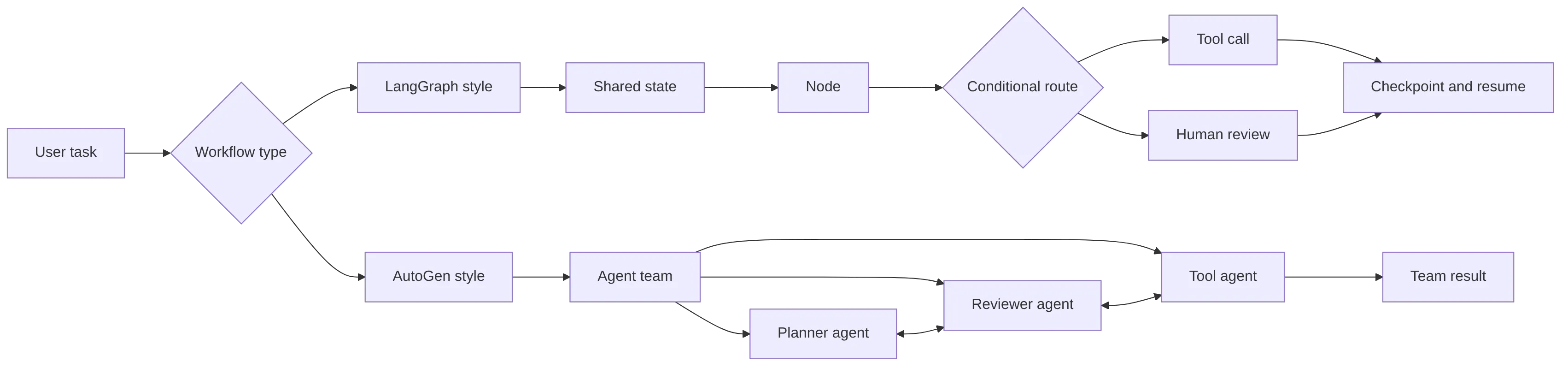
This architectural difference affects nearly every other part of the AI agent framework comparison.
LangGraph is better when you want workflow topology to be explicit. That includes tasks such as support escalation, document review, compliance approval, controlled data processing, hardware/software coordination, and long-running LLM workflow automation.
AutoGen is better when you want agents to collaborate naturally. That includes research assistants, coding agents, brainstorming agents, reviewer agents, and exploratory analysis systems where the next step may emerge from conversation.
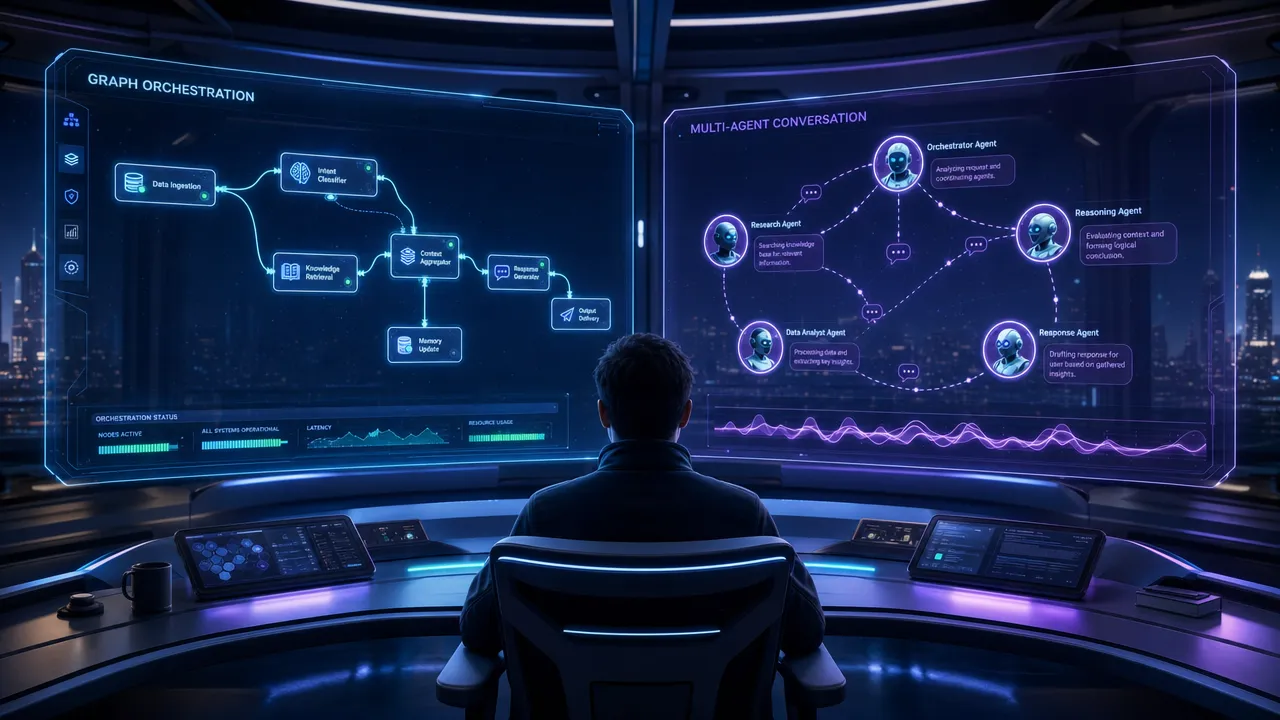
The architecture does not mean LangGraph cannot support multi-agent workflows. It can model agents as nodes or subgraphs. It also does not mean AutoGen cannot support state. AutoGen teams can be stateful, and Microsoft Research describes newer AutoGen directions around event-driven, observable, and extensible systems. The difference is where each framework starts: LangGraph starts with controlled workflow state; AutoGen starts with agent collaboration.
LangGraph vs AutoGen for stateful agent framework requirements
State is where LangGraph has the clearest advantage for complex workflows.
Production AI systems often need to know more than the last chat message. They need to track current task status, intermediate decisions, external API results, tool outputs, validation results, user approvals, retries, and recovery points. That is why stateful agent framework design is becoming a major concern in 2026.
LangGraph is explicitly designed for long-running, stateful workflows. Its documented capabilities include persistence, checkpoints, durable execution, memory patterns, and human-in-the-loop support. In practical terms, that means a team can design workflows that pause, resume, inspect state, and recover from failure more predictably.
AutoGen also supports stateful behavior. Its team-based abstractions keep conversation history unless reset, and its architecture includes components for memory, tools, extensions, and runtime behavior. Microsoft Research also highlights observability and OpenTelemetry support for AutoGen’s newer direction. Still, AutoGen’s state model is more conversation-centered, while LangGraph’s state model is more workflow-centered.
A useful way to compare them is by asking what kind of state matters most.
| Stateful requirement | Better default | Why it matters |
|---|---|---|
| Checkpointing workflow progress | LangGraph | Useful for long-running tasks and failure recovery |
| Inspecting and editing execution state | LangGraph | Important for approvals, debugging, and compliance |
| Maintaining agent conversation history | AutoGen | Natural fit for collaborative multi-agent workflows |
| Resuming after interruption | LangGraph | Durable execution is central to production workflow automation |
| Human guidance during collaboration | AutoGen | Human input can fit naturally into agent conversations |
| Human approval before continuing | LangGraph | Approval gates fit graph-based execution well |
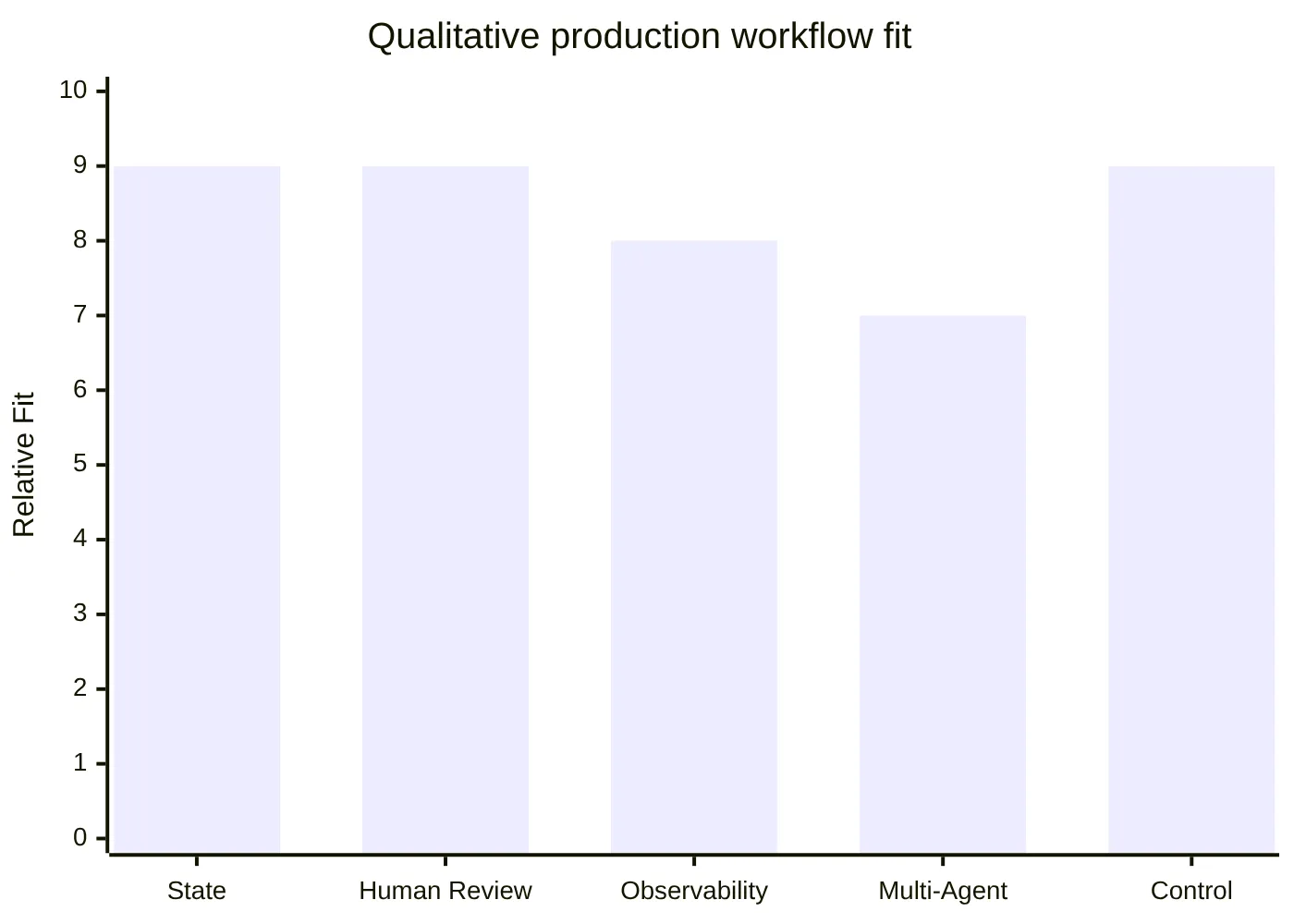
The chart above reflects LangGraph’s typical fit for controlled production workflows. It is qualitative, not a benchmark. No public evidence proves that one framework is universally faster, cheaper, or more accurate across all use cases.
For teams building AI agent hardware and software systems, state management becomes even more important. When agents coordinate APIs, services, devices, sensors, logs, and human approvals, the orchestration layer must be predictable. LangGraph’s explicit state graph can help define safety boundaries and execution paths. AutoGen can still be valuable when specialized agents need to plan, discuss, and evaluate options before action.
If you’re evaluating agent frameworks for your workflow, Aiden can help you map the right architecture — aidenai.io
LangGraph vs AutoGen for multi-agent workflows and LLM workflow automation
AutoGen is often the stronger starting point for conversational multi-agent workflows.
Its AgentChat layer gives developers high-level patterns for teams of agents. One agent can plan, another can critique, another can execute code or call tools, and another can summarize results. This maps naturally to research assistants, coding copilots, analysis teams, and reviewer workflows.
The AutoGen GitHub repository describes the framework as a way to create multi-agent AI applications that can operate autonomously or alongside humans. The AutoGen stack also includes Extensions for integrations and Studio for visual or low-code experimentation. Microsoft Research describes AutoGen as moving toward an asynchronous, event-driven, distributed, observable, and extensible architecture.
LangGraph supports multi-agent workflows differently. Instead of making conversation the central abstraction, it lets developers place agents inside a controlled graph. This works especially well when agent handoffs must follow business logic. For example, a research agent might gather information, a validation agent might check constraints, a policy step might determine whether human review is required, and a final agent might generate an output only after approval.
That makes LangGraph better for governed LLM workflow automation. AutoGen is better for flexible agent collaboration.
The production question is more nuanced. AutoGen has production-relevant capabilities, but Microsoft’s own ecosystem direction adds a strategic caveat. Microsoft provides migration guidance from AutoGen to Microsoft Agent Framework, which teams should review before committing to a long-term AutoGen architecture.
That does not make AutoGen obsolete. It means engineering leaders should evaluate versioning, migration cost, API stability, and long-term platform direction. For a short-lived prototype, AutoGen can be an excellent choice. For a multi-year enterprise system, the migration path matters.
Here is a practical use-case guide:
| Use case | Recommended default | Reason |
|---|---|---|
| Enterprise approval workflow | LangGraph | Checkpoints, review gates, and resumability are central |
| Research assistant team | AutoGen | Agents can discuss, critique, and revise naturally |
| Coding agent prototype | AutoGen | Multi-agent coding and review patterns fit conversation well |
| Governed coding pipeline | LangGraph | Better for controlled stages, validation, and audit trails |
| Customer support automation | Depends | LangGraph for escalation control; AutoGen for conversational triage |
| Data analysis workflow | Depends | LangGraph for repeatable pipelines; AutoGen for exploratory analysis |
| Hardware/software orchestration | LangGraph | Explicit state and deterministic routing are safer defaults |
| Brainstorming or planning agents | AutoGen | Dynamic collaboration is the main value |
A common hybrid pattern is conceptually possible: use LangGraph as the outer workflow controller and place an AutoGen-style conversational team inside one step. However, treat this as an architectural option, not a documented best practice, unless your engineering team validates it directly.
LangGraph vs AutoGen production checklist for 2026 decisions
The best 2026 framework choice starts with operational requirements, not feature lists. Teams should define how the agent system behaves when the model is wrong, a tool fails, a user changes requirements, an approval is denied, or execution must resume later.
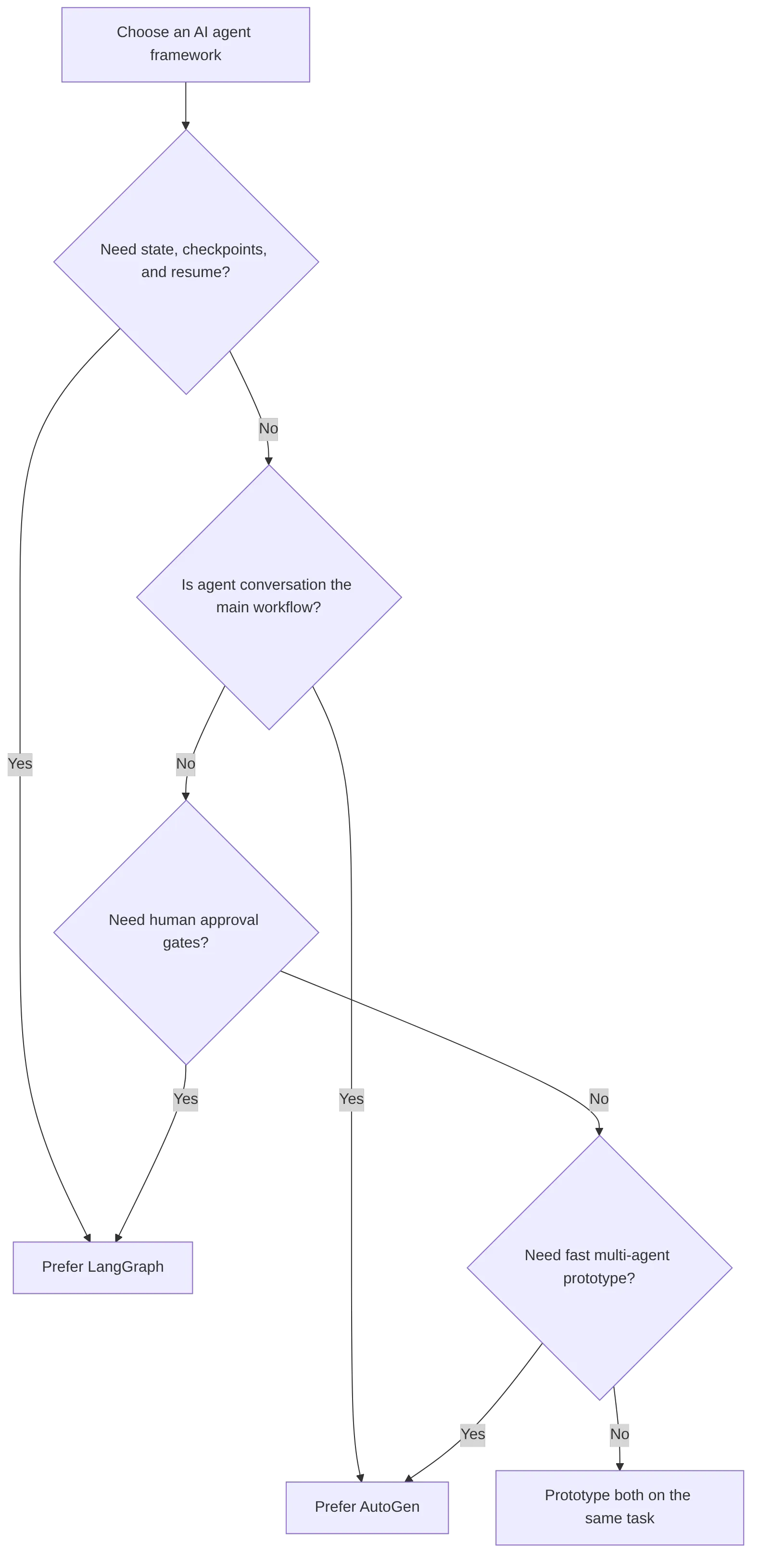
Use this checklist before choosing LangGraph vs AutoGen:
| Question | If yes, lean toward |
|---|---|
| Does the workflow need durable checkpoints? | LangGraph |
| Must humans approve or edit state before execution continues? | LangGraph |
| Does the workflow need deterministic routing? | LangGraph |
| Is auditability a major requirement? | LangGraph |
| Is the main value agent-to-agent collaboration? | AutoGen |
| Do agents need to debate, critique, or delegate dynamically? | AutoGen |
| Is the project primarily a prototype or research system? | AutoGen |
| Is the organization deeply aligned with Microsoft’s agent ecosystem? | AutoGen or Microsoft Agent Framework evaluation |
| Does the system coordinate tools, APIs, services, or devices with safety constraints? | LangGraph |
| Is long-term framework direction a major risk factor? | Evaluate both carefully |
Observability should also influence the decision. LangGraph is commonly paired with the broader LangChain ecosystem’s tracing and evaluation tooling, while AutoGen’s newer materials discuss tracking, tracing, debugging, and OpenTelemetry support. For production systems, observability is not optional. Teams need traces, logs, test cases, evaluation datasets, and clear failure recovery procedures.
The most practical recommendation is to prototype both frameworks against the same representative workflow. Do not compare a LangGraph toy graph with an AutoGen polished demo, or an AutoGen chat prototype with a production-grade LangGraph pipeline. Use the same task, same tools, same models, same success criteria, and same failure scenarios.
Measure:
- How clearly the workflow can be represented.
- How easily state can be inspected.
- How reliably failures can be recovered.
- How much code is required for guardrails.
- How easy it is to add human review.
- How understandable traces and logs are.
- How confident the team feels maintaining the system six months later.
The 2026 Decision
LangGraph and AutoGen are not competing for the same job. LangGraph is infrastructure for workflows that need to be reliable, inspectable, and resumable. AutoGen is infrastructure for agent teams that need to think, discuss, and adapt.
The clearest signal for LangGraph: your workflow has defined stages, requires human approval at specific points, and must recover predictably from failure. The clearest signal for AutoGen: your workflow’s value comes from agents reasoning together, and flexibility matters more than determinism.
For most production systems in 2026, LangGraph is the safer default. For most research and prototyping work, AutoGen gets you further faster.
If you are building an agent system and need help mapping the right architecture to your workflow — whether that is LangGraph, AutoGen, CrewAI, or a hybrid — Aiden works with teams on agent infrastructure design and deployment. Start at aidenai.io.
LangGraph vs AutoGen FAQs
Is LangGraph better than AutoGen?
LangGraph is generally better for stateful, deterministic, production-oriented workflows that need checkpoints, human review, and resumability. AutoGen is generally better for conversational multi-agent collaboration, research prototypes, and agent teams that discuss or delegate tasks.
Is AutoGen good for production?
AutoGen has production-relevant capabilities, including event-driven architecture, extensions, tracing concepts, OpenTelemetry support, Studio, and stateful teams. However, teams should review Microsoft’s AutoGen-to-Microsoft-Agent-Framework migration guidance before starting a long-term production project.
Which framework is better for complex workflows?
LangGraph is usually better for complex workflows when complexity comes from state, routing, approvals, retries, and auditability. AutoGen is better when complexity comes from multiple agents collaborating through conversation.
Which framework is better for multi-agent workflows?
AutoGen is often easier for multi-agent workflows because agent teams are a first-class abstraction. LangGraph is still strong for multi-agent systems when each agent must operate inside a controlled graph with explicit routing and state.
Which is the better stateful agent framework?
LangGraph is the stronger default stateful agent framework because persistence, checkpoints, and durable execution are core parts of its design. AutoGen supports stateful teams and conversation history, but its model is more collaboration-oriented.
Can LangGraph and AutoGen be used together?
Yes, it is technically possible for engineering teams to combine Python-accessible frameworks in a larger architecture. A practical concept would be using LangGraph as the outer controller and an AutoGen-style team for a specialized conversational step. Treat that as a custom architecture requiring validation, not an official default pattern.
What is the final recommendation for 2026?
Choose LangGraph for controlled agent orchestration, complex workflows, stateful execution, approvals, and production LLM workflow automation. Choose AutoGen for conversational multi-agent workflows, research assistants, coding agents, and rapid collaborative prototypes. For high-stakes systems, prototype both and decide based on state, recovery, observability, and maintainability.
Related posts
Why CrewAI beats LangChain for multi-agent work
CrewAI vs LangChain compared by workflow shape, showing when role-based agents beat graph orchestration for multi-agent systems.

Claude vs GPT-5 for Business Automation
Business automation AI comparison of Claude vs GPT-5 using workflow fit, governance, tools, and agent evaluation criteria for ROI.
Perplexity vs ChatGPT vs Claude: Which AI is Best for Research in 2026?
Perplexity vs ChatGPT vs Claude research 2026: compare retrieval, analysis, synthesis, citations, and verification workflows.