Perplexity vs ChatGPT vs Claude: Which AI is Best for Research in 2026?
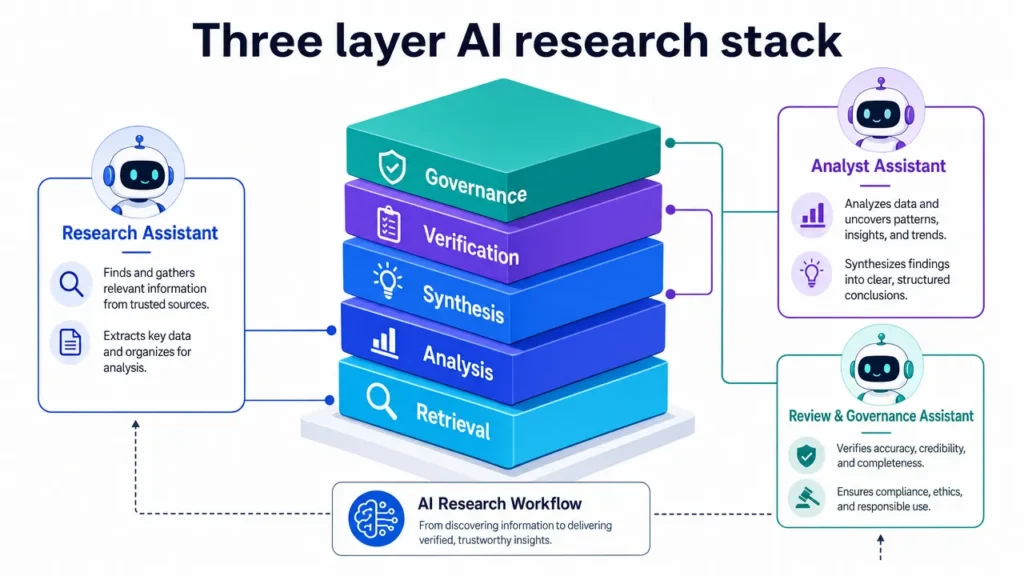
ChatGPT is the best overall choice in the Perplexity vs ChatGPT vs Claude research 2026 debate because it combines web research, file analysis, data tools, multimodal workflows, connectors, and business controls in one broad platform. Perplexity is the best source-first AI search assistant 2026 option for fast cited answers. Claude is the strongest choice for long documents, careful synthesis, and polished writing. For serious research, the highest-quality workflow is not one tool. It is Perplexity for retrieval, ChatGPT for analysis, Claude for synthesis, and human review for verification.
Why Perplexity vs ChatGPT vs Claude research 2026 depends on the research layer
The best AI for research depends on which part of the research process matters most: source discovery, reasoning, synthesis, data analysis, or governance. A simple "smartest chatbot" ranking misses the way modern AI research tools actually work.
In 2026, AI research assistants are moving from single-response chatbots into workflow systems. A good AI research tool can search the web, inspect sources, process files, compare claims, summarize long material, create tables, analyze data, and help draft a final report. None of Perplexity, ChatGPT, or Claude dominates every layer equally.

A practical AI research tool comparison should separate the work into five layers: retrieval, citation checking, reasoning, synthesis, and final human validation. Perplexity is strongest at retrieval and citation visibility. ChatGPT is strongest as the broad all-purpose research platform. Claude is strongest for long-form synthesis and careful writing.
| Research layer | Best fit | Why it matters |
|---|---|---|
| Fast web retrieval | Perplexity | It is designed around real-time, source-visible answers. |
| Multi-step research | ChatGPT or Perplexity | Both support deeper research-style workflows, but ChatGPT is broader. |
| Long document synthesis | Claude | Claude is especially strong for reasoning across lengthy documents. |
| Data and code analysis | ChatGPT | ChatGPT is strongest when research includes files, tables, code, or analysis. |
| Polished writing | Claude | Claude often produces careful, structured, nuanced prose. |
| Enterprise workflow | ChatGPT or Claude | Teams should verify current privacy, retention, and admin controls before adoption. |
For most professional users, the best AI for research is ChatGPT if only one subscription is allowed. But if the research must be source-first, Perplexity wins. If the research involves long PDFs, dense reports, policy documents, or narrative synthesis, Claude is often the better final-draft partner.

Perplexity vs ChatGPT vs Claude research 2026 quick verdict table
The short answer is that ChatGPT is the best overall research assistant, Perplexity is the best citation-first research tool, and Claude is the best long-document synthesis assistant. That conclusion is based on documented product positioning, current feature direction, and the way each tool fits a professional research workflow.
| Category | Winner | Practical reason |
|---|---|---|
| Overall research assistant | ChatGPT | Broadest combination of research, file, data, multimodal, and workflow capabilities. |
| Fast cited answers | Perplexity | Most source-native experience for web research and quick verification. |
| Long documents | Claude | Strong for careful synthesis, reasoning, and rewriting across large inputs. |
| Academic source discovery | Perplexity | Useful for finding sources quickly, though academic validation is still required. |
| Data analysis | ChatGPT | Strongest fit when research includes spreadsheets, code, charts, or calculations. |
| Writing and editing | Claude | Excellent for turning raw research into polished narrative. |
| Technical research | ChatGPT or Claude | ChatGPT is strong for broad technical workflows; Claude is strong for code reasoning and explanation. |
| Enterprise evaluation | ChatGPT or Claude | Business users should compare current privacy, retention, compliance, and admin documentation. |
| Multi-tool workflow | Perplexity + ChatGPT + Claude | Best quality when retrieval, analysis, and synthesis are separated. |
A useful way to view this LLM comparison for research is to map each tool to its default research behavior:
| Tool | Default research personality | Best use |
|---|---|---|
| Perplexity | "Find sources and answer quickly." | Current events, market snapshots, competitor checks, academic starting points. |
| ChatGPT | "Analyze the task and produce structured work." | Deep research reports, files, data analysis, coding, business briefs. |
| Claude | "Read deeply and write carefully." | Long PDFs, policy documents, strategy memos, polished reports. |
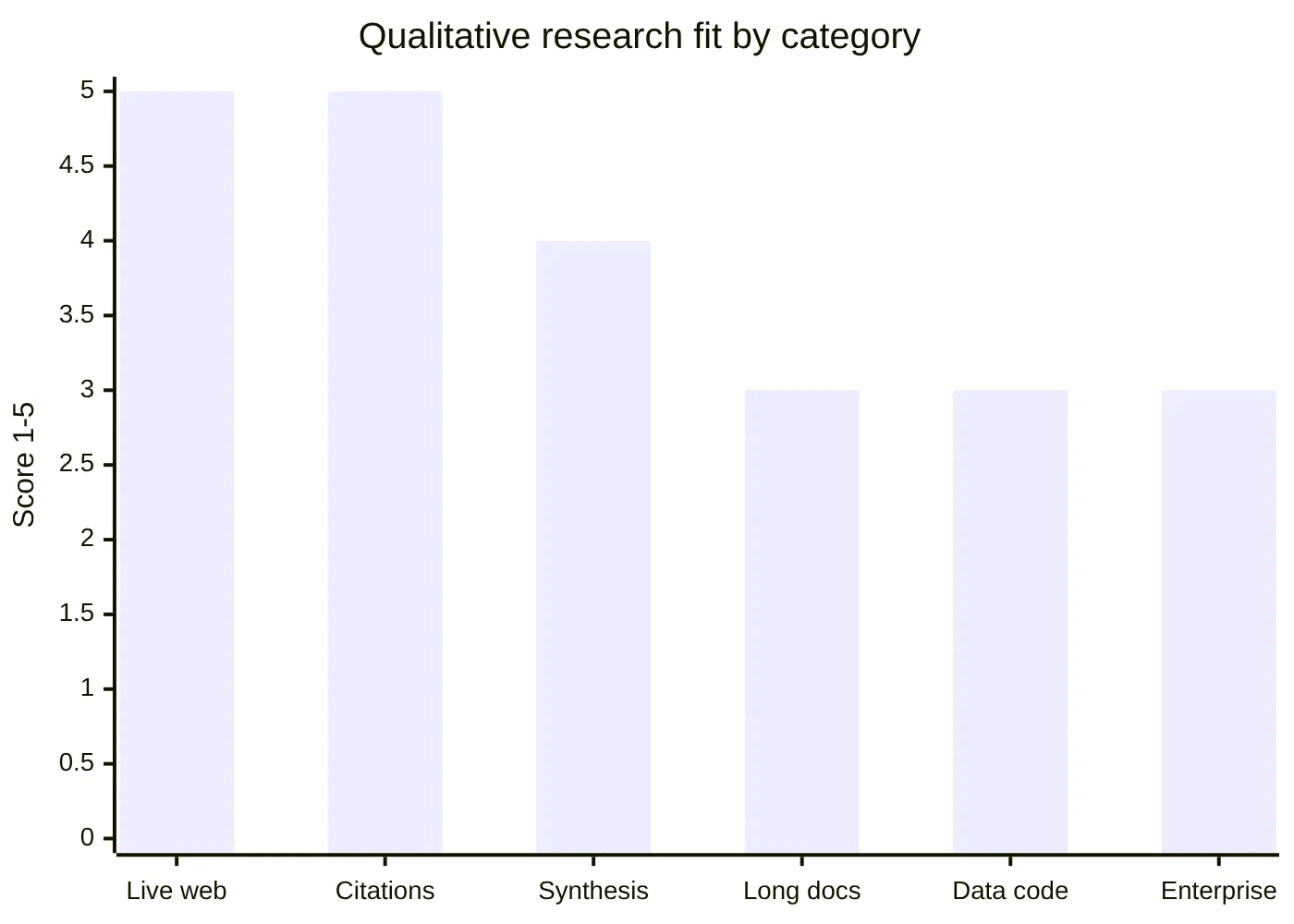
The chart above represents Perplexity’s qualitative fit. It is excellent for live web research and citations, strong for synthesis, and more limited for advanced data, coding, or enterprise workflows compared with the broadest research platforms.
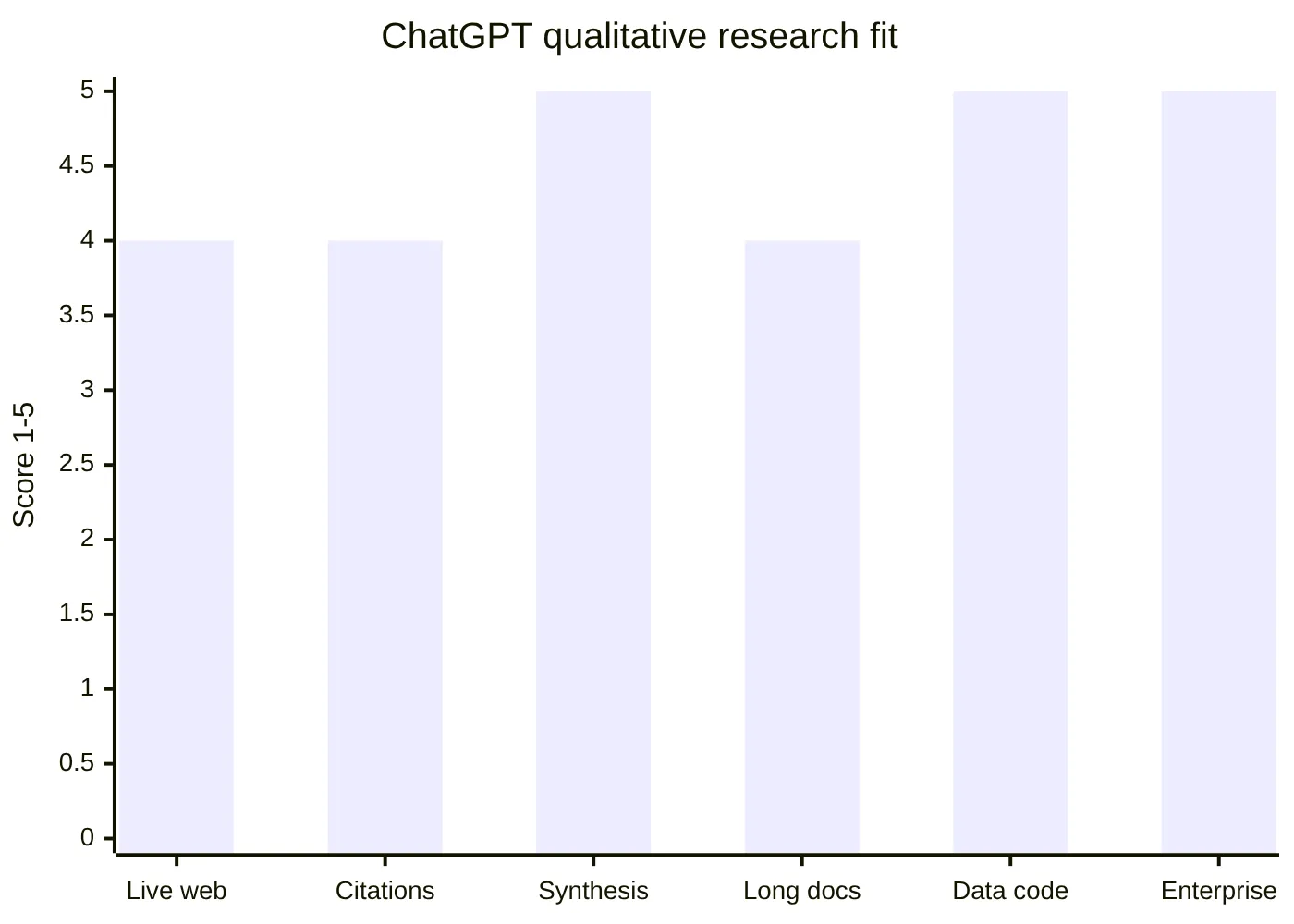
ChatGPT scores highest as an all-purpose platform. Its strongest research advantage is not only answering questions, but moving from source gathering to analysis, structured outputs, files, tables, and technical workflows.
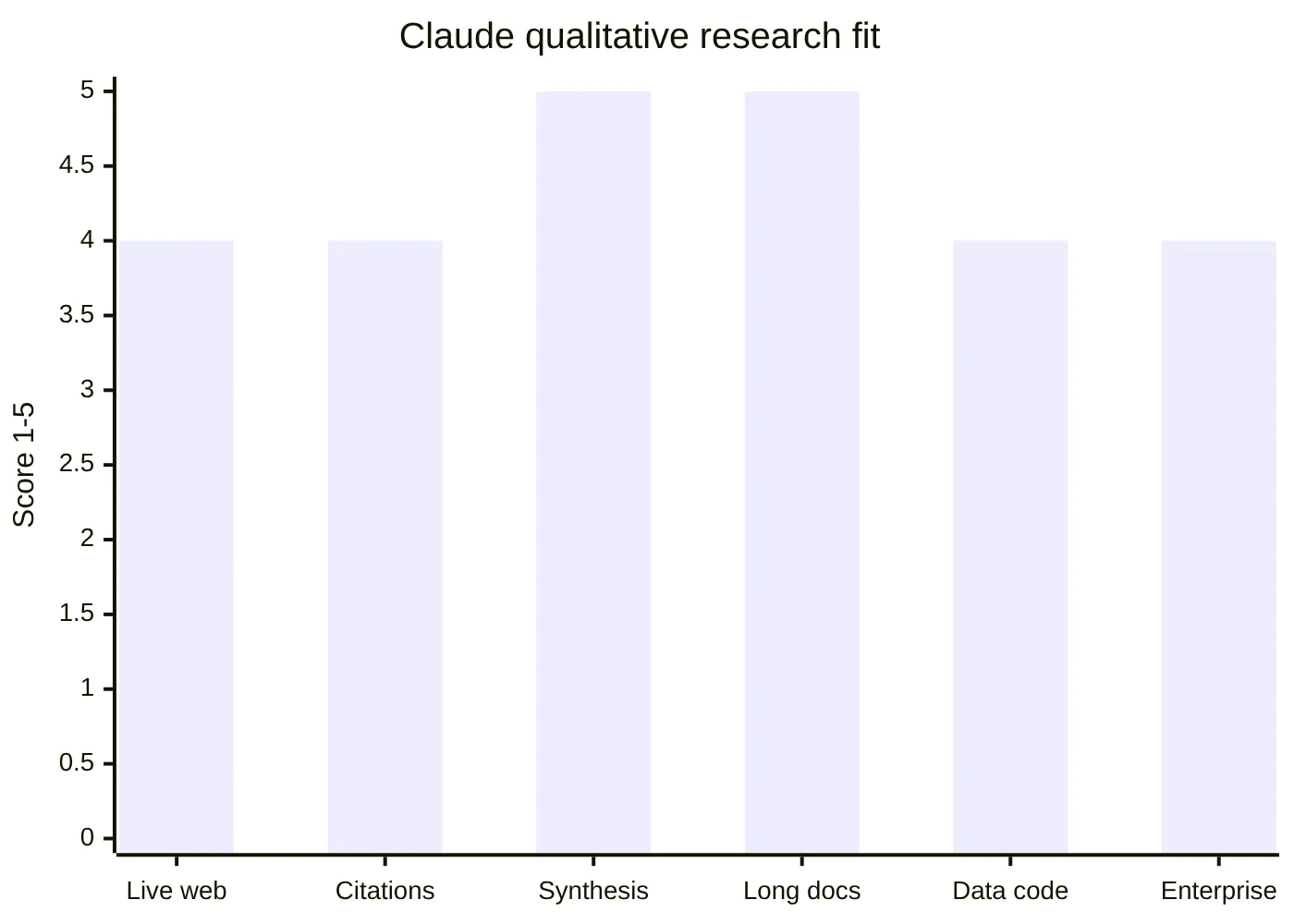
Claude’s strongest value appears when the research material is long, nuanced, or writing-intensive. It is less source-first than Perplexity, but it is one of the strongest tools for turning dense material into a coherent explanation.
Perplexity vs ChatGPT vs Claude research 2026 feature comparison
A strong AI research tool comparison should focus on real user tasks rather than abstract model rankings. Benchmark scores can be useful context, but they do not prove that a tool’s citations are accurate, that its summaries are faithful, or that its workflow fits a specific organization.
Perplexity, ChatGPT, and Claude all support research workflows, but they prioritize different behaviors. Perplexity feels closest to an answer engine. ChatGPT feels like a general-purpose AI workspace. Claude feels like a long-context reasoning and writing partner.
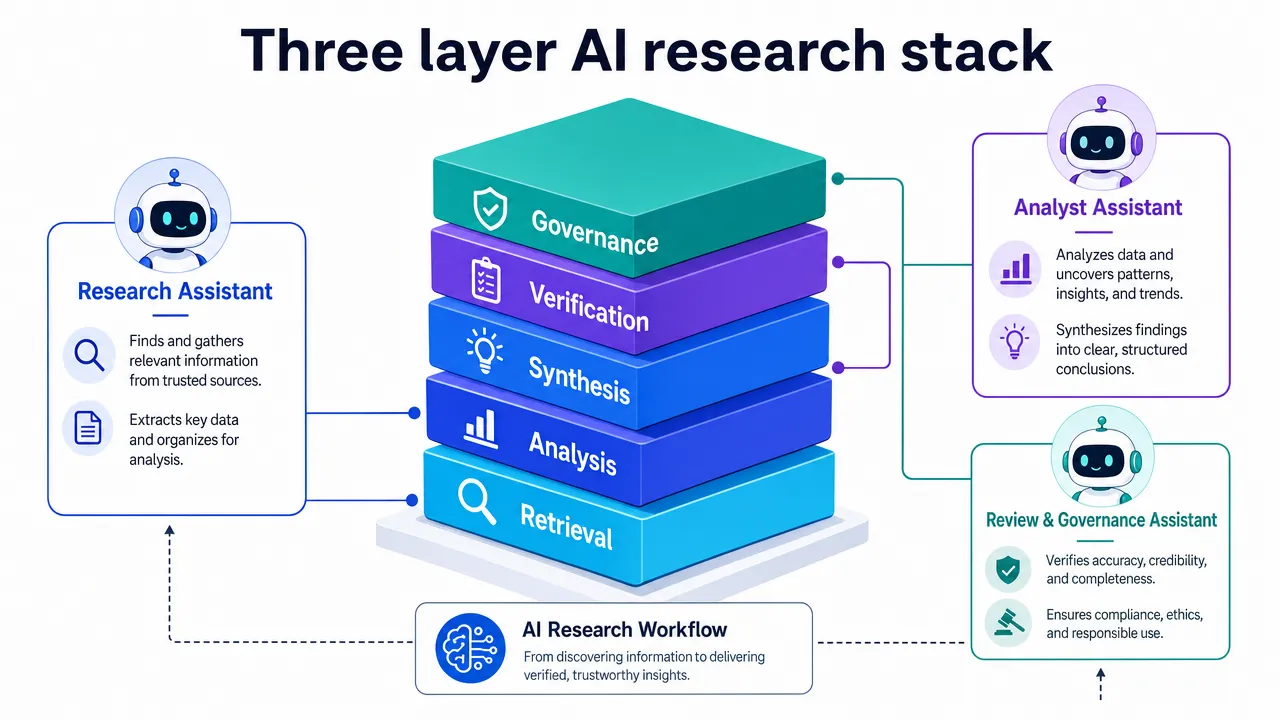
The most important features for professional research are citations, live search, long context, file handling, data analysis, and privacy. A tool can be excellent at one of these and only average at another. That is why the best AI search assistant 2026 workflow often combines tools instead of forcing one tool to do everything.
| Feature | Perplexity | ChatGPT | Claude |
|---|---|---|---|
| Live web research | Excellent | Strong | Strong when web search is enabled |
| Citation visibility | Excellent | Strong in search or deep research modes | Strong with web search, less source-first |
| Source discovery | Excellent | Strong | Good |
| Long-form synthesis | Strong | Excellent | Excellent |
| Long document reading | Capable | Strong | Excellent |
| File analysis | Capable, depending on plan and limits | Excellent | Excellent |
| Data analysis | Limited to moderate | Excellent | Strong in supported contexts |
| Coding and technical research | Moderate | Excellent | Excellent |
| Academic research | Excellent for discovery | Strong for structure and analysis | Strong for synthesis |
| Market research | Excellent for current source gathering | Excellent for frameworks and comparisons | Strong for narrative analysis |
| Multimodal research | Moderate | Excellent | Strong |
| Speed for quick answers | Excellent | Strong | Strong but often more deliberative |
| Writing quality | Strong | Strong | Excellent |
| Enterprise readiness | Requires direct vendor review | Strong documented business posture | Strong candidate, verify current terms |
| Best buyer profile | Source-first researcher | All-purpose professional user | Long-doc, writing, and synthesis user |
The difference between Perplexity vs ChatGPT is clearest when the task begins with current web evidence. Perplexity is often faster for finding cited sources and getting a compact answer. ChatGPT is better when the next step requires analysis, classification, data transformation, code, or a deliverable such as a memo, table, plan, or presentation outline.
The difference between Claude vs ChatGPT is more subtle. ChatGPT is usually the broader platform. Claude often feels stronger when the user needs careful prose, nuanced interpretation, and synthesis across a long body of text. For example, Claude may be the better choice for rewriting a dense report into an executive narrative, while ChatGPT may be better for extracting data from files and producing structured analysis.
| Use case | Best choice | Runner-up | Why |
|---|---|---|---|
| Quick fact-checking | Perplexity | ChatGPT | Fast citation-first answers. |
| Literature discovery | Perplexity | Claude | Good for finding sources, then synthesizing papers. |
| Business research | ChatGPT | Perplexity | Better for turning research into structured strategy outputs. |
| SEO research | Perplexity + ChatGPT | Claude | Perplexity finds sources; ChatGPT turns findings into briefs. |
| Technical documentation research | ChatGPT | Claude | Strong for code, troubleshooting, and structured technical answers. |
| Long PDF analysis | Claude | ChatGPT | Better fit for long-context reading and careful synthesis. |
| Data-heavy research | ChatGPT | Claude | Strongest fit for files, tables, calculations, and code-style workflows. |
| Final report writing | Claude | ChatGPT | Excellent for tone, structure, and polish. |
Perplexity vs ChatGPT vs Claude research 2026 accuracy and citation risks
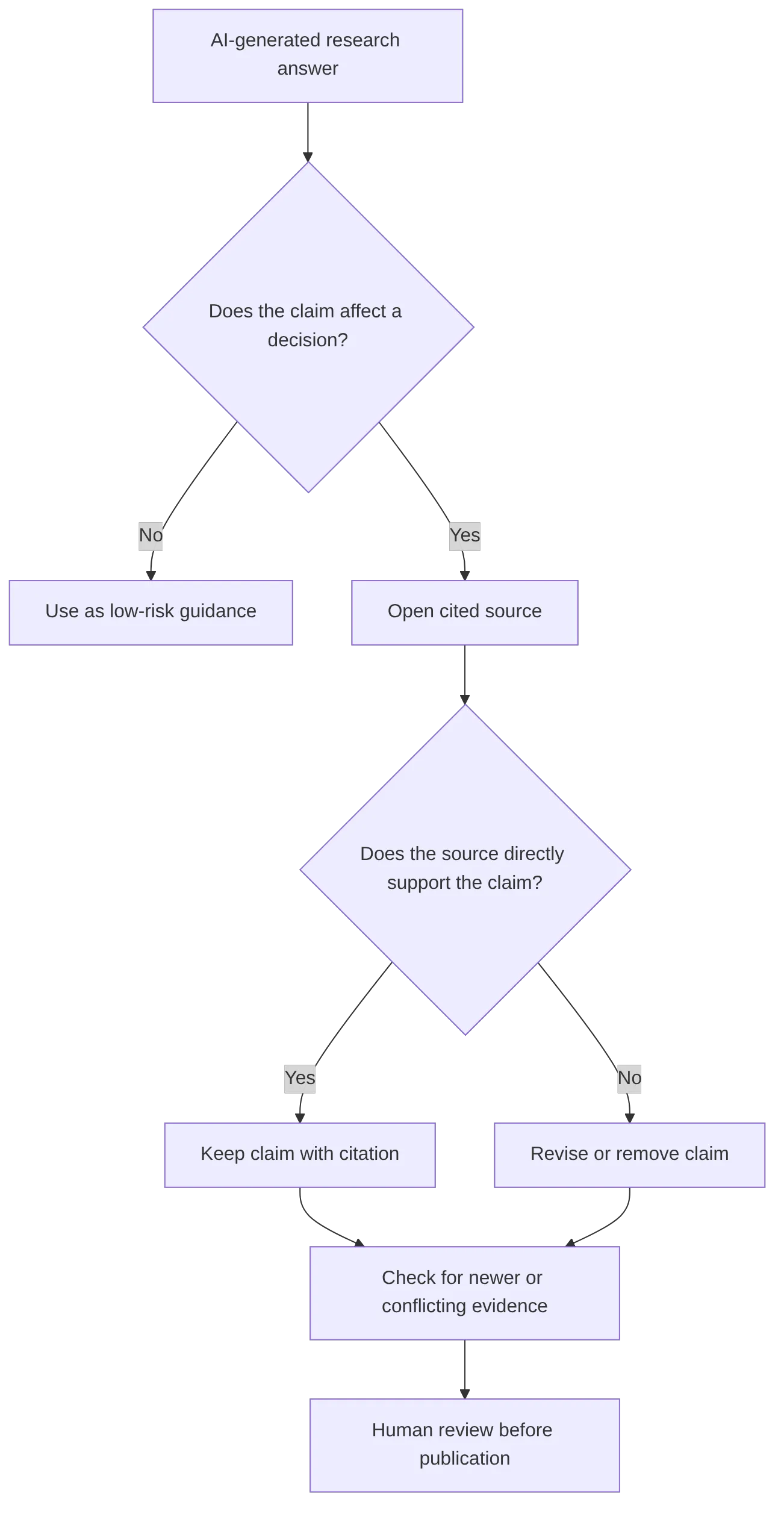
AI-generated research still requires human verification. Citations reduce risk, but they do not eliminate it. A cited answer can still misread a source, overstate a finding, omit conflicting evidence, or cite a page that is relevant but does not support the exact claim.
Perplexity has the clearest citation-native workflow. That makes it especially useful when the user wants to inspect sources immediately. However, citation density can create false confidence. A source link does not automatically mean the answer is fully supported.
ChatGPT is strongest when research moves beyond retrieval. It can produce structured reports, compare sources, analyze files, and help with data workflows. The main risk is that, outside explicit search or deep research modes, users may not always know which parts are sourced and which parts are model reasoning.
Claude is strong at synthesis and careful writing. It is particularly useful for long documents, but users should verify quotations, page references, numbers, and claims against the original source. Claude can be very persuasive, which makes verification especially important.

The safest workflow is to treat AI as a research accelerator, not a final authority. The more important the decision, the more source checking is required. This applies to academic, legal, medical, financial, technical, and enterprise research.
| Risk | What can happen | How to reduce it |
|---|---|---|
| Unsupported citation | The linked page is related but does not prove the claim. | Open the source and confirm the exact claim. |
| Outdated information | The AI uses an older article or model memory. | Ask for current sources and publication dates. |
| Secondary-source bias | The AI cites commentary instead of primary documents. | Request primary sources first. |
| Missing counterevidence | The answer summarizes only one side. | Ask for contradictory evidence and limitations. |
| Misread data | Tables, charts, or PDFs are interpreted incorrectly. | Check the original table or run the calculation manually. |
| Overconfident synthesis | The final answer sounds more certain than the evidence allows. | Ask the tool to label facts, assumptions, and opinions. |
A reliable workflow for any AI research assistant 2026 setup should include these steps:
- Start with a narrow research question.
- Ask for primary sources before summaries.
- Require citations for major factual claims.
- Save source links in a separate research library.
- Ask for conflicting evidence.
- Use ChatGPT or Claude to structure findings, but keep the source list visible.
- Verify high-impact claims manually.
- Separate facts from interpretation.
- Record the date of the research session.
- Have a human subject-matter expert review sensitive conclusions.
For academic research, Perplexity is useful as a discovery layer, but it should not replace databases, journals, citation managers, or expert review. For business research, ChatGPT can build useful frameworks and comparisons, but current market facts should be validated. For long reports, Claude can summarize and refine, but direct quotations and numbers should be checked.
Perplexity vs ChatGPT vs Claude research 2026 pricing, privacy, and enterprise fit
Pricing changes quickly, so any pricing decision should be verified directly on each vendor’s current pricing page before purchase. The research report found Perplexity Pro references around $17 per month when billed annually and Max references around $167 per month when billed annually, but those numbers should be rechecked before publication or procurement. ChatGPT and Claude pricing also changes by plan, region, and release cycle.
The bigger issue for teams is not only cost. It is governance. Enterprise buyers should evaluate data retention, model training defaults, encryption, admin controls, connector permissions, audit logs, legal terms, and compliance documentation.
| Buyer type | Best starting point | Why |
|---|---|---|
| Casual researcher | Perplexity or ChatGPT free tier | Good for low-risk source discovery and general questions. |
| Student | Perplexity + Claude or ChatGPT | Perplexity finds sources; Claude or ChatGPT helps explain and organize. |
| Marketer | Perplexity + ChatGPT | Strong combination for competitor research and content briefs. |
| Analyst | ChatGPT | Best fit for files, data, tables, and structured outputs. |
| Writer or editor | Claude | Strong for turning research into clear narrative. |
| Developer | Claude or ChatGPT | Strong for technical reasoning, documentation, and coding tasks. |
| Enterprise team | ChatGPT or Claude | Evaluate governance, privacy, connectors, and admin controls. |
| AI agent builder | All three | Use retrieval, reasoning, and synthesis as separate layers. |
OpenAI has especially clear public business-data positioning in the research report, including statements around business data privacy, ownership, encryption, and not training on ChatGPT Business or Enterprise data by default. Claude is also positioned around safety, accuracy, and secure work, but teams should verify current enterprise terms directly. Perplexity is excellent for public web research, but sensitive internal research should not be routed into any tool until the organization’s legal and security teams approve the vendor’s current documentation.
For teams building AI-native research workflows, the decision should be framed around risk level:
| Research type | Recommended tool posture |
|---|---|
| Public web research | Perplexity, ChatGPT, or Claude can be appropriate. |
| Internal business documents | Use business or enterprise plans with verified data controls. |
| Regulated data | Require procurement, legal, security, and compliance review. |
| Academic publication | Use AI for assistance only; verify citations and methods manually. |
| Competitive intelligence | Validate claims against primary sources and dated evidence. |
| Product strategy | Combine AI synthesis with human domain judgment. |
The best enterprise workflow often looks like an AI agent stack. Retrieval gathers evidence. Reasoning compares and tests it. Synthesis turns it into a useful document. Governance controls what data enters the system and who can access the output. This framing aligns with how AI agent hardware and software systems are evolving: not as one chatbot, but as connected layers of automated and human-reviewed work. For teams building agent workflows on top of these models, see Why Most AI Agents Fail in Production and How to Build an AI Agent for Your Business Without Writing Code for practical implementation guidance.
Explore AI agent automation at Aiden →
Final recommendation for Perplexity vs ChatGPT vs Claude research 2026
ChatGPT is the best overall answer to Perplexity vs ChatGPT vs Claude research 2026 because it is the strongest all-purpose research platform. It is the best default for professionals who want one tool for search, files, data analysis, technical work, multimodal tasks, and structured outputs.
Perplexity is the best choice when citations and current source discovery are the priority. It is the most natural fit for quick fact-checking, market snapshots, competitor discovery, and early academic source gathering.
Claude is the best choice when the research material is long, dense, or writing-intensive. It is especially strong for long documents, nuanced synthesis, careful explanations, and polished reports.
| Final question | Best answer |
|---|---|
| Which is best overall? | ChatGPT |
| Which is best for citations? | Perplexity |
| Which is best for long documents? | Claude |
| Which is best for data analysis? | ChatGPT |
| Which is best for writing? | Claude |
| Which is best for fast web research? | Perplexity |
| Which is best for teams? | ChatGPT or Claude, after governance review |
| Which is best for serious research quality? | A combined workflow with human verification |
For a single-tool choice, pick ChatGPT. For source-first research, pick Perplexity. For long-document synthesis, pick Claude. For the highest-quality professional workflow, use Perplexity to find sources, ChatGPT to analyze and structure the evidence, Claude to refine the final narrative, and a human reviewer to verify every important claim.
FAQs:
Is Perplexity better than ChatGPT for research?
Perplexity is better for fast source discovery and citation-first web research. ChatGPT is better for broader workflows that include files, data analysis, structured reports, multimodal inputs, and connected tools.
Is Claude better than ChatGPT for research?
Claude is often better for long documents, careful synthesis, and polished writing. ChatGPT is usually better as an all-purpose research platform.
Which AI has the best citations?
Perplexity has the most citation-native experience. ChatGPT is strong when using search or deep research workflows. Claude can provide citations through web search, but its main strength is synthesis.
Which AI is best for academic research?
Perplexity is strong for finding sources quickly, Claude is strong for explaining and synthesizing papers, and ChatGPT is useful when academic work includes data analysis or structured reporting.
Should I use more than one AI research tool?
Yes. A strong 2026 workflow uses Perplexity for retrieval, ChatGPT for analysis, Claude for synthesis, and human review for accuracy.
Related posts
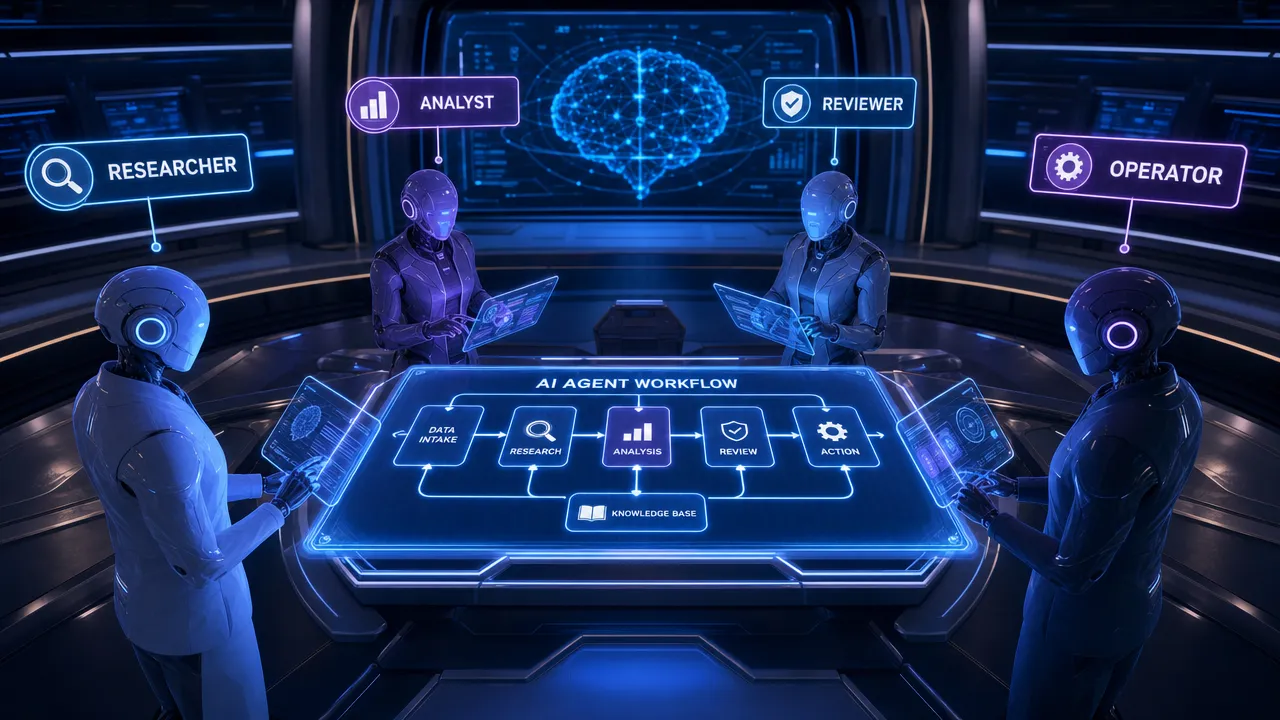
Why CrewAI beats LangChain for multi-agent work
CrewAI vs LangChain compared by workflow shape, showing when role-based agents beat graph orchestration for multi-agent systems.
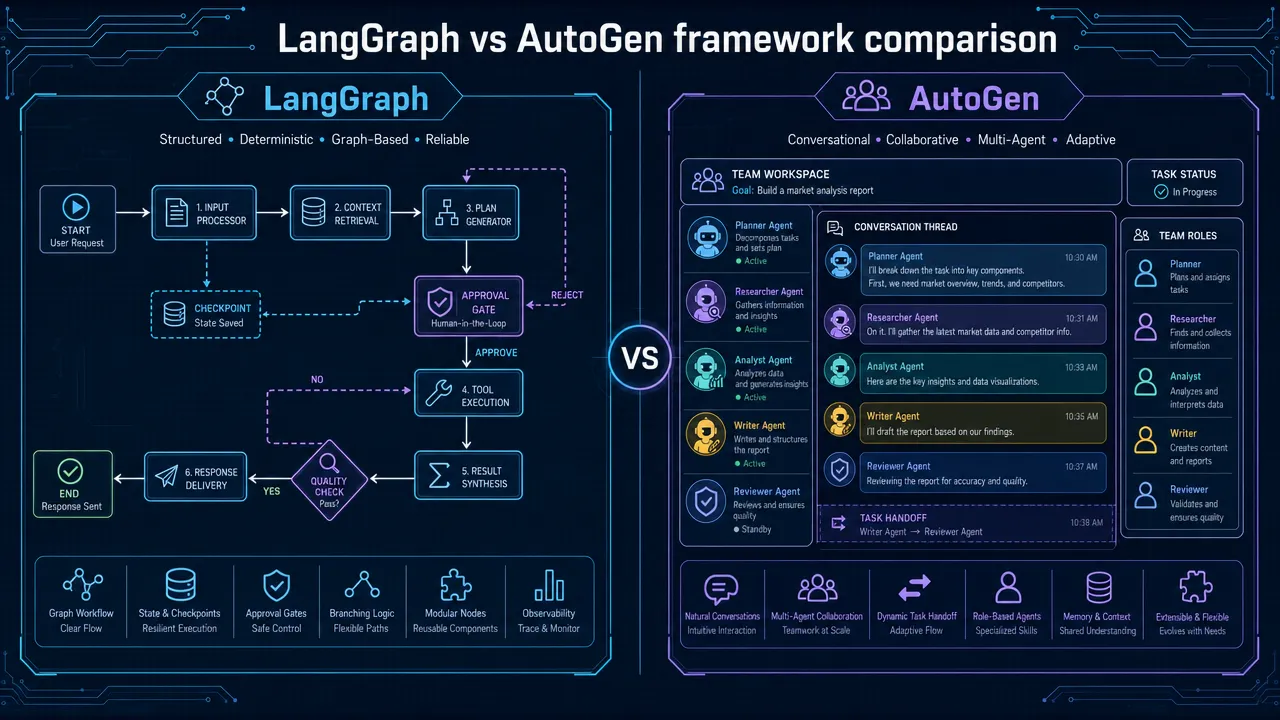
LangGraph vs AutoGen: Which AI Agent Framework Handles Complex Workflows in 2026?
LangGraph vs AutoGen comparison: assess state, checkpoints, human review, and collaboration to choose the right AI agent framework

Claude vs GPT-5 for Business Automation
Business automation AI comparison of Claude vs GPT-5 using workflow fit, governance, tools, and agent evaluation criteria for ROI.