Why CrewAI beats LangChain for multi-agent work
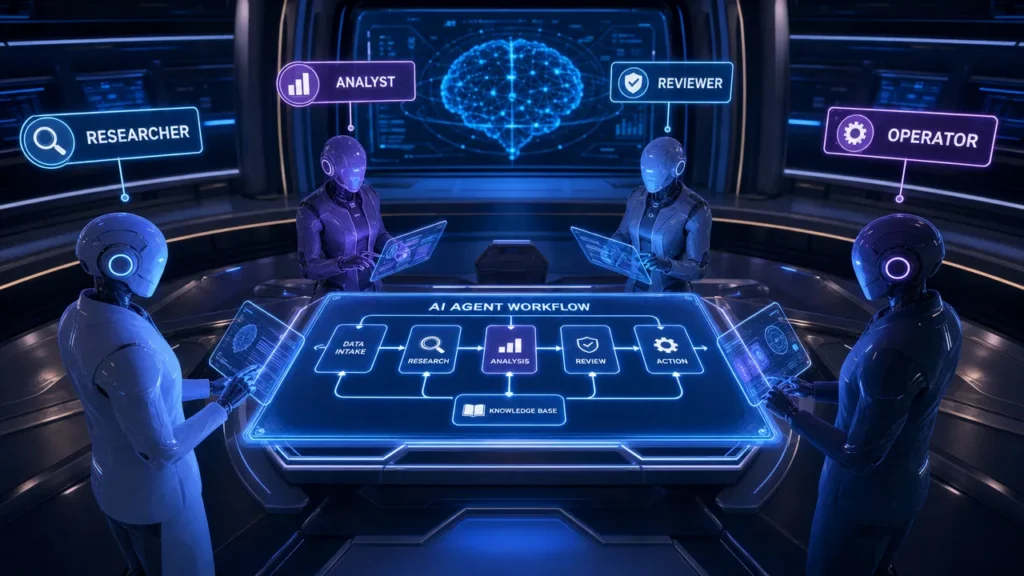
CrewAI beats LangChain for multi-agent work when the workflow is role-based, task-oriented, and easier to describe as a team of specialists than as a state machine. The stronger opinion is not that CrewAI is universally better. It is that CrewAI is often the better multi-agent framework when teams need to define agents, assign responsibilities, coordinate handoffs, and move from idea to prototype without designing a full graph runtime first.
That distinction matters because the modern CrewAI vs LangChain debate is really a three-part comparison: CrewAI for agent teams, LangChain for broad LLM application development, and LangGraph plus LangSmith for complex orchestration and production observability. A fair LangChain comparison must include that wider ecosystem. A fair CrewAI comparison must recognize why its narrower focus is exactly what makes it effective for many agent workflow comparison scenarios.
CrewAI vs LangChain quick verdict for multi-agent teams
CrewAI wins the quick verdict for multi-agent teams because its core abstractions match how people already think about collaborative work: roles, goals, tasks, tools, memory, delegation, crews, and process flow. LangChain is broader. It supports agents, tools, retrievers, prompts, chains, and many integrations, but its original center of gravity is the larger category of LLM application development rather than role-based agent teamwork.
In practice, CrewAI feels like designing a compact organization. LangChain with LangGraph feels like designing a programmable workflow engine. Both are valuable. The better choice depends on whether the work looks more like a team or a graph.
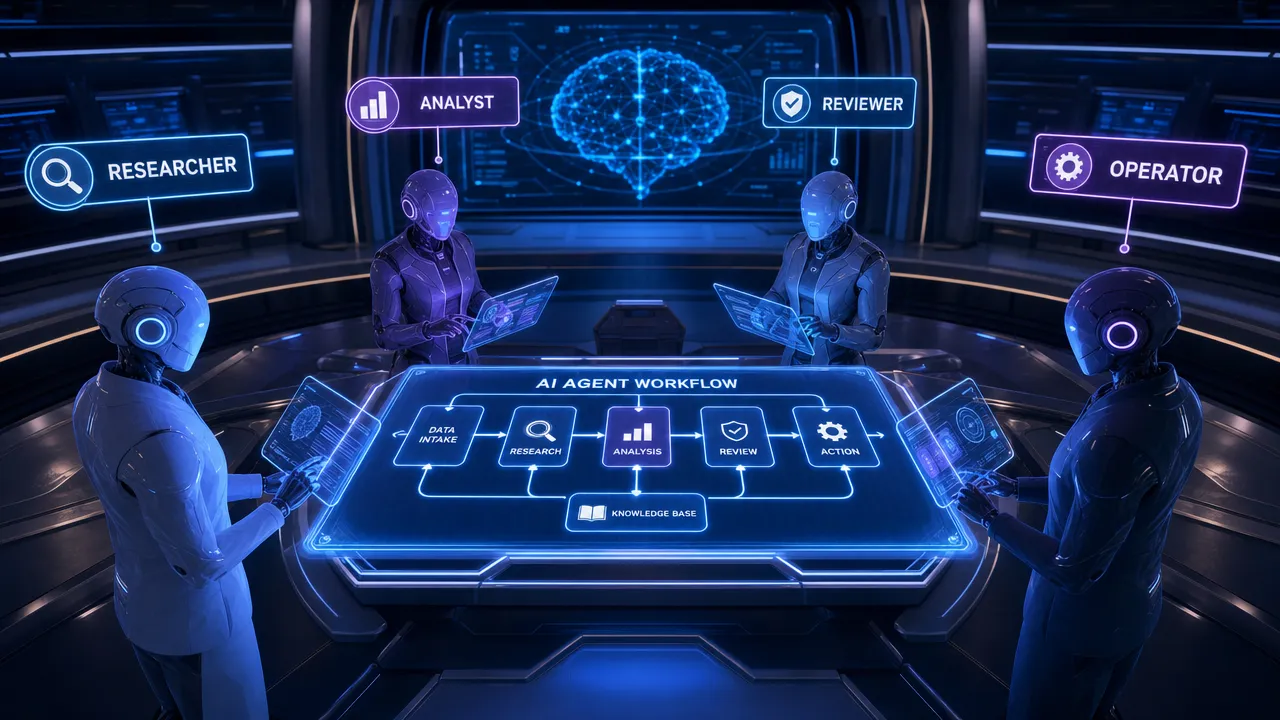
For a fast role-based prototype, CrewAI usually gives the cleaner path. A research agent gathers facts, an analyst interprets them, a writer drafts output, and a reviewer checks quality. That structure is natural in CrewAI. In LangGraph, the same system can be powerful, but it requires explicit state, nodes, edges, routing, and persistence decisions.
| Decision point | Better fit | Why |
|---|---|---|
| Fast multi-agent prototype | CrewAI | Agents, tasks, and crews map directly to the intended workflow. |
| Role-based business process | CrewAI | The framework language mirrors human team structure. |
| Broad LLM orchestration framework | LangChain | It has a wider component and integration ecosystem. |
| Complex stateful execution | LangGraph | Graph state, checkpoints, branching, and durable execution are more explicit. |
| Production tracing and evaluation | LangSmith | The LangChain ecosystem has a dedicated observability layer. |
| AI hardware and software operations | Hybrid | CrewAI can coordinate roles, while graph-based control may be better for telemetry-driven state. |
This is why "CrewAI vs LangChain" should not be reduced to a simple winner-takes-all claim. CrewAI is a sharper AI agent framework for role-based multi-agent work. LangChain and LangGraph are stronger when the application requires broad integrations, complex state, or enterprise-grade observability.
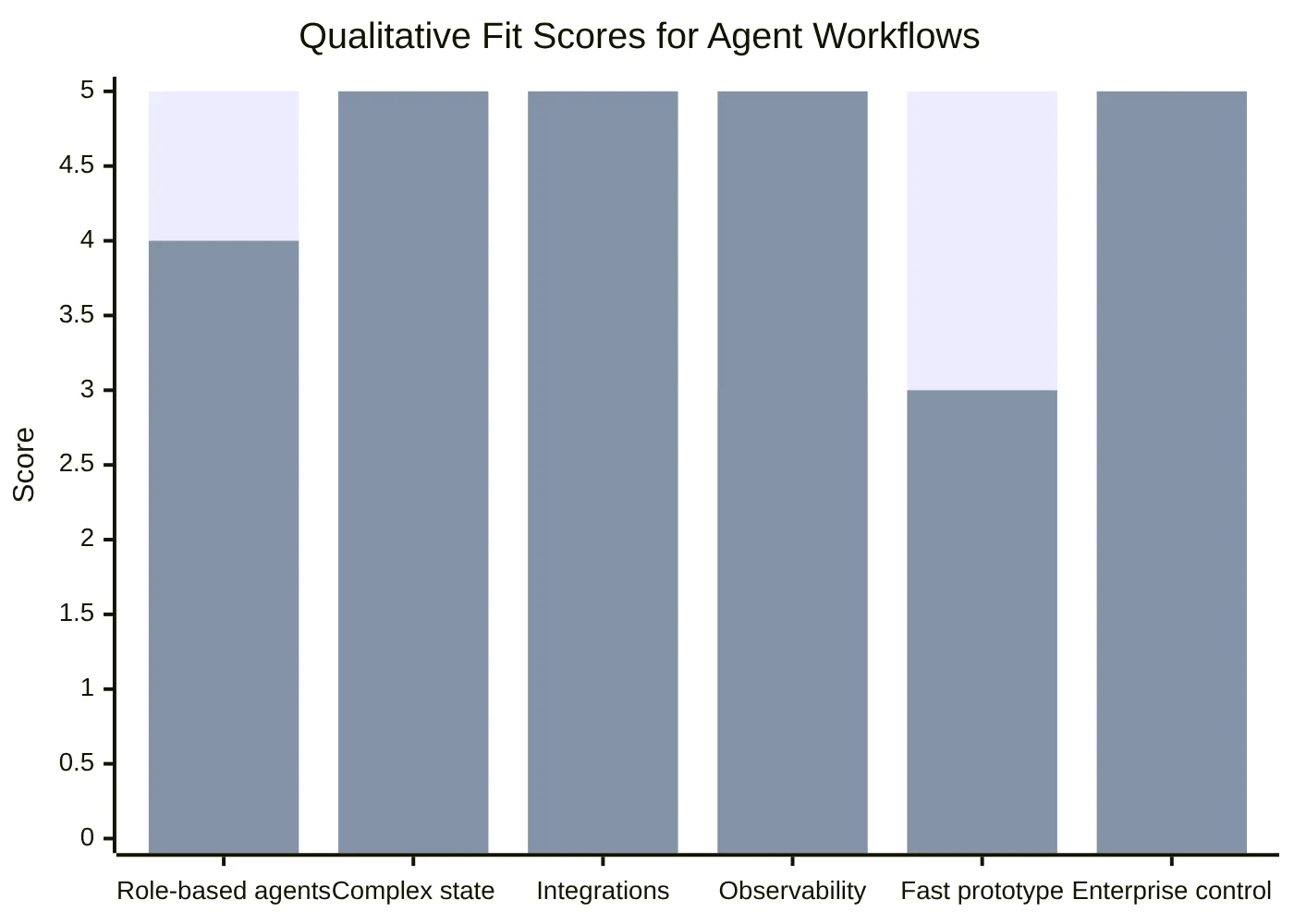
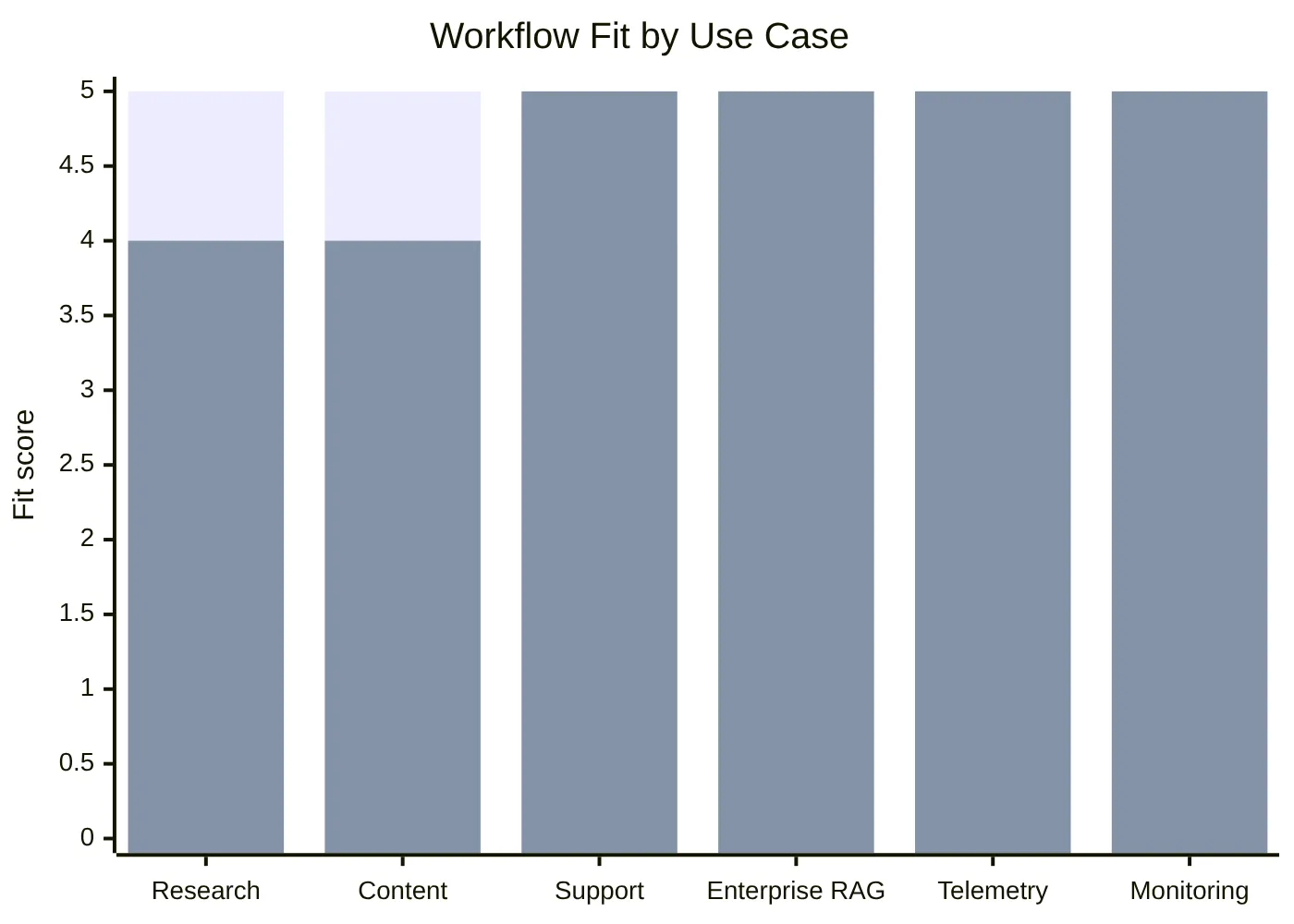
The chart is qualitative, not a benchmark. It reflects the pattern found across official documentation and reputable third-party analysis, including IBM’s discussion of agent framework trade-offs in its comparison of CrewAI, LangGraph, and BeeAI.
CrewAI vs LangChain architecture: Team model vs state graph
The architectural difference is the heart of the CrewAI vs LangChain comparison. CrewAI starts with people-like roles. LangChain starts with reusable LLM application components, and LangGraph adds stateful graph orchestration on top.
CrewAI’s model is simple to explain:
- Define agents with roles, goals, tools, and memory.
- Define tasks with expected outputs.
- Assign tasks to agents.
- Put agents into a crew.
- Run the crew through a process or flow.
LangGraph’s model is more explicit and more programmable:
- Define a shared state schema.
- Define nodes.
- Define edges.
- Add conditional routes.
- Add persistence or checkpointing.
- Compile and run the graph.
- Observe and evaluate behavior.
Neither model is inherently superior. The CrewAI model is better when clarity, delegation, and role boundaries matter more than low-level control. The LangGraph model is better when the workflow must pause, resume, retry, branch, loop, or preserve detailed state over time.

CrewAI’s advantage is cognitive speed. A product manager, support lead, or operations team can often understand a CrewAI workflow just by reading the role names and task descriptions. That is harder with graph code unless the team is already comfortable thinking in state transitions.
LangChain’s advantage is architectural breadth. It is not only an AI agent framework. It also supports retrieval, document processing, tool calling, structured outputs, model abstraction, prompt orchestration, and other building blocks for LLM applications. Its documentation has long emphasized a large integration ecosystem, while independent explainers such as IBM’s overview of LangChain also frame it as a general framework for building LLM-powered applications.
| Architecture layer | CrewAI approach | LangChain/LangGraph approach |
|---|---|---|
| Agent definition | First-class role-based agents | Agents can be modeled through components, nodes, and prompts. |
| Task coordination | Tasks, crews, collaboration, delegation | Nodes, edges, state, and routing logic |
| Workflow shape | Sequential, hierarchical, or flow-based | Graph-based, cyclic, conditional, and resumable |
| Context handling | Memory, task outputs, crew context, knowledge | Shared graph state, persistence, checkpoints |
| Developer burden | Lower for agent-team workflows | Higher upfront, but more control |
| Best mental model | "A team completing work" | "A state machine managing execution" |
For many teams, that mental model difference decides the framework. A multi-agent workflow for content review, support triage, market research, or test reporting does not always need a graph runtime first. It needs reliable role separation, clear task ownership, and understandable handoffs.
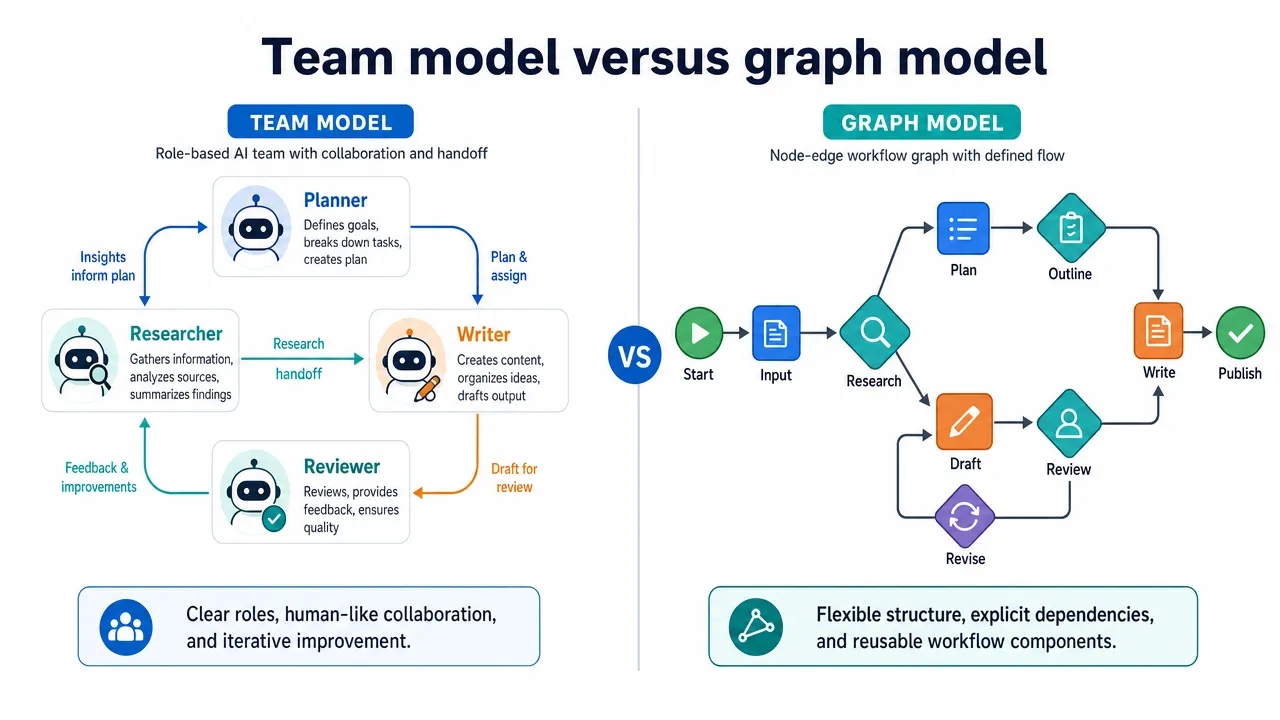
That is the main reason CrewAI often beats LangChain for multi-agent work: it reduces the amount of architecture a team must invent before the first useful agent workflow is running. LangGraph can absolutely model the same collaboration, but it asks the developer to make more structural decisions earlier.
CrewAI vs LangChain agent workflow comparison for real projects
A useful agent workflow comparison should start with the work pattern, not the brand name. CrewAI is strongest when the workflow resembles role-based collaboration. LangChain with LangGraph is strongest when the workflow resembles a controlled system with branching, loops, checkpoints, and long-running state.
Consider a research-to-report workflow. CrewAI can define a researcher, analyst, writer, and reviewer. Each agent has a role and a task. The crew produces a final report. The same workflow in LangGraph would define a shared state object, nodes for research and writing, a review route, and conditional loops when the reviewer rejects the draft.
CrewAI is not less capable just because it is simpler. Its simplicity is the product advantage for many workflows.
| Use case | CrewAI fit | LangChain/LangGraph fit | Recommended choice |
|---|---|---|---|
| Research automation | High | Medium | CrewAI |
| Content pipeline automation | High | Medium | CrewAI |
| Sales or support triage | High | High | CrewAI for prototype, LangGraph for complex escalation |
| Enterprise RAG | Medium | High | LangChain/LangGraph |
| Long-running approval workflow | Medium | High | LangGraph |
| Hardware telemetry triage | Medium | High | Hybrid |
| Documentation generation | High | Medium | CrewAI |
| Production monitoring and evaluation | Medium | High | LangSmith layer |
The "team versus state machine" rule is especially helpful for AI hardware and software companies. A hardware/software operations workflow may include a telemetry triage agent, diagnostic reasoning agent, documentation agent, and QA reviewer. CrewAI is a natural fit for coordinating those roles. But if the workflow must respond to device state, retry failed actions, persist checkpoints, or wait for human approval, LangGraph-style orchestration may be safer.
The point is not that one stack replaces the other. The point is that each framework rewards a different design instinct. CrewAI rewards clear specialization. LangGraph rewards explicit state control.
For a simple support workflow, CrewAI might define:
- A triage agent that classifies the request.
- A knowledge agent that retrieves relevant internal information.
- A response agent that drafts the answer.
- A review agent that checks quality and policy alignment.
For a more complex support workflow, LangGraph may become preferable because the process may need escalation loops, human approval, persistent case state, and conditional routing based on user sentiment, account tier, or risk level.
That is why the best multi-agent framework is often not the one with the most features. It is the one whose abstractions match the first version of the system you actually need to ship.
CrewAI vs LangChain production trade-offs: Integrations, state, and observability
CrewAI’s biggest advantage is role-based orchestration. LangChain’s biggest advantage is ecosystem breadth. LangGraph’s biggest advantage is stateful control. LangSmith’s biggest advantage is observability.
A serious CrewAI vs LangChain opinion must acknowledge where LangChain still wins. The LangChain ecosystem is broader for model providers, retrievers, vector stores, document loaders, tools, and non-agent LLM applications. For enterprise RAG, document intelligence, or existing data stack integration, LangChain often has the stronger starting point.
LangGraph also changes the comparison. Without LangGraph, CrewAI can look far more natural for multi-agent work. With LangGraph, the LangChain ecosystem becomes much stronger for durable agent systems that need persistence, branching, retries, interrupts, and graph state.
LangSmith matters for production because debugging agent systems is not optional. Multi-agent applications can fail in subtle ways: tool misuse, hallucinated assumptions, poor routing, excessive token usage, broken handoffs, or unbounded loops. LangSmith is designed around tracing, evaluation, monitoring, and observability. IBM’s overview of LangSmith describes the platform in that broader lifecycle context.
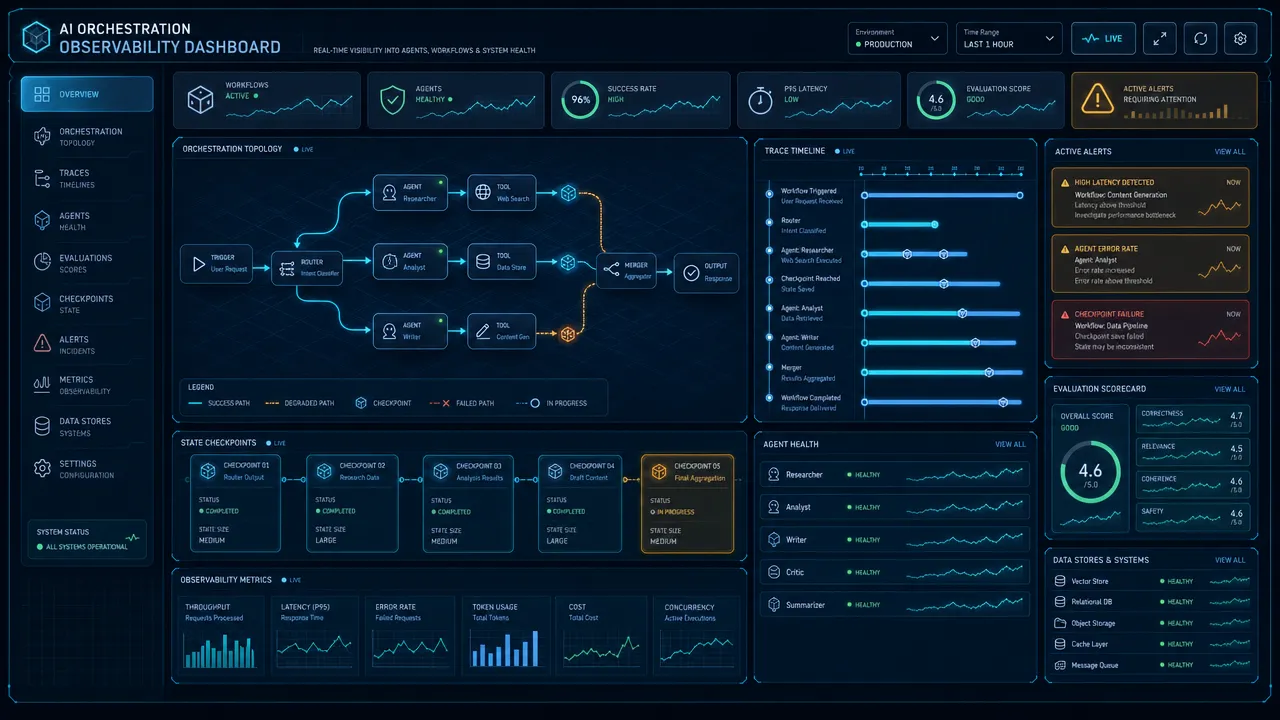
CrewAI also has production-oriented concepts such as flows, memory, tools, guardrails, and observability positioning. The difference is that LangSmith is a more explicit and mature observability product in the LangChain ecosystem. For teams that need dashboards, evaluations, traces, cost visibility, latency tracking, and governance workflows, that advantage is meaningful.
| Production requirement | CrewAI | LangChain/LangGraph/LangSmith |
|---|---|---|
| Fast role-based deployment | Strong | Moderate |
| Complex branching | Moderate | Strong |
| Persistent state | Moderate | Strong |
| Long-running workflows | Moderate | Strong |
| Enterprise integrations | Moderate | Strong |
| Observability and evaluation | Improving | Strong |
| Human approval checkpoints | Possible through workflow design | Strong with graph interrupts and persistence |
| Business readability | Strong | Moderate |
| Low-level control | Moderate | Strong |
The key production question is not "Can CrewAI go to production?" A better question is "What kind of production behavior does the system need?" If the answer is a team-like workflow with clear tasks and limited branching, CrewAI is often enough and easier to maintain. If the answer is a long-running graph with retries, persistent state, and audit-heavy monitoring, LangGraph and LangSmith deserve serious consideration.
This is where some comparisons become misleading. Saying "CrewAI beats LangChain" is true only within a specific context. Saying "LangChain beats CrewAI" is also true in other contexts. The accurate opinion is sharper: CrewAI beats LangChain for many role-based multi-agent workflows because it is purpose-built for agent teams, while LangChain’s ecosystem wins when breadth, state, and observability dominate.
CrewAI vs LangChain decision framework for AI hardware and software teams
AI hardware and software teams should choose the framework based on workflow shape, production constraints, and the level of control required. For a company building agentic systems, the choice may also be hybrid: CrewAI for high-level agent collaboration and LangGraph or equivalent state orchestration for device-aware control flows.
Choose CrewAI when the system needs:
- Clear agent roles.
- Task ownership.
- Delegation between specialized agents.
- Sequential or hierarchical workflows.
- Fast prototyping.
- Business-readable architecture.
- Agent teams for research, documentation, diagnostics, support, or operations.
Choose LangChain with LangGraph when the system needs:
- Complex state transitions.
- Conditional branching.
- Loops and retries.
- Durable execution.
- Persistent checkpoints.
- Human approval at arbitrary points.
- Advanced RAG.
- Broad model, vector store, and data integrations.
- Production tracing and evaluation through LangSmith.
Consider a hybrid approach when high-level work is role-based but low-level execution is stateful. For example, a diagnostic crew might include an intake agent, telemetry analyst, troubleshooting agent, and report writer. CrewAI can coordinate those responsibilities. A graph runtime can manage device state, retry rules, approval checkpoints, and persistent execution.
| Question | If yes, lean toward |
|---|---|
| Can the workflow be described as roles completing tasks? | CrewAI |
| Does the workflow require complex graph routing? | LangGraph |
| Do stakeholders need to understand the system quickly? | CrewAI |
| Does the system need 1000-plus style integration breadth? | LangChain ecosystem |
| Is observability a central requirement from day one? | LangSmith |
| Does the workflow combine human-like collaboration with stateful control? | Hybrid |
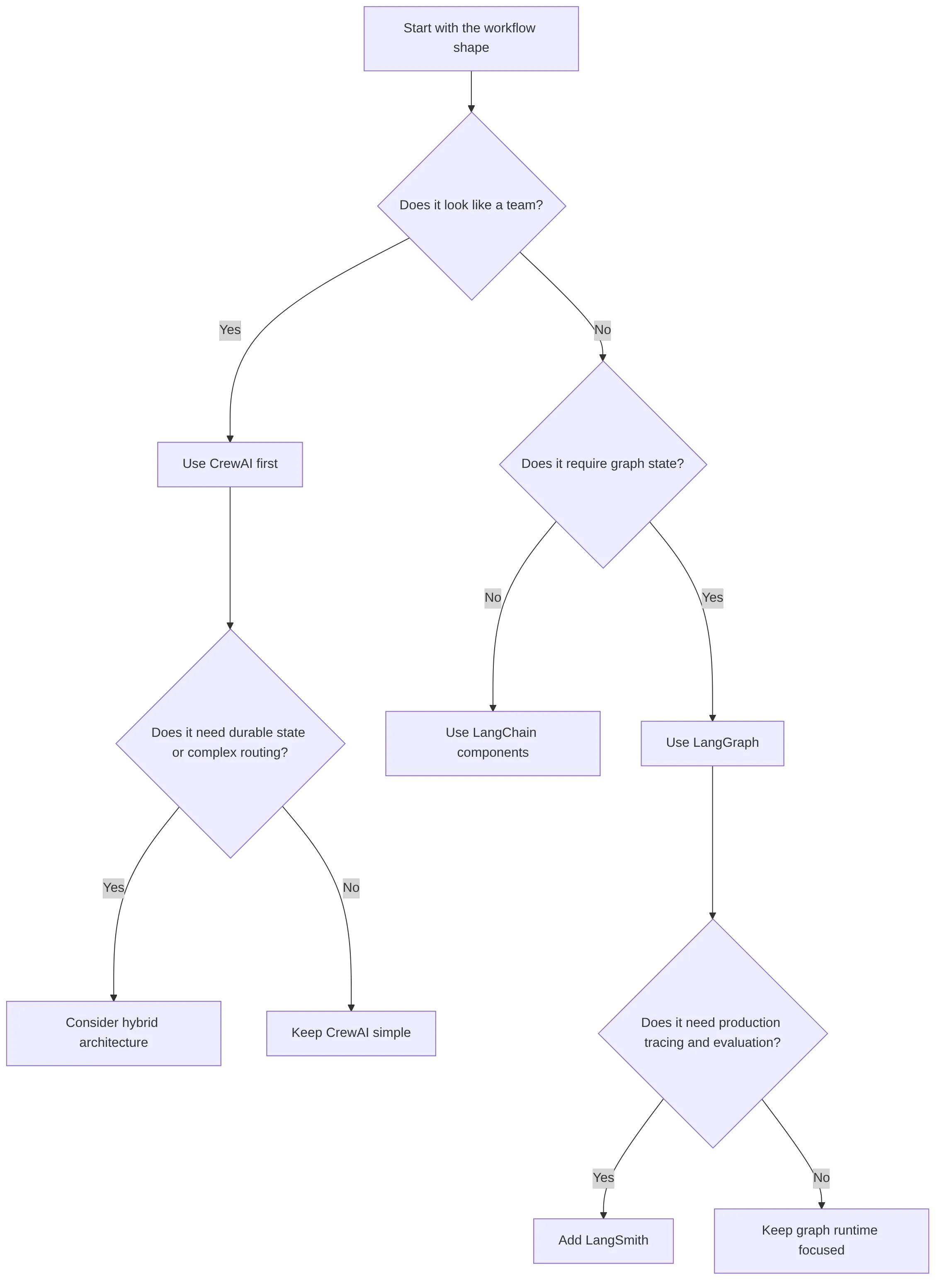
A practical decision tree looks like this:
For aidenai.io’s audience, the most useful takeaway is pragmatic: agent orchestration should serve the operating model of the product, not the other way around. AI hardware and software workflows often combine human-readable roles with machine-level state. That combination is why CrewAI vs LangChain should be treated as an architecture decision, not a popularity contest.
CrewAI is the better starting point when the job is to build a team of agents that can collaborate on bounded tasks. LangChain, especially with LangGraph and LangSmith, is the better stack when the job is to build a deeply integrated, stateful, observable LLM system. The strongest engineering teams will not ask which brand wins every scenario. They will ask which abstraction reduces risk for the workflow in front of them.
The final verdict is clear: CrewAI beats LangChain for many multi-agent workflows because its agents, tasks, crews, and collaboration model make role-based orchestration faster and easier to reason about. LangChain still wins as the broader LLM orchestration framework, and LangGraph still wins when the workflow needs state-machine precision. For AI agent hardware and software teams, the smartest path may be CrewAI for agent teamwork, LangGraph for stateful execution, and strong observability wherever production risk demands it.
Related posts
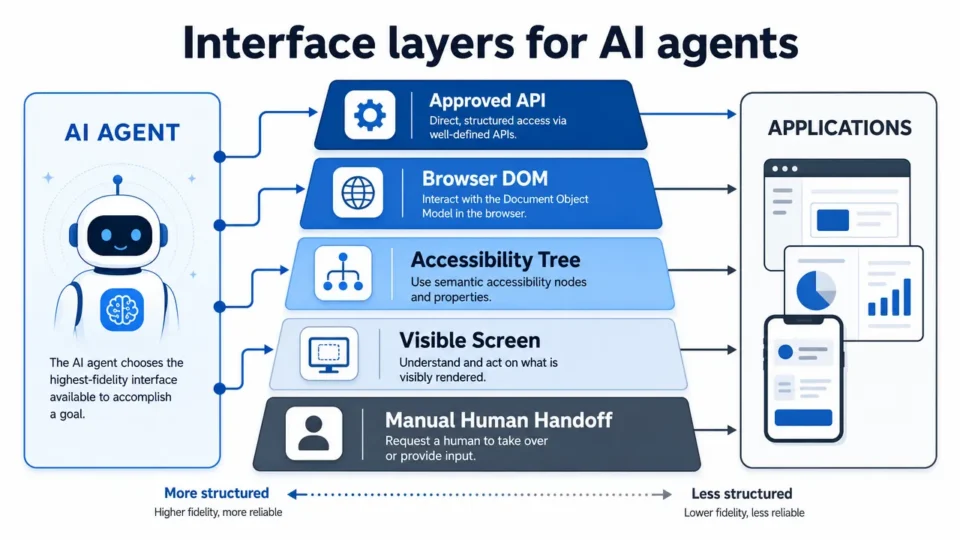
Can AI Agents Use Apps Without APIs? Methods, Trade-Offs and Limits
AI agents for apps without APIs: choose structured UI automation, verify every action, and keep human control for sensitive tasks.
Mobile AI Agent vs Computer-Use Agent: What’s the Difference?
Mobile AI agent vs computer use agent: compare interfaces, architecture, use cases, risks, and selection criteria for GUI automation.
Does Aiden Store Your Data?
Aiden data storage: assess no-backend architecture, provider data flows, local context, and retention gaps before deployment decisions.