Why AI Hardware Keeps Failing — and What an AI Agent Device Should Actually Do
AI hardware keeps failing because many devices sell novelty before they solve a frequent, high-value job better than the smartphone users already trust.
That does not mean the AI agent device category is doomed. It means the bar is higher than "put a chatbot in a gadget." A real AI agent device has to understand context, use tools, ask for permission, act reliably, remember only with consent, and make its physical form factor feel necessary rather than decorative.
Why an AI agent device must earn its place beside the smartphone
The smartphone is not just another device in the user’s pocket. It is the default remote control for modern life: payments, photos, messaging, maps, authentication, documents, entertainment, work apps, and personal identity all live there. Any AI hardware that asks people to buy, charge, carry, wear, and trust another object has to clear a brutal test: does it remove more friction than it adds?
Recent AI hardware struggled because it often failed that test. The Humane AI Pin review from The Verge highlighted a familiar pattern: ambitious vision, premium hardware, but slow interactions, limited usefulness, awkward interface choices, and a difficult comparison against the phone. TechCrunch later reported that HP acquired Humane’s assets and the AI Pin was being shut down, turning a product-readiness problem into a trust problem for the whole category.
The Rabbit R1 launch announcement described a compelling idea: a pocket companion that moves AI "from words to action." That phrase captured what many people want from an agentic AI device. They do not want another place to ask trivia questions. They want AI that can do things: book, compare, summarize, draft, remember, schedule, search, and follow up. But early hands-on criticism focused on whether the device could execute enough real workflows reliably enough to justify carrying a second screen.
This is the core problem with AI hardware: the hardware is visible, but the job-to-be-done is often vague.
An AI device can be interesting. An AI assistant hardware product can be charming. But an AI agent device has to become useful at the exact moment when a phone is too slow, too distracting, too hands-on, or too removed from context.
| Category | What it usually does | Why it is not enough |
|---|---|---|
| AI hardware | Runs, supports, senses, or accelerates AI workloads | It may not directly help a user complete a task |
| AI device | Adds AI features to a physical product | It may only answer questions or summarize content |
| AI assistant hardware | Responds to voice or simple commands | It may lack reliable planning, memory, and tool use |
| Agentic AI device | Uses context, tools, and permissions to complete tasks | This is the real standard an AI agent device must meet |
The phrase "AI agent device" should therefore mean something specific: a physical product that combines sensors, context, memory, reasoning, and tool use to complete user-approved actions. IBM describes AI agents as systems that can autonomously perform tasks on behalf of users or other systems, while Nielsen Norman Group frames an AI agent around goal pursuit, iterative action, progress evaluation, and next-step decisions. Those definitions matter because they separate true agents from voice assistants with better language models.
A chatbot answers. An assistant helps. An agent acts. An AI agent device brings that action into the physical world.
Why recent AI agent device attempts exposed the limits of AI hardware
The first wave of high-profile AI hardware revealed a painful truth: "agentic" language is easier to market than to ship.
Humane AI Pin and Rabbit R1 became shorthand for different versions of the same challenge. Humane leaned into a post-smartphone, screenless wearable future. Rabbit leaned into a lower-cost, AI-native handheld built around action. Both attracted attention because the market was ready for something after chatbots. Both also showed why early AI assistant hardware can disappoint when the real-world experience falls short of the demo.
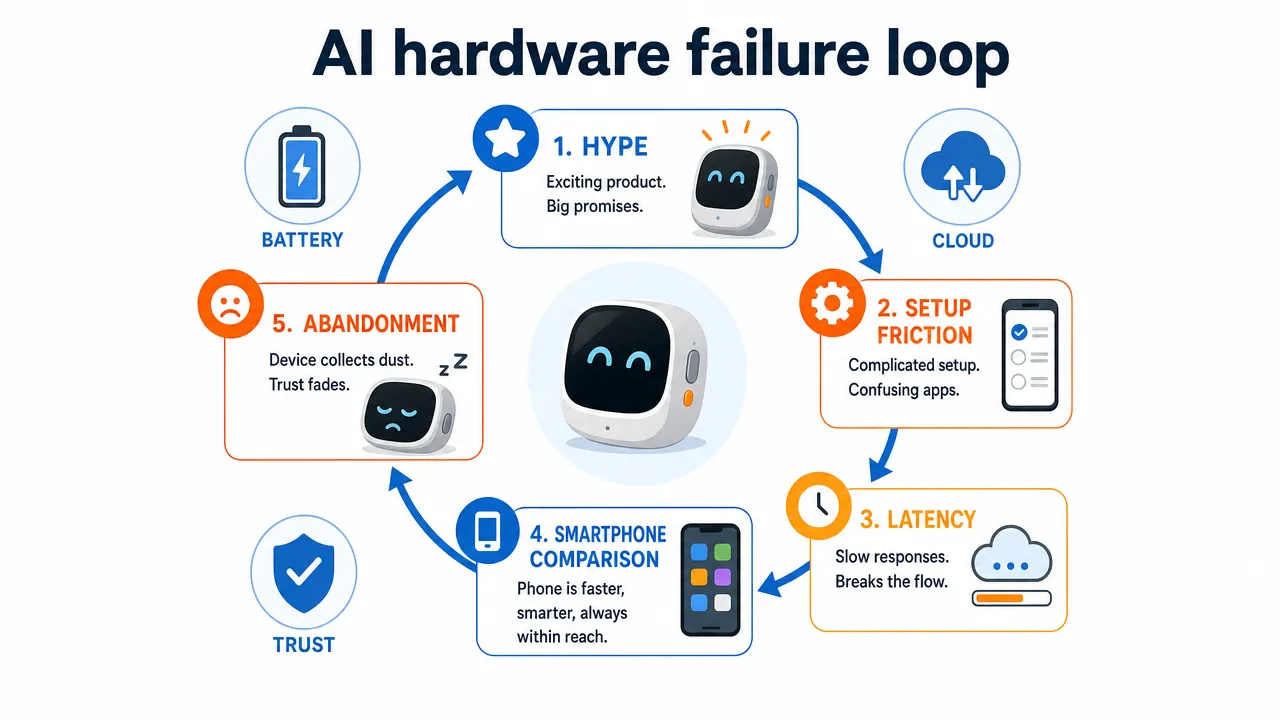
The common failure pattern is not "AI hardware is impossible." The pattern is "AI hardware without a clear, repeatable job fails."
Several issues keep appearing.
First, many AI hardware products overpromise. Demos make complex tasks look clean: order food, book travel, interpret the world, manage apps, remember everything. Real life is messier. Users need comparison, editing, authentication, judgment, payment confirmation, account permissions, and error recovery. A voice-only workflow is fragile when a user needs to review three options, compare prices, or approve a sensitive action.
Second, latency hurts more on dedicated AI hardware. A phone app can feel acceptable if it takes a few seconds because people expect apps to load, switch, and process. A wearable AI device promises immediacy. If it has to capture audio, send it to the cloud, wait for inference, use a tool, return output, and speak the result, the magic disappears quickly. IBM’s edge AI overview is useful here because it explains why processing closer to the device can matter for speed, privacy, and reliability.
Third, battery and heat are not secondary details. They define the product. A small AI device may need microphones, cameras, radios, screens or projection systems, sensors, local processing, and constant connectivity. If the battery cannot support the promised use case, the AI device becomes another object that demands attention.
Fourth, privacy is a product requirement, not a policy-page afterthought. AI assistant hardware often includes cameras, microphones, memory, or ambient capture. That raises obvious questions: when is it recording, who else is captured, how is data stored, can it be deleted, and what happens if the company shuts down? The NIST AI Risk Management Framework and the OWASP Top 10 for Large Language Model Applications both reinforce a broader point: AI systems need governance, security boundaries, transparency, and risk controls, especially when they can access tools or personal data.
Fifth, pricing has to match maturity. Humane’s reported launch pricing of $699 plus a $24 monthly subscription made sense only if the device delivered extraordinary daily value. When reviewers questioned reliability and utility, the price became part of the critique. Rabbit’s $199, no-subscription positioning lowered the barrier, but affordability alone cannot create daily use.
The strongest contrast is not between failed AI hardware and successful AI hardware. It is between gadget-first hardware and job-first hardware. Ray-Ban Meta smart glasses, covered by The Verge’s first look and Wired’s review, did not initially ask users to abandon the phone. They extended a familiar form factor with hands-free capture, audio, calls, and AI features. That is a more modest and more credible entry point.
| Failure driver | How it shows up | Why it damages adoption |
|---|---|---|
| Weak product-market fit | Broad claims without a daily job | Users cannot form a habit |
| Smartphone redundancy | Phone is faster and more flexible | The device feels unnecessary |
| Latency | Cloud-dependent responses feel slow | The promise of immediacy breaks |
| Battery and heat | Charging friction or discomfort | Wearability becomes a burden |
| Privacy uncertainty | Cameras, microphones, and memory feel invasive | Trust collapses before utility is proven |
| Incomplete integrations | The device cannot act across real apps | "Agentic" claims feel hollow |
| Poor confirmation UX | Voice is used for complex decisions | Users fear wrong actions |
What an AI agent device should do beyond answering questions
An AI agent device should not be judged by how futuristic it looks. It should be judged by what it can do under pressure, in context, with the user’s permission.
The most useful AI agent device will probably not start as a universal phone replacement. It will start by winning specific moments where physical presence matters:
- During a meeting, when the user needs notes, decisions, action items, and follow-up drafts.
- During field work, when hands are occupied and a technician needs visual or procedural guidance.
- During travel, when translation, navigation, reminders, and local context need to happen quickly.
- During accessibility use cases, when vision, speech, summarization, and navigation can reduce barriers.
- During focused work, when the user wants help without opening a distracting app.
The difference between an AI assistant and an agentic AI device is controlled action. A useful AI agent device should be able to understand the user’s intent, determine what information is missing, ask clarifying questions, choose tools, prepare an action, request approval when needed, and verify the result.
For example, "remind me to follow up with Jordan" is assistant behavior. "Capture this meeting, identify decisions, draft the follow-up, create tasks, and ask before sending" is agent behavior.
A real AI agent device should do at least five things well.
| Capability | What it means in practice |
|---|---|
| Understand context | Use voice, vision, location, calendar, device state, and user-approved memory to interpret the moment |
| Take action across tools | Connect to calendars, email, documents, messaging, task systems, knowledge bases, and APIs |
| Remember with consent | Store preferences, facts, and history only with clear controls to view, edit, export, or delete |
| Work in real time | Respond fast enough that the device feels present, not remote |
| Keep the user in control | Use permission gates, previews, confirmations, audit trails, and safe fallback |
This is where many AI hardware products lose the thread. They treat voice as the entire interface. Voice is powerful for intent capture, but weak for complex review. If an AI agent device is about to send a message, book a service, change a calendar, delete a file, or make a purchase, the user needs confirmation. That confirmation may happen through a small display, a companion app, a paired phone, a desktop handoff, haptics, or a clear audio summary. The point is not the screen size. The point is control.
An agentic AI device also needs memory, but memory must be permissioned. A device that remembers everything without strong controls will feel invasive. A device that remembers nothing will feel generic. The right model is explicit: "remember this preference," "forget that meeting," "show what you know about this project," "delete my last recording," and "do not use this for future suggestions."
Privacy is especially important for ambient AI hardware. Devices like meeting pendants and smart glasses raise bystander-consent questions because they can capture people who did not buy the device. The Limitless Pendant FAQ and Ray-Ban Meta privacy information illustrate how much explanation users now expect around recording indicators, data handling, and privacy controls.
The strongest AI agent device experience is not "always autonomous." It is bounded autonomy: the agent can act independently only inside user-approved limits.
| Action type | Appropriate autonomy level |
|---|---|
| Set a timer or create a draft note | Can be automatic |
| Summarize a meeting for the user | Can be automatic if consented |
| Send an email to a client | Should require review |
| Book travel or make a purchase | Should require explicit approval |
| Delete files or change shared documents | Should require strong confirmation |
| Access sensitive personal data | Should require granular permission |
The safest principle is simple: no action is better than the wrong action. An AI agent device should ask when uncertain, explain when acting, and recover gracefully when something fails.
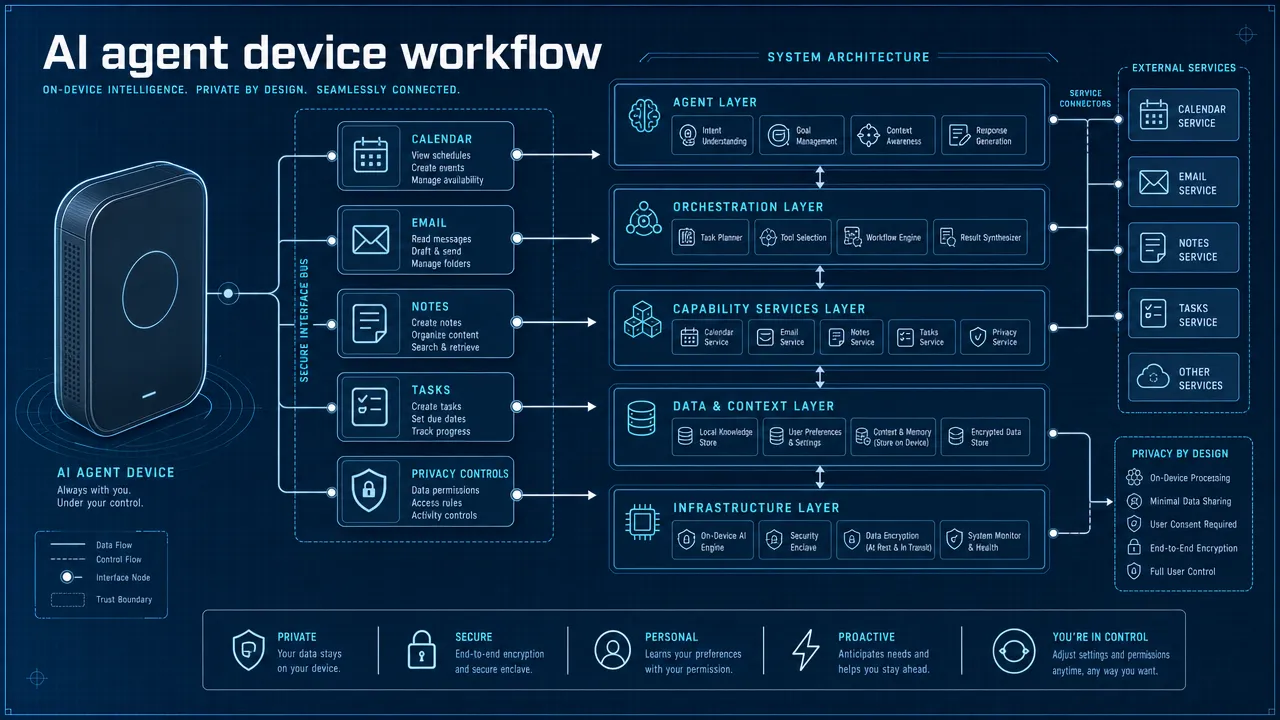
How AI agent device architecture should balance context, action, and consent
A credible AI agent device is not a standalone gadget. It is a layered system. The device is only the visible endpoint; the product experience depends on sensors, models, memory, permissions, integrations, security, and feedback loops working together.
At a high level, the architecture should include:
- Sensors and input: microphones, camera where appropriate, touch, buttons, motion, location, and companion app input.
- Local context engine: wake detection, speech recognition, simple intent routing, device state, and environmental awareness.
- Memory layer: user-approved preferences, projects, relationships, tasks, and interaction history.
- Reasoning and planning layer: goal interpretation, task decomposition, clarification, and risk assessment.
- Tool and action layer: connectors to calendars, email, documents, messaging, task systems, enterprise systems, and APIs.
- Permission and consent layer: access rules, action approvals, memory controls, audit logs, and safety policies.
- Feedback interface: voice, display, haptics, lights, companion app, and status notifications.
- Hybrid inference layer: on-device AI for private or fast tasks, cloud AI for heavier reasoning when appropriate.
The hard part is not drawing this architecture. The hard part is making it dependable in real use.
An AI agent device needs tool access, but tool access creates security risk. The more an agent can do, the more carefully its permissions must be designed. OWASP’s guidance on LLM application risks is relevant because tool-using agents can be vulnerable to prompt injection, data leakage, excessive agency, and insecure output handling. A malicious document, email, webpage, or message could try to manipulate the agent. A responsible device must separate instructions from untrusted content, limit tool permissions, and require human approval for sensitive actions.
Hybrid AI also matters. Fully cloud-dependent AI hardware risks latency, outages, and privacy concerns. Fully on-device AI can be faster and more private, but small hardware has power, heat, and model-size constraints. The practical path is hybrid: run simple, private, time-sensitive tasks locally; route complex reasoning to cloud systems with clear user consent and status feedback.
A meeting workflow shows how this should work:
This is what "agentic" should mean in hardware: the device is present in the moment, but the agent remains accountable to the user.
For teams building in this space — including Aiden — the opportunity is not to promise magic. The opportunity is to make the contract with users clearer: here is what the device can sense, here is what it can remember, here is what it can do, here is when it asks, and here is how you stay in control. Aiden’s approach pushes this further on the form-factor question: rather than asking people to buy, carry, and charge another standalone gadget that competes with the phone, it plugs into the phone or computer the user already owns and operates it directly — seeing the screen and sending input the way a person does. Its firmware is open-source and self-hostable, which turns the privacy and "what happens if the company shuts down" questions into concrete answers rather than promises. (It currently runs on a development board, built in the open.)
That kind of transparency may not sound as exciting as "replace your phone." It is more credible.
What buyers should demand from the next AI agent device
Buyers should demand proof, not vibes. A polished demo is not enough, because AI hardware often looks best in controlled conditions and worst in daily ambiguity.
Before trusting an AI agent device, users should ask seven questions.
| Buyer question | Why it matters |
|---|---|
| What specific job does this AI device solve better than my phone? | Prevents novelty purchases |
| What can it actually do today, not in a future update? | Separates shipped capability from roadmap claims |
| Which actions require my approval? | Protects against unsafe autonomy |
| What data does it capture, store, and remember? | Clarifies privacy risk |
| Can I delete, export, or edit memory? | Gives the user control |
| What happens when the network is poor? | Tests cloud dependency |
| What happens if the company shuts down the service? | Tests long-term trust |
The best future AI agent device may not be a phone killer. It may be a meeting companion, field-work assistant, accessibility device, smart glasses layer, enterprise badge, desk assistant, or personal memory tool. The winning form factor will depend on the job.
Pendants may fit conversation capture. Glasses may fit visual context. Badges may fit workplace workflows if privacy and labor concerns are handled responsibly. Handheld devices may work for experimentation, but they face the harshest smartphone comparison. Desk devices may work when persistent work context matters more than mobility. And an agent that plugs into and operates the phone a user already carries can sidestep the second-device problem entirely — there is nothing new to buy into, charge, or learn, because the interface is the phone itself.
The chart is qualitative, but the hierarchy is real. Novelty gets attention. Reliability earns habits. Privacy earns trust. Tool access creates usefulness. Latency determines whether the device feels intelligent or remote. Battery determines whether it stays in the user’s life.
The next wave of AI hardware should therefore avoid three traps.
First, it should avoid "phone replacement" language unless it can truly replace core phone workflows. Most AI assistant hardware cannot. A more realistic goal is to reduce phone dependence in specific moments.
Second, it should avoid "do anything" claims. Agents are most useful when their scope is clear. A bounded agent that reliably manages meeting follow-ups is more valuable than a universal agent that fails half the time.
Third, it should avoid hidden data practices. Ambient AI hardware lives in social spaces. Recording indicators, consent flows, memory controls, deletion tools, and audit logs are not compliance decorations. They are part of the user experience.
A useful AI agent device should feel less like a gadget and more like a trusted action layer. It should know when to listen and when not to. It should know when to act and when to ask. It should know when the phone, desktop, or human judgment is the better interface. It should make the user’s life calmer, not more complicated.
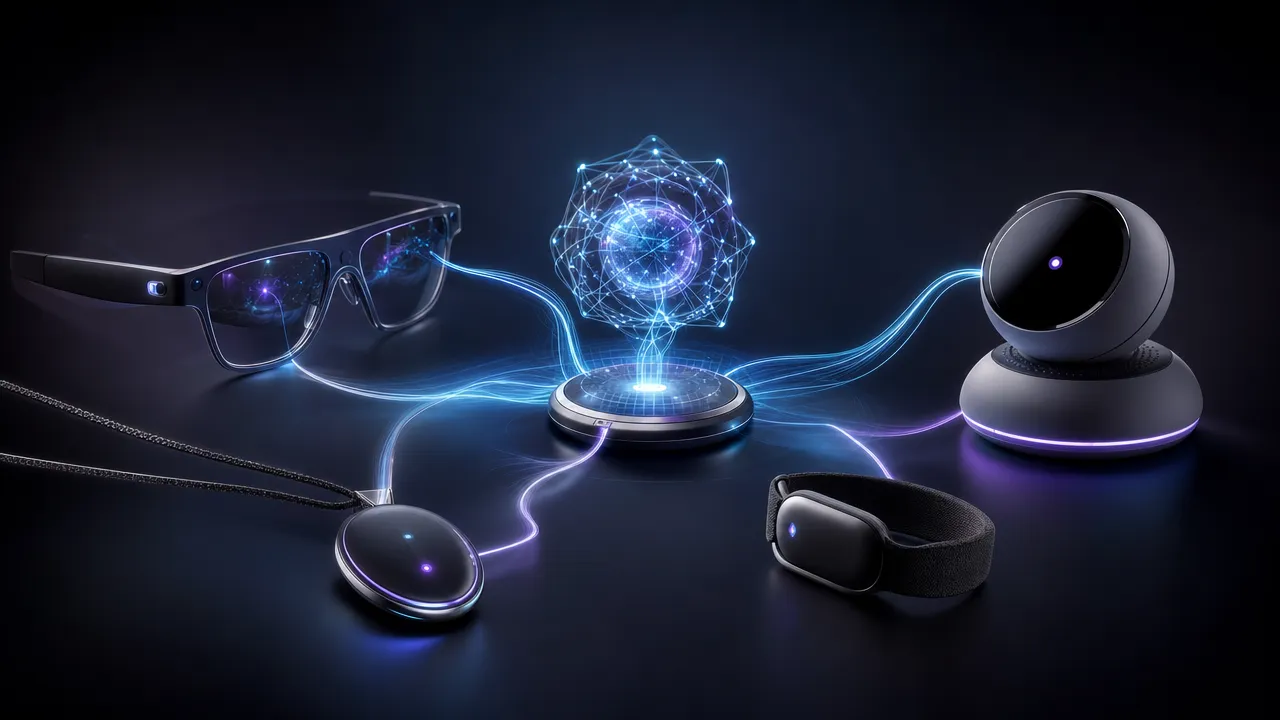
This is the position Aiden is built around: an AI agent should be agent-first, not gadget-first — built on context, consent, action, and reliability. Rather than asking users to believe in a post-smartphone future, an agent that operates the phone they already use can earn a place in their routine today, while standalone AI agent phones remain years away.
The future of AI hardware belongs to products that solve real jobs, respect user control, and make agentic AI practical in the moments where a screen is not enough.
Frequently asked questions
Why does AI hardware keep failing?
Most failed AI hardware sold novelty before it solved a frequent, high-value job better than the smartphone. When a device asks people to buy, carry, charge, and trust another object without removing more friction than it adds, it gets compared to the phone and loses.
What makes something a true "AI agent device" rather than an AI assistant?
An assistant answers questions and executes simple commands. An agent device understands context, plans, uses tools, asks for permission, completes user-approved actions, and verifies the result — bringing that action into the physical world reliably, not just in a demo.
Do I need a separate device, or can an AI agent work on the phone I already have?
You do not necessarily need a new gadget. An agent that plugs into and operates the phone or computer you already own avoids the "second device" problem entirely — there is nothing extra to carry or charge, and the interface is the device you already trust.
What should I ask before buying an AI agent device?
What specific job does it do better than my phone; what can it do today versus in a future update; which actions require my approval; what data it captures and stores; whether I can delete or export that memory; how it behaves on a poor network; and what happens if the company shuts the service down.
Are AI agent devices private and safe?
It depends on the design. The safest options are transparent about recording, keep the user in control with permission gates and approvals for sensitive actions, and — at the strongest end — are open-source and self-hostable so their behavior can be audited and your data stays under your control.
Related posts
Why CrewAI beats LangChain for multi-agent work
CrewAI vs LangChain compared by workflow shape, showing when role-based agents beat graph orchestration for multi-agent systems.
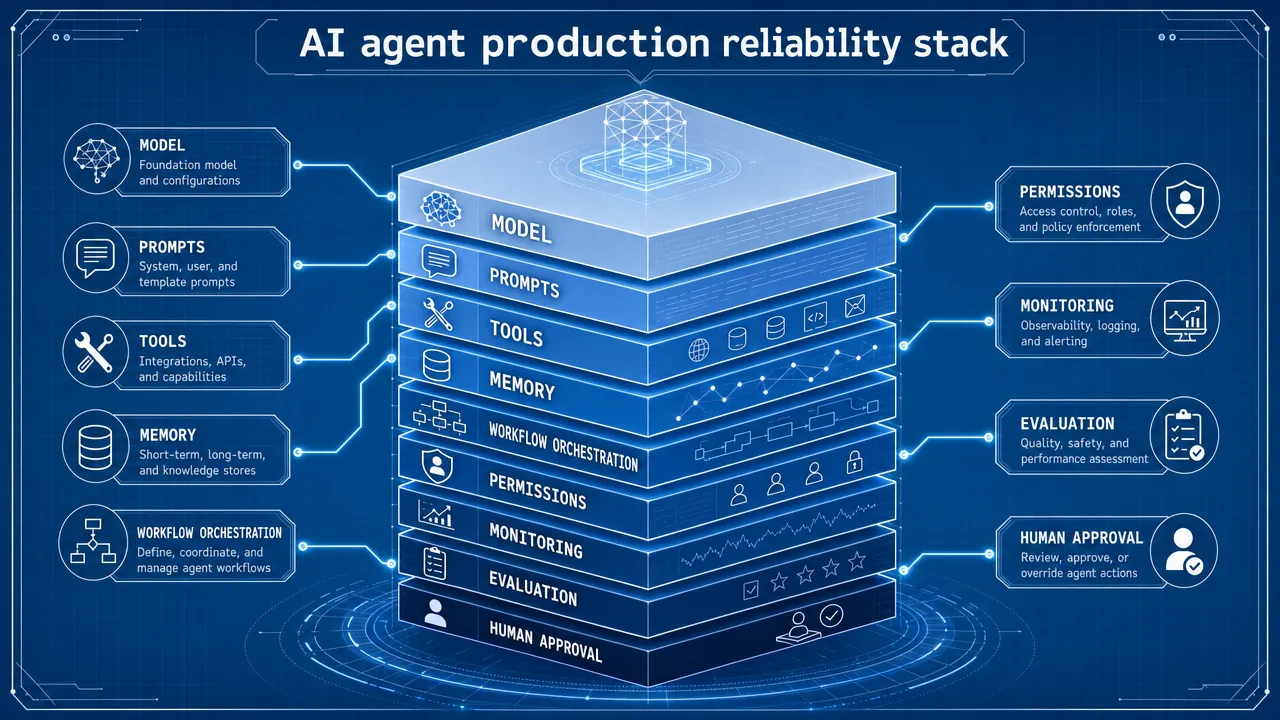
Why Most AI Agents Fail in Production (And the 3 Patterns That Actually Work)
Why AI agents fail in production: a workflow-first method for evaluating tools, security, monitoring, and human approval gates.
How to Build an AI Agent for Your Business Without Writing Code in 2026
Build AI agent business no code 2026 with a workflow-first framework for data access, approvals, risk controls, and ROI tracking.