Why Every Startup Needs an AI Agent Strategy in 2026 — Not Just AI Tools

Meta title: AI Agent Strategy for Startups: Why 2026 Requires More Than AI Tools
Meta description: Learn why startups need an AI agent strategy for startups in 2026, how AI agents differ from AI tools, where to automate operations, and how to manage ROI, security, and governance.

Startups need an AI agent strategy in 2026 because scattered AI tools create isolated pockets of productivity, not a durable operating advantage — turning AI into a real system means deciding which workflows to automate, what data agents can touch, and who approves the results.
Startup AI usage today often lives in scattered chats, browser extensions, meeting tools, writing assistants, coding copilots, and one-off automations. That can feel productive in the moment, but it rarely becomes a durable operating advantage.
In 2026, the better question is not, "Which AI tool should we buy next?" It is, "What is our AI agent strategy for startups, and how will it change how work gets done?"
That distinction matters. AI tools help individuals complete tasks. AI agents can coordinate multi-step work toward a goal, use tools, retrieve context, interact with systems, and escalate to humans when needed. IBM describes AI agents as systems that can work toward tasks on behalf of a user or system, while AWS frames agentic AI as goal-driven systems that reason, act, and adapt in complex environments.
For startups, this is not just a technical shift. It is an operating model shift. A serious startup AI strategy should decide which workflows deserve automation, which systems agents can access, who approves important actions, how results are measured, and how risk is controlled.
Aiden is defined by the provided client context as an AI agent hardware and software technology company. This article therefore discusses AI agent infrastructure and hardware/software-connected workflows in general terms only. It does not make unverified claims about specific products, features, pricing, customers, or geographic coverage.
AI agent strategy for startups starts with workflow design, not tool collection
An AI agent strategy for startups is a practical plan for using AI agents to improve business workflows, not just individual productivity. It defines where agents should operate, what data they can use, what actions they can take, where humans remain in control, and how success is measured.
A simple definition:
An AI agent strategy for startups is a roadmap for turning AI from isolated task assistance into supervised, integrated, measurable workflow execution across the startup’s operations.
That means a founder should not begin with a list of trendy tools. The starting point should be business friction:
- Where does the team repeat the same work every week?
- Which workflows depend on copying information between systems?
- Where do customers wait too long for a response?
- Which founder decisions are bottlenecked by missing context?
- Which teams spend time cleaning data instead of acting on it?
- Which tasks are high-volume, rule-bound, and still require judgment?
This is why startup AI strategy must be broader than experimentation. A chatbot may help a founder draft an investor update. A meeting summarizer may save a few minutes after calls. A coding copilot may accelerate engineering. All of that matters. But the real leverage appears when AI agents for startups are designed into workflows such as support triage, CRM updates, sales follow-up, product feedback synthesis, financial reporting, recruiting coordination, and internal knowledge retrieval.
The shift is similar to the difference between buying apps and designing an operating system. Random AI adoption creates islands of productivity. An AI agent strategy creates a shared system of execution.
| Strategic question | AI tool mindset | AI agent strategy mindset |
|---|---|---|
| Starting point | "What tool should we try?" | "Which workflow is slowing us down?" |
| Main user | Individual contributor | Team or function |
| Primary value | Faster task completion | Faster business throughput |
| Data flow | Manual copy and paste | Integrated systems and APIs |
| Human role | Operator | Supervisor, approver, exception handler |
| Measurement | Usage and subjective satisfaction | Time saved, cycle time, quality, cost per workflow |
| Risk control | Informal | Permissions, logs, approvals, governance |
The reason 2026 matters is that agentic AI is moving from demos into mainstream business systems. Small businesses are also experimenting heavily with AI, but production maturity is uneven. JP Morgan Chase Institute notes a gap between survey-reported small-business AI use and more fully integrated or paid AI use. That gap is where strategy becomes decisive.
The strategic direction runs from individual productivity toward integrated execution: chat use gives way to point tools, then workflows, then supervised agents, then a full agent strategy.
AI agent strategy for startups clarifies AI tools vs AI agents
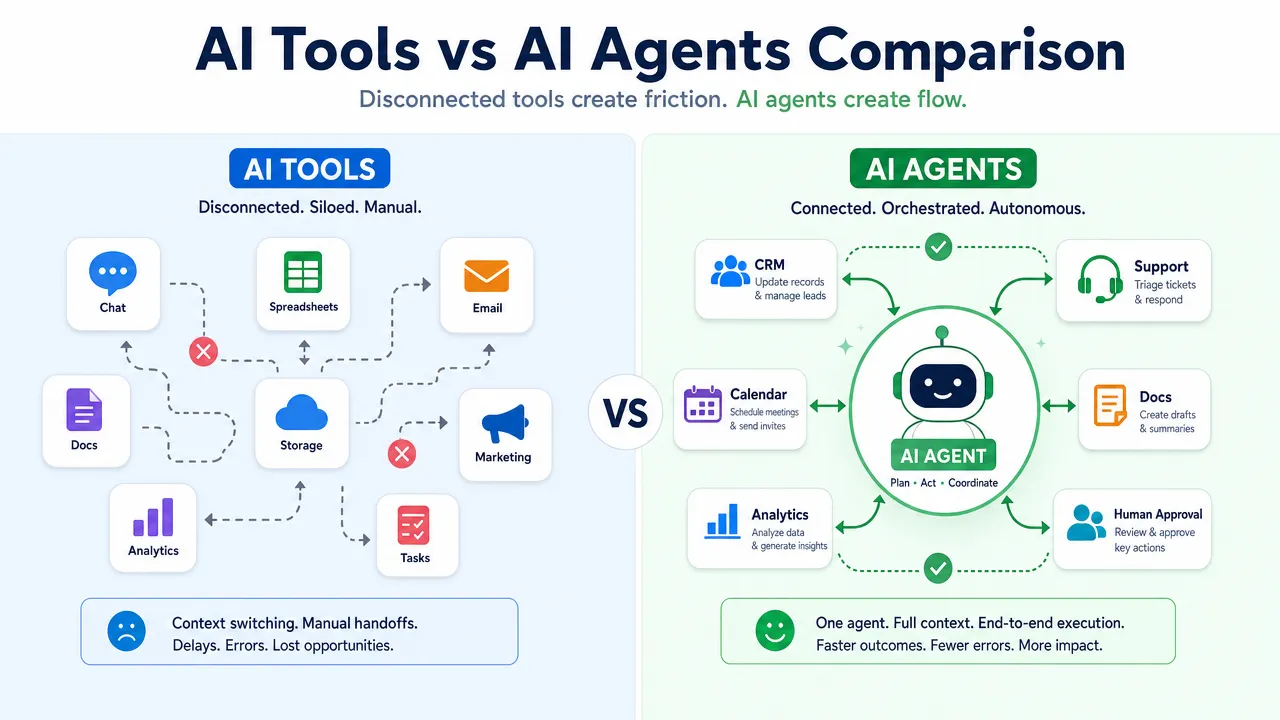
The phrase "AI tools vs AI agents" is not just terminology. It changes how founders budget, govern, measure, and design work.
AI tools are usually task-specific. They help a human write, summarize, code, analyze, search, or brainstorm. The human still knows the goal, triggers the work, moves the output into another system, checks the result, and decides the next step.
AI agents are different. They can be given a goal or trigger, break work into steps, use tools or APIs, retrieve relevant context, update systems, and ask for human approval when a decision crosses a defined threshold. The level of autonomy can vary, but the strategic point is the same: agents are designed around workflows, not isolated prompts.
| Dimension | AI tools | AI agents |
|---|---|---|
| Primary role | Assist with a task | Execute a workflow toward a goal |
| Interaction model | Prompt-by-prompt | Trigger-based or goal-based |
| Autonomy | Low | Medium to high, depending on permissions |
| Workflow scope | Single task | Multi-step process |
| System access | Usually limited | Can connect to APIs, databases, apps, or devices |
| Human role | Direct operator | Reviewer, approver, escalation owner |
| Startup example | Draft a cold email | Research lead, draft email, update CRM, request approval |
| Main risk | Poor output quality | Unauthorized or incorrect action |
| Strategy required | Useful | Essential |
Consider sales. A writing assistant can draft a prospecting email. That helps. But an agentic workflow might identify a target account, research recent company news, compare the account to ideal customer criteria, prepare a personalized message, update the CRM, schedule a reminder, and ask a sales rep for approval before sending. That is not just content generation. It is workflow orchestration.
Consider support. A chatbot can answer a customer question. An agent can classify a ticket, retrieve relevant documentation, check customer history, draft a response, detect urgency, route the case to the right person, and log the outcome. Again, the value is not just speed. It is operational consistency.

This distinction also explains why buying more tools can create less clarity. A startup may end up with one AI tool for meetings, another for writing, another for support, another for code, another for CRM, and another for analytics. Each one may be useful, but none may share context or accountability.
A real AI implementation strategy asks different questions:
- Which systems should become sources of truth?
- Which workflows should agents observe or execute?
- Which actions require human approval?
- Which data should never leave approved environments?
- Which teams own agent performance?
- Which metrics decide whether a pilot scales or shuts down?
The best early deployments are not fully autonomous. They are supervised. Human-in-the-loop AI gives startups the benefit of automation while keeping accountability clear.
AI agent strategy for startups enables startup operations automation
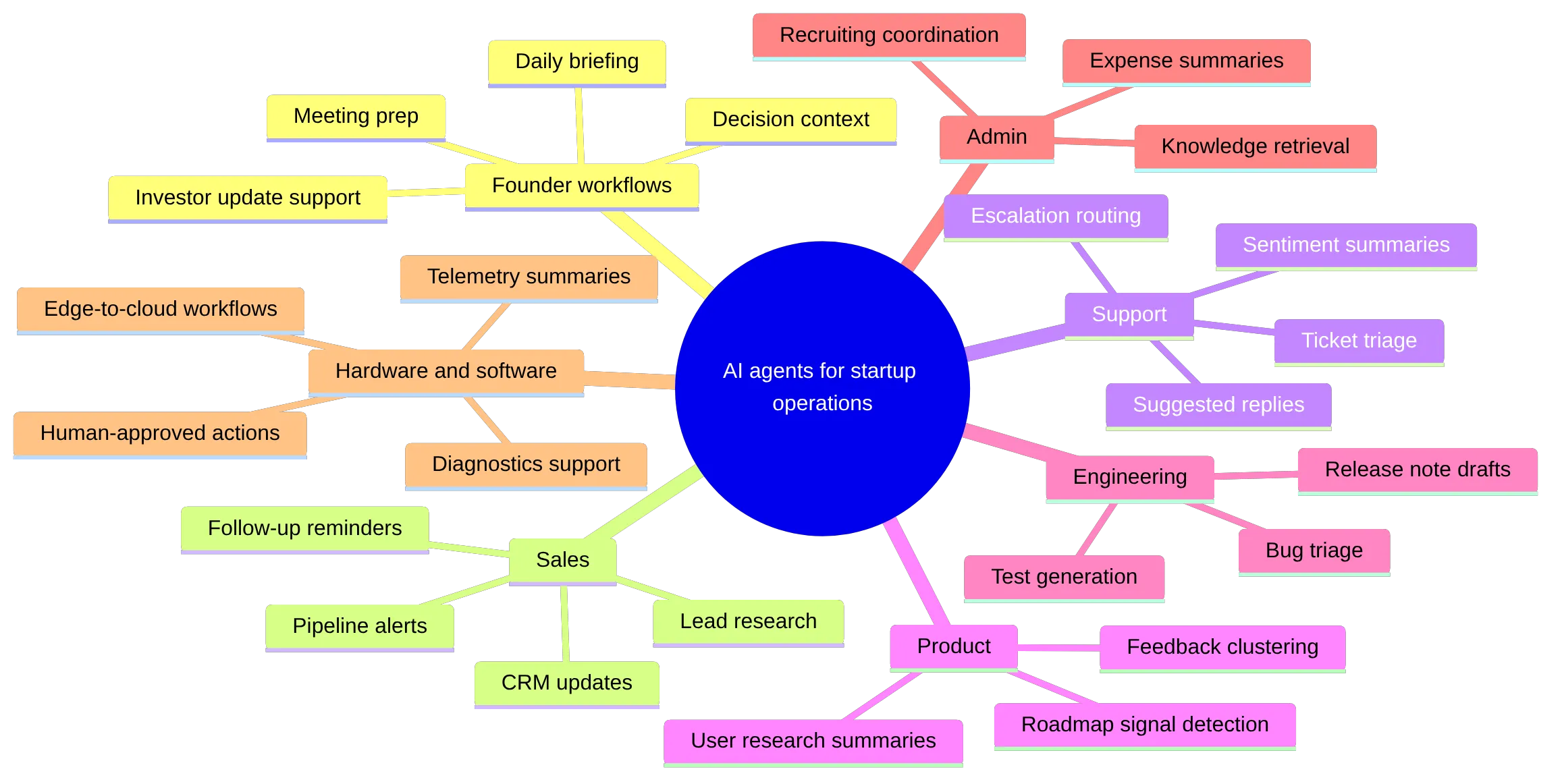
The most useful AI automation for startups usually begins in workflows that are repetitive, data-heavy, time-sensitive, cross-system, and easy to review. The goal is not to replace the team. The goal is to remove avoidable coordination work so the team can focus on judgment, customers, product, and growth.
For lean startups, startup operations automation can be especially valuable because small teams often carry too many functions at once. A founder may act as CEO, head of sales, recruiter, customer support escalation owner, product strategist, and investor relations lead in the same week. AI agents can reduce some of that routing burden.
High-potential areas include:
| Startup workflow | Agent role | Human oversight |
|---|---|---|
| Founder daily briefing | Summarize calendar, messages, tasks, KPIs, and risks | Founder reviews priorities |
| Sales prospecting | Research leads, enrich accounts, draft outreach, update CRM | Sales approves outbound messages |
| CRM hygiene | Extract call notes, next steps, and deal status updates | Sales manager spot-checks records |
| Customer support triage | Classify tickets, suggest replies, route escalations | Support reviews sensitive responses |
| Marketing research | Track market themes, prepare briefs, summarize search trends | Marketer validates sources and claims |
| SEO content operations | Convert research into outlines, briefs, FAQs, and metadata | Editor approves final content |
| Product feedback synthesis | Cluster support tickets, calls, and survey feedback | Product manager validates roadmap signals |
| Engineering triage | Summarize bugs, suggest reproduction steps, generate tests | Engineer reviews all code and tests |
| Recruiting coordination | Schedule interviews and summarize candidate materials | Hiring manager makes decisions |
| Finance and admin | Categorize expenses and prepare exception reports | Finance owner approves records |
| Knowledge management | Retrieve SOPs, decisions, policies, and product docs | Owners maintain source documentation |
| Hardware/software workflows | Summarize telemetry, support diagnostics, or edge-to-cloud events | Engineer or support lead approves actions |
For an AI agent hardware and software technology company, the hardware/software angle is strategically important, but it must be discussed carefully. In general, AI agents may eventually connect physical devices, edge data, cloud software, support systems, and human approval processes. Examples include device telemetry summarization, field diagnostics, anomaly detection, support ticket enrichment, and human-approved device-related actions. These scenarios require stronger safety, reliability, and access-control standards than ordinary office automation.
A practical prioritization method is to score each use case across value, risk, complexity, frequency, and data readiness.
| Score factor | Best early candidate | Poor early candidate |
|---|---|---|
| Business value | Saves time or improves customer speed every week | Interesting but rarely used |
| Risk | Low customer, legal, financial, or safety impact | High-impact decisions with weak oversight |
| Complexity | Uses a few clean systems | Requires many messy integrations |
| Frequency | Repeats often | One-off executive task |
| Reviewability | Easy for a human to check | Hard to verify before consequences occur |
| Data readiness | Uses maintained docs and structured records | Depends on stale, scattered, or restricted data |
In other words, do not automate the riskiest workflow first. Start with workflows where the agent can prepare, classify, summarize, retrieve, draft, or recommend, while a person approves the final action. This builds trust and produces measurable startup productivity with AI before moving into more autonomous execution.
AI agent strategy for startups requires governance, data, and an implementation roadmap
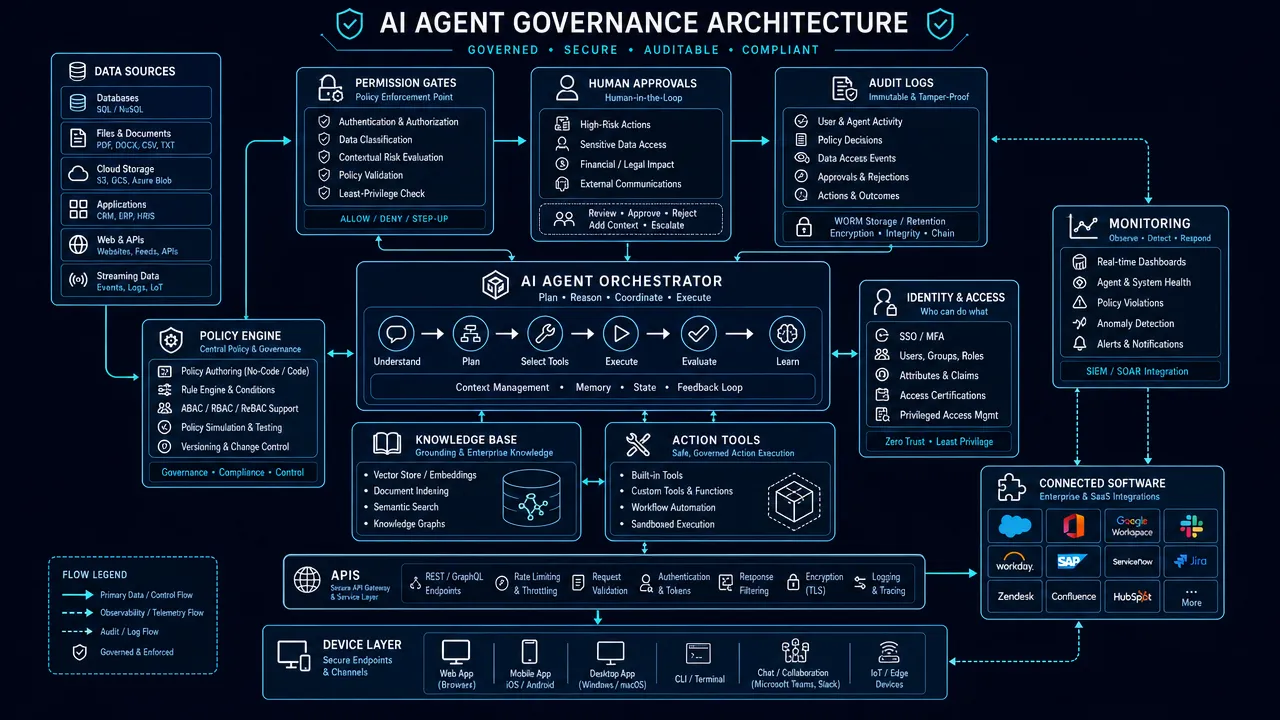
An AI agent strategy for startups succeeds or fails on operational foundations. If a startup lacks clean data, clear permissions, workflow owners, and success metrics, agents may simply make messy systems move faster.
The foundation includes six requirements.
| Requirement | Why it matters | Practical startup move |
|---|---|---|
| Clean knowledge base | Agents need reliable source material | Assign owners for docs, SOPs, policies, and product information |
| System integrations | Agents need access to actual workflows | Prioritize CRM, helpdesk, email, calendar, docs, analytics, and project tools |
| Permission controls | Agents should not have broad access by default | Use least privilege, scoped credentials, and role-based access |
| Human approval gates | Important actions need accountability | Require approval for outbound emails, customer-impacting decisions, payments, code changes, and device actions |
| Logging and observability | Teams need to know what agents did and why | Track prompts, tool calls, approvals, errors, and costs |
| Evaluation datasets | Quality must be tested repeatedly | Build examples of good support replies, CRM updates, reports, and edge cases |
Security cannot be an afterthought. OWASP’s Top 10 for LLM Applications identifies risks such as prompt injection, sensitive information disclosure, insecure plugin or tool design, excessive agency, overreliance, and model denial of service. These are especially relevant when agents can access systems, credentials, customer data, or operational tools.
NIST’s AI Risk Management Framework is also useful because it frames AI risk management around governance, mapping, measurement, and management. Even small teams benefit from that discipline. A five-person startup does not need enterprise bureaucracy, but it does need clarity about who owns the agent, what the agent can do, and how incidents are handled.
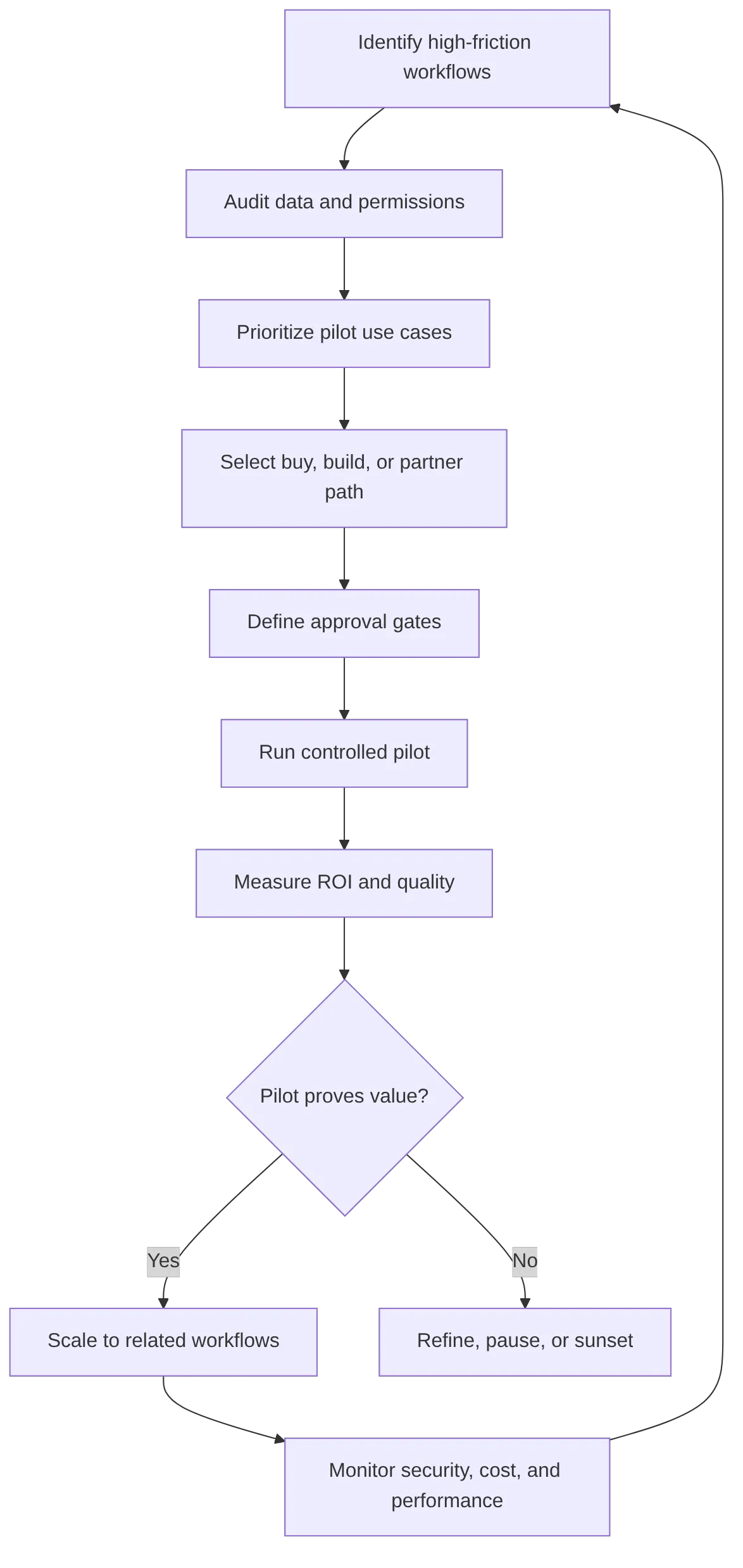
A practical 2026 AI implementation strategy can follow this sequence:
- Identify high-friction workflows.
- Audit data sources and permissions.
- Prioritize two or three low-risk, high-frequency pilots.
- Choose whether to buy, build, or partner.
- Define human approval rules and escalation paths.
- Launch a limited pilot.
- Measure time saved, quality, adoption, and cost per workflow.
- Expand only after the pilot proves value.
- Add monitoring, security review, and documentation.
- Refresh the roadmap quarterly.
Build, buy, or partner decisions should depend on workflow uniqueness, data sensitivity, time to value, and technical capability.
| Option | Best fit | Tradeoff |
|---|---|---|
| Buy AI tools | Simple individual productivity tasks | Fast, but limited workflow integration |
| Adopt AI agent platforms | Common business workflows with available integrations | Faster than custom build, but platform constraints apply |
| Build internal agents | Core IP, sensitive workflows, or unique systems | More control, but higher maintenance burden |
| Partner with an AI hardware/software provider | Specialized agent infrastructure, device-connected workflows, or complex integration needs | Potentially strategic, but requires careful architecture and governance |
The right choice may change over time. Very early startups may begin with off-the-shelf tools and simple automations. As workflows mature, agent platforms or custom systems may become more appropriate. If hardware, edge data, or physical-world interactions are involved, the bar for safety and oversight should be higher from the beginning.
AI agent strategy for startups is the real 2026 productivity advantage
The most important 2026 startup AI trends point in one direction: AI is moving from isolated assistance to integrated execution. Agentic workflows, multimodal AI, voice agents, vertical agents, model orchestration, human-in-the-loop systems, and hardware/software-connected automation are all part of that shift.
But trend awareness is not enough. Startups need a way to measure whether AI agents actually improve the business.
Usage is not ROI. A team can use AI every day and still fail to improve cycle time, quality, or customer experience. The better metrics are workflow-level outcomes.
| KPI category | Example metrics |
|---|---|
| Time saved | Hours saved per workflow, manual steps removed |
| Cycle time | Lead response time, ticket routing time, report generation time |
| Quality | Error reduction, completeness of CRM fields, support answer accuracy |
| Customer impact | CSAT, response speed, escalation rate, sentiment |
| Revenue impact | Pipeline created, demo booking rate, win-rate contribution |
| Team adoption | Weekly active workflow users, completion rate, qualitative feedback |
| Cost control | Cost per ticket, lead, report, or workflow run |
| Governance | Approval rate, incident rate, audit completeness |
Salesforce’s startup AI implementation guidance emphasizes tying AI efforts to measurable outcomes such as lead conversion, service response time, operational cost, customer satisfaction, and employee productivity. That is the right lens for startup productivity with AI.
A good pilot might not promise dramatic transformation. It might simply save four founder hours per week on market research, reduce support triage time, or improve CRM completeness after sales calls. Those gains compound when they are standardized, measured, and expanded into related workflows.
Here is a practical measurement flow:
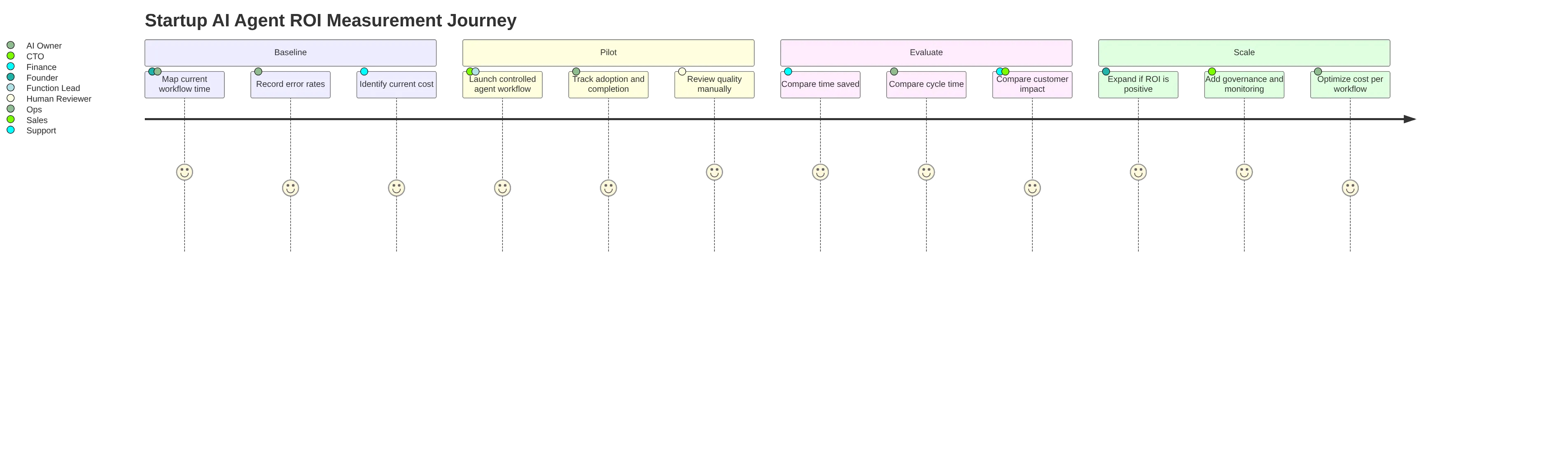
The deeper strategic point is that AI agents should not be treated as a novelty layer on top of broken processes. They should force the startup to clarify how work should happen. What is the source of truth? Who approves exceptions? What data is reliable? What actions are safe? What outcomes matter?
That is why AI agent strategy for startups is becoming a leadership issue, not only a technical issue. The founder, CTO, COO, product lead, and functional owners all need a shared plan. Without one, AI becomes another form of tool sprawl. With one, AI becomes operating leverage.
A useful founder checklist for 2026:
- Do we know our top 10 workflow bottlenecks?
- Have we separated AI tools vs AI agents in our roadmap?
- Do we know which systems agents can access?
- Have we defined read-only, draft-only, and action-taking permissions?
- Do we require human approval for high-impact actions?
- Are prompts, tool calls, errors, and approvals logged?
- Do we measure cost per workflow, not just total AI spend?
- Do we have a policy for customer data, financial data, code, and device-related actions?
- Do we know when to buy, build, or partner?
- Do we review our AI implementation strategy quarterly?

The final takeaway is simple: startups do not need more disconnected AI tools in 2026. They need an AI agent strategy for startups that connects automation to real operations, measurable productivity, secure data access, and human accountability.
For startups exploring AI automation for startups, the next step is not to automate everything. It is to map the workflows that matter most, choose one or two supervised pilots, measure the results, and build a repeatable operating model.
For teams evaluating the future of AI agent hardware and software, the same principle applies. The value is not in the technology alone. The value is in how agents, software, connected systems, data, and human approvals work together to create faster, safer, and more scalable startup operations.
FAQ: AI agent strategy for startups
What’s the difference between an AI tool and an AI agent?
An AI tool completes a single task when a human prompts it. An AI agent works toward a goal across multiple steps, using tools and systems, retrieving context, and escalating to a human when a decision crosses a defined threshold.
Do early-stage startups really need an AI agent strategy, or is that premature?
Even a five-person team benefits from basic governance — who owns the agent, what it can access, and how incidents are handled — before scaling any agentic workflow.
Where should a startup start with AI agents?
With low-risk, high-frequency workflows an agent can prepare, classify, summarize, or draft while a human approves the final action — not with the highest-risk workflow first.
How should startups measure AI agent ROI?
Usage alone isn’t ROI. Track workflow-level outcomes: time saved, cycle time, quality, customer impact, and cost per workflow — not just how often the tool gets opened.
Should a startup build, buy, or partner for AI agent infrastructure?
It depends on workflow uniqueness, data sensitivity, and technical capability. Simple productivity tasks favor off-the-shelf tools; core IP or sensitive workflows favor building; specialized or device-connected infrastructure often favors a partner.
Related posts

Why CrewAI beats LangChain for multi-agent work
CrewAI vs LangChain compared by workflow shape, showing when role-based agents beat graph orchestration for multi-agent systems.
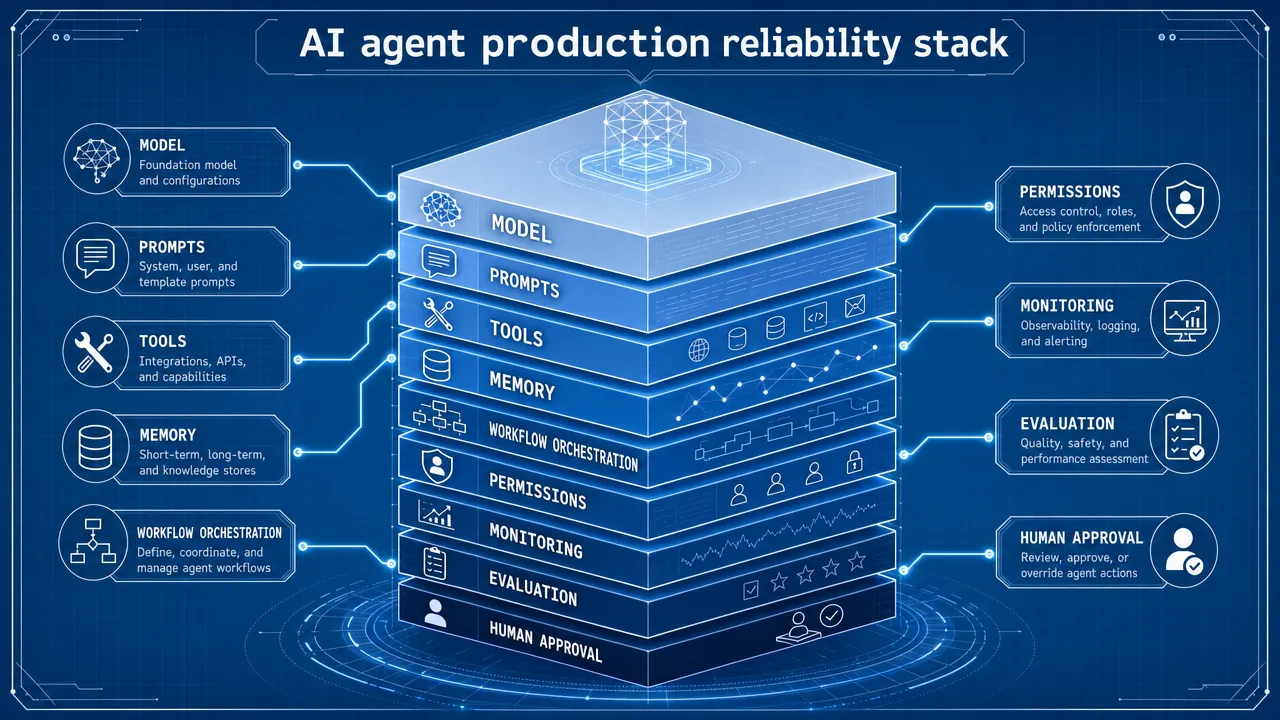
Why Most AI Agents Fail in Production (And the 3 Patterns That Actually Work)
Why AI agents fail in production: a workflow-first method for evaluating tools, security, monitoring, and human approval gates.
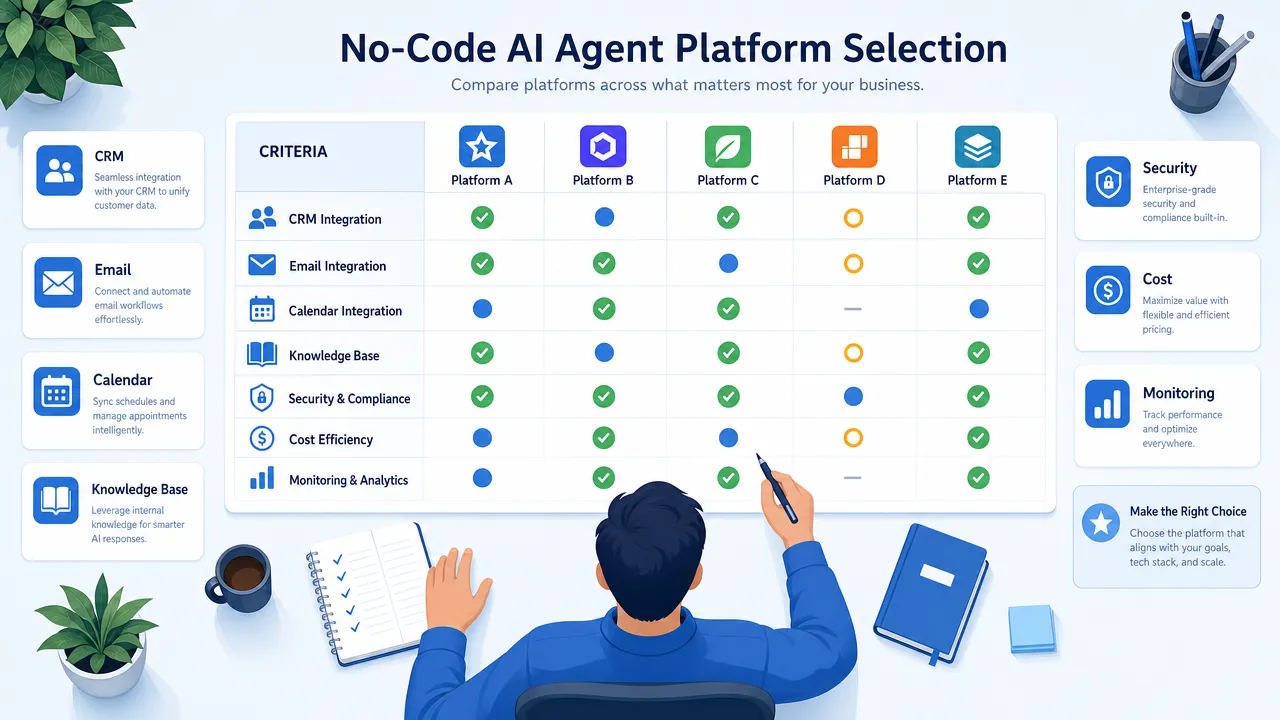
How to Build an AI Agent for Your Business Without Writing Code in 2026
Build AI agent business no code 2026 with a workflow-first framework for data access, approvals, risk controls, and ROI tracking.