Why Most AI Agents Fail in Production (And the 3 Patterns That Actually Work)
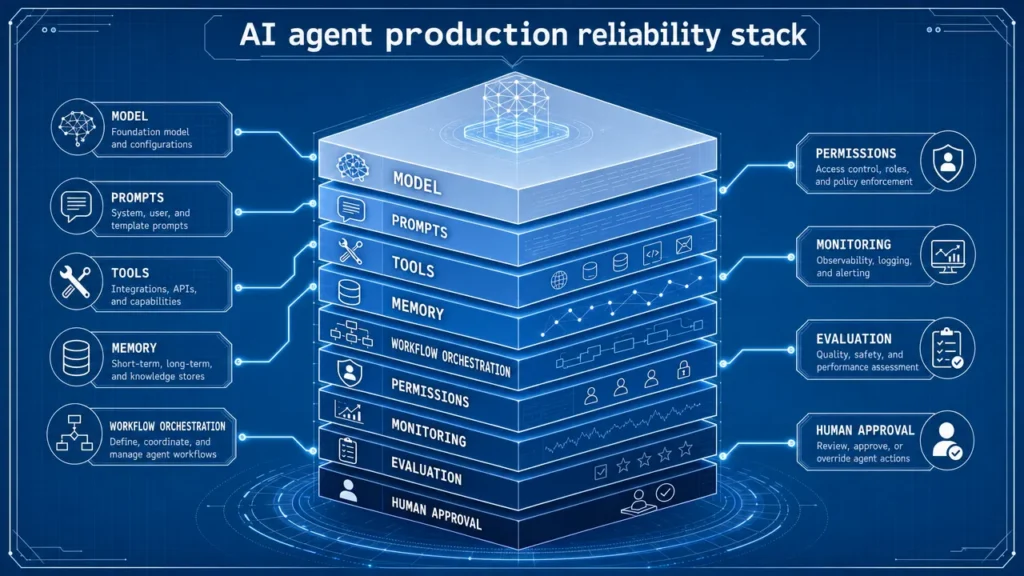
The short answer: Most AI agents fail in production because teams treat them like smarter chatbots instead of operational systems. The three patterns that consistently work are: constrained workflows instead of open-ended autonomy, human approval for high-risk actions, and continuous observability across every step of every run — not just final outputs.
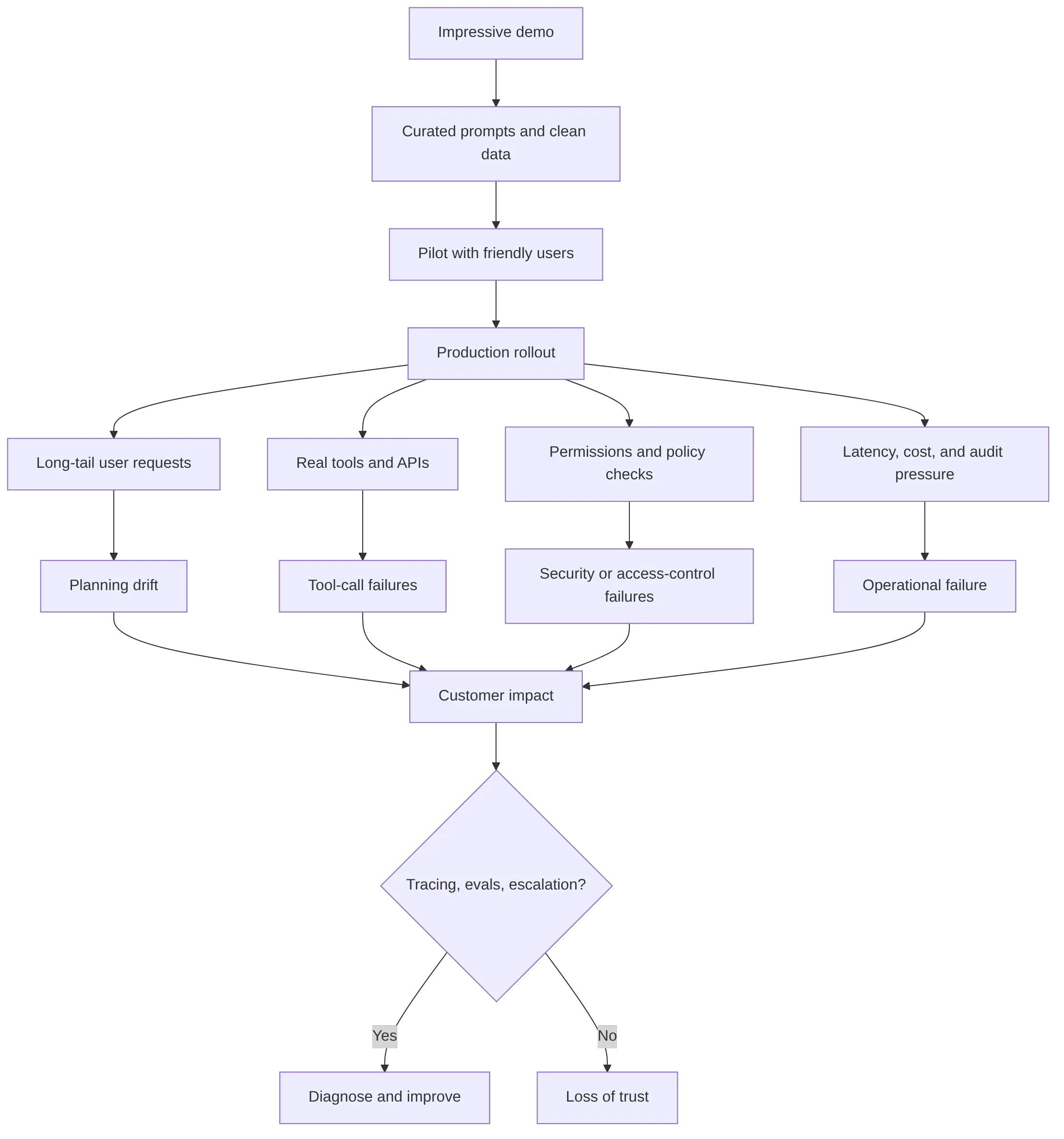
AI agents fail in production because teams often deploy them as open-ended reasoning systems before they have the workflow constraints, tool reliability, evaluation coverage, security controls, and human accountability that production work requires. A polished demo can hide that reality because it usually runs on curated prompts, clean data, short sessions, known tools, and low-risk outputs. Production replaces that clean path with long-tail user intent, API failures, permission boundaries, stale enterprise data, latency budgets, cost pressure, and audit requirements.
The problem is not that AI agents are useless. The problem is that many teams treat them like smarter chatbots when they are actually operational systems. An agent that can choose tools, retrieve data, remember context, update records, or trigger actions needs the same engineering discipline as other production infrastructure, plus new controls for nondeterministic behavior.
Why AI agents fail in production after impressive demos
The shortest answer to "why AI agents fail in production" is this: demos prove that an agent can succeed on a controlled path, while production proves whether the system can survive variability, uncertainty, and operational consequences.
In a demo, the agent may receive a friendly prompt like "summarize this ticket and create a response." The data is available, the tools are preselected, the user intent is obvious, and the output can be judged informally. In production, the same agent may face conflicting customer records, missing permissions, ambiguous instructions, outdated policies, API timeouts, and a user who expects the result to be correct the first time.
Anthropic’s guidance on building effective agents makes an important distinction between predictable workflows and more autonomous agents. The recommendation is not to maximize autonomy by default. It is to use the simplest pattern that solves the task. OpenAI’s practical guide to building agents makes a similar point by emphasizing clear success criteria, constrained scope, guardrails, and human approval for higher-impact actions.
That distinction matters because AI agent production challenges are system-level challenges. A standard LLM application may generate a response. An agent may decide a plan, call tools, read retrieved context, write memory, invoke external APIs, and produce an action. Every one of those steps can fail.
This is why benchmark progress does not automatically translate into production reliability for AI agents. Carnegie Mellon University’s TheAgentCompany benchmark summary shows that current agents still struggle with realistic office work involving tool use, persistence, and multi-step coordination. Benchmarks are useful, but production reliability also depends on data quality, access control, monitoring, cost, latency, and organizational readiness.
Enterprise adoption reflects the same gap. McKinsey reports that many organizations are experimenting with agents, while fewer are scaling them broadly. In The State of AI, McKinsey reported broad experimentation with AI agents, and in its article on building the foundations for agentic AI at scale, it emphasized that scaling depends on foundations such as data, governance, operating models, and technology architecture.
Why AI agents fail in production at the system level
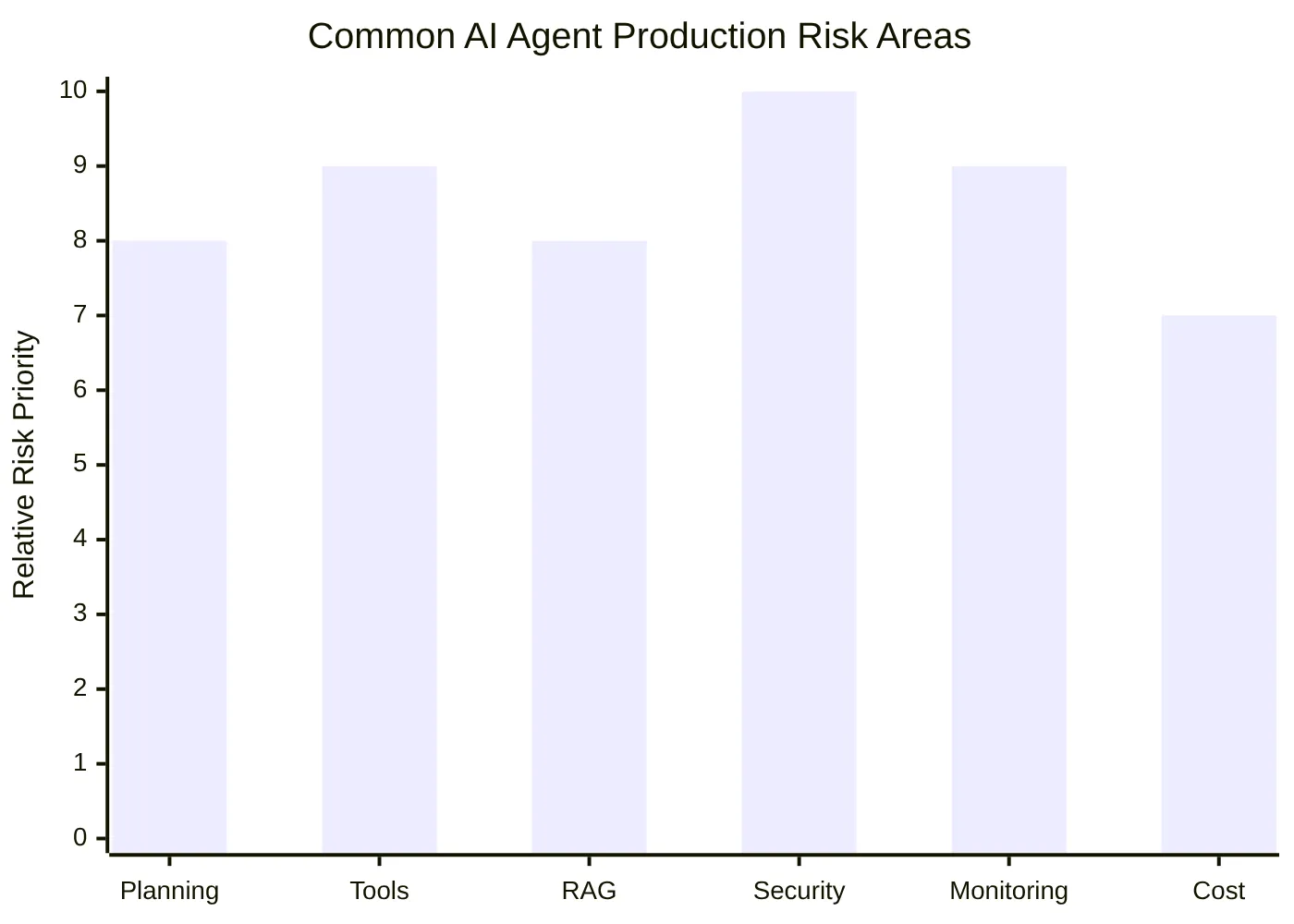
Most AI agent failure causes are not isolated model mistakes. They are failures across the agent stack: reasoning, tools, retrieval, memory, permissions, evaluation, and operations.
| Failure category | What it looks like in production | Likely cause | Better control |
|---|---|---|---|
| Planning failure | The agent takes irrelevant steps, loops, or solves the wrong problem | Open-ended autonomy with weak success criteria | Bounded workflows, max-step limits, plan validation |
| Tool-calling failure | The agent selects the wrong tool or sends invalid parameters | Ambiguous tool descriptions, weak schemas, changing APIs | Typed tools, argument validation, retries, fallbacks |
| Retrieval failure | The agent answers from stale, irrelevant, or missing context | Poor indexing, weak metadata, stale documents | RAG evals, freshness controls, source authority checks |
| Memory failure | The agent forgets constraints or uses the wrong prior context | Unclear state model, long sessions, unsafe memory writes | Explicit state, memory governance, tenant isolation |
| Security failure | The agent follows malicious instructions from external content | Prompt injection or overprivileged tools | Least privilege, sandboxing, approval gates |
| Monitoring failure | Users discover failures before the team does | Only final answers are logged | Tracing, online monitoring, incident review |
| Evaluation failure | Tests pass, but production behavior fails | Eval set does not represent real use | Golden datasets, adversarial cases, regression tests |
| Cost and latency failure | Tasks take too long or cost too much | Too many model calls, tool calls, retries, or long contexts | Model routing, caching, step budgets, latency alerts |
Tool use is a major source of LLM agent production problems. Tool-calling documentation from major AI platforms generally treats tools as structured interfaces, not casual prompt add-ons. In practice, every tool needs a narrow purpose, a clear schema, validation before execution, timeout behavior, retry logic, and audit logging. Write actions also need idempotency so the agent does not accidentally repeat a refund, email, database update, or workflow change.
RAG is another common failure point. An agent can reason well over the wrong evidence and still produce a confident answer. That is why AI agent monitoring and evaluation must include retrieval quality, not just final-answer quality. LangSmith’s documentation on evaluation and observability reflects this broader need: production teams need to inspect traces, datasets, evaluators, tool calls, retrieved context, latency, and errors.
Security changes the risk profile again. OWASP identifies prompt injection as a major LLM application risk, including indirect prompt injection where external content can manipulate model behavior. For agents, this is especially serious because the model may control tools. A malicious instruction hidden in a webpage, document, email, or ticket can become dangerous if the agent has excessive permissions.
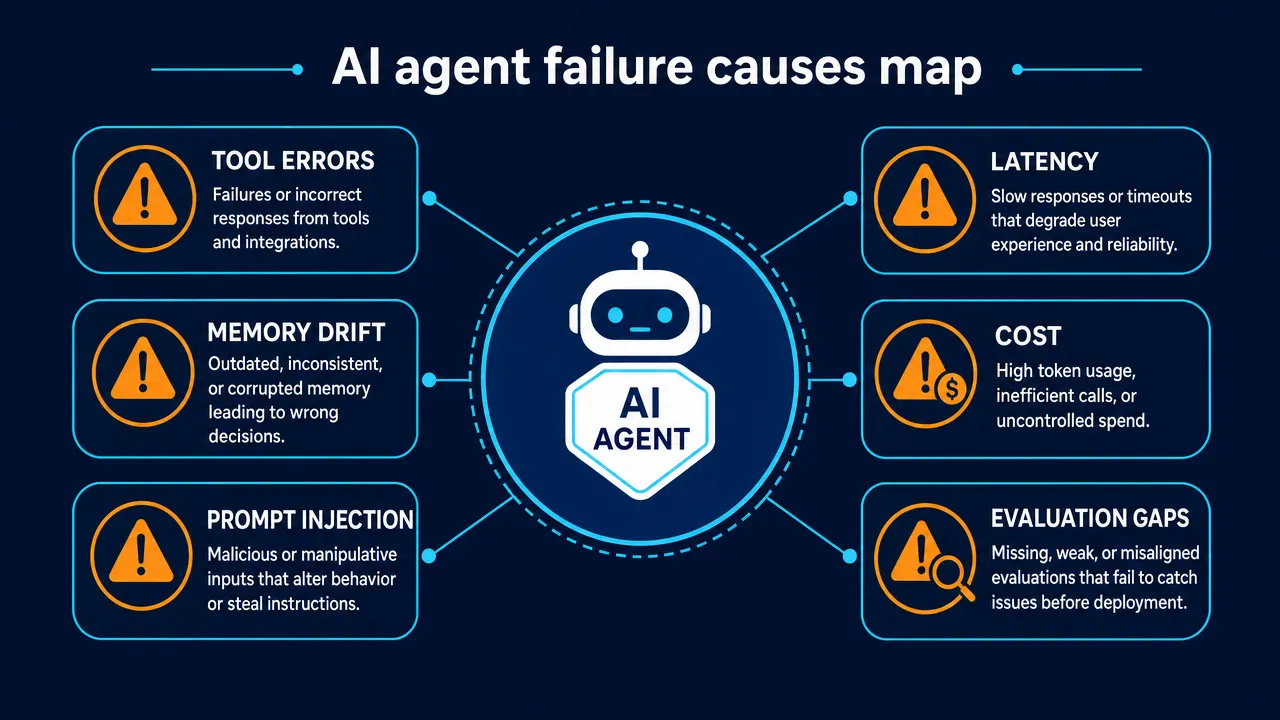
The result is a simple but uncomfortable truth: making the model smarter helps, but it does not remove the need for production engineering. Better models may reduce some reasoning errors, but they do not automatically solve API reliability, access control, stale data, audit trails, human accountability, or cost management.
Why AI agents fail in production inside enterprise environments
Enterprise AI agent adoption is difficult because production agents must operate inside existing systems, policies, and human workflows. They are not just model deployments. They are organizational deployments.
A small team can build a useful prototype quickly. Scaling it requires answers to harder questions:
| Enterprise question | Why it matters |
|---|---|
| Who owns the agent? | Production agents need product, engineering, risk, data, and business ownership. |
| What systems can it access? | Access determines both utility and risk. |
| What actions can it take? | Read-only assistance is very different from write access or autonomous execution. |
| How is success measured? | "It works in demos" is not a production metric. |
| What happens when it is uncertain? | Ambiguity needs fallback, escalation, or refusal behavior. |
| How are incidents handled? | Agent failures need trace review, rollback, and regression updates. |
| What must be audited? | Regulated or high-impact workflows require explainability and logs. |
NIST’s AI Risk Management Framework is useful here because it frames AI risk as a lifecycle issue involving governance, mapping, measurement, and management. For AI agents, those ideas become concrete: version prompts, log tool calls, classify risk by autonomy and impact, document approval policies, and monitor real-world behavior after launch.
Enterprise deployment also exposes workflow mismatch. A sales research agent that enriches CRM records may be useful, but sending outbound emails without approval can create brand and compliance risk. A support agent that drafts replies may improve cycle time, but issuing refunds autonomously can create financial and customer-experience risk. An IT agent that diagnoses tickets may be safe, but changing infrastructure requires stronger approval and rollback controls.
For AI agent hardware and software systems, reliability can also include physical and edge constraints: device availability, network connectivity, local latency, sensor quality, firmware updates, and safety boundaries. These considerations do not replace software reliability. They add another layer. A production-ready agentic system must account for the environment where the agent acts, not just the model that reasons.
The most reliable deployments usually start with lower-risk modes of autonomy:
| Autonomy level | Example | Reliability profile |
|---|---|---|
| Read-only assistant | Answers questions from approved knowledge sources | Lower risk if retrieval and citations are strong |
| Drafting copilot | Writes a response for human review | Human remains accountable |
| Workflow step executor | Classifies, extracts, routes, or summarizes inside a deterministic flow | Easier to test and monitor |
| Human-approved action agent | Proposes actions that require approval | Good balance for sensitive work |
| Autonomous action agent | Executes multi-step actions with limited oversight | Highest reliability, security, and governance burden |
The mistake is jumping to the final row too early.
For teams evaluating which framework to build on before reaching production, see LangGraph vs AutoGen: Which AI Agent Framework Handles Complex Workflows in 2026 and How to Compare AI Agent Frameworks in 2026.
Why AI agents fail in production without the 3 patterns that work
The agents that survive production are usually less magical than the demos. They are constrained, observable, and designed to involve humans at the right moments. Three patterns consistently reduce AI agent deployment issues.
Pattern 1: AI agents fail in production less when autonomy is constrained by workflows
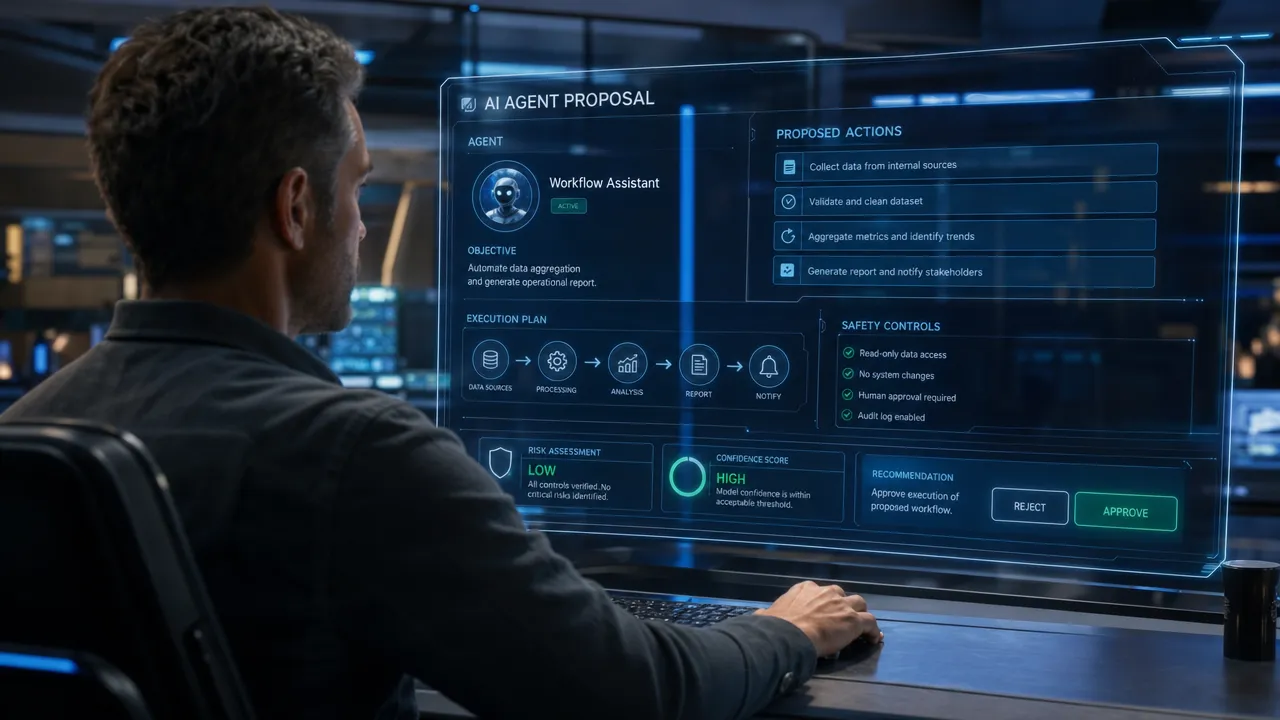
The first reliable pattern is a constrained agent inside a deterministic workflow. The workflow owns the control flow. The LLM handles bounded tasks such as classification, extraction, summarization, drafting, routing, or evidence comparison.
This pattern works because predictable processes do not need open-ended autonomy. If the steps are known, the system should not ask the model to reinvent the process on every run. Anthropic’s workflow-first guidance supports this approach: use routing, prompt chaining, parallelization, orchestrator-worker patterns, or evaluator-optimizer loops when they provide enough control.
A workflow-constrained agent should include:
- Clear task boundaries.
- Typed tools with limited permissions.
- Structured outputs.
- Validation after every model-generated step.
- Max-step, max-cost, and max-latency budgets.
- Fallback behavior when confidence is low.
- Escalation for ambiguous or high-impact cases.
- Versioned prompts, tools, models, and configurations.
This is often the right pattern for ticket triage, document classification, invoice extraction, internal knowledge retrieval, compliance checklist generation, and support response drafting.
Pattern 2: AI agents fail in production less when humans approve high-risk actions
The second reliable pattern is human-in-the-loop design with explicit escalation. Human review should not be an afterthought. It should be part of the architecture.
OpenAI’s agent guidance emphasizes human approval for high-impact actions. That is a practical reliability principle, not just a safety principle. Human approval protects the business when the task involves external communication, financial impact, legal exposure, regulated data, infrastructure changes, employment decisions, or irreversible actions.
Good human-in-the-loop design includes:
- Risk classification before action.
- Escalation triggers based on uncertainty, policy, value, or user impact.
- A review queue with the agent’s proposed action.
- Evidence, retrieved sources, and tool results shown to the reviewer.
- A concise handoff summary.
- Reviewer decisions captured as evaluation data.
- Monitoring for approval rate, rejection reasons, and reviewer burden.
Poor human-in-the-loop design creates alert fatigue. Good design creates a learning loop. Every rejected action becomes a future eval case. Every unclear handoff improves the agent’s state model. Every escalation metric helps leadership understand where automation is working and where judgment is still required.
Pattern 3: AI agents fail in production less when every run is observable and evaluated
The third reliable pattern is continuous evaluation and observability. Final-answer accuracy is not enough for production agents because an agent can produce a plausible answer after taking a broken path.
A production trace should show:
- User intent.
- Prompt and model version.
- Tool calls and parameters.
- Tool results and errors.
- Retrieved sources.
- Intermediate decisions.
- Policy checks.
- Latency and cost.
- Escalation events.
- Final outcome.
- User or reviewer feedback.
OpenAI’s evaluation best practices emphasize representative evals, clear criteria, and regression testing. For agents, evaluation should include both final outputs and intermediate behavior. Did the agent choose the right tool? Did it retrieve the right source? Did it obey permissions? Did it stop when it should have escalated?
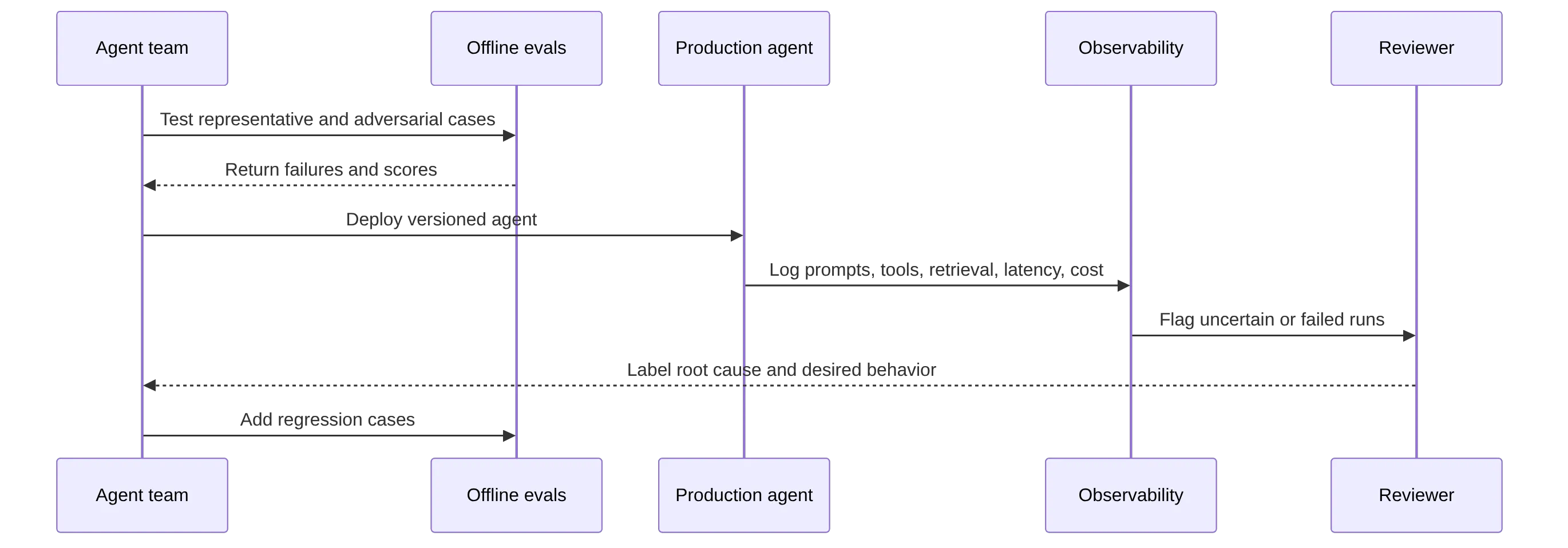
The key is to evaluate the agent as a system. That means measuring not only whether the answer was acceptable, but whether the path was safe, efficient, grounded, authorized, and repeatable enough for the use case.
How teams stop AI agents fail in production with reliability metrics
Production reliability for AI agents requires metrics that connect engineering behavior to business outcomes. A team that only measures model accuracy will miss tool failures. A team that only measures cost will miss hallucinations. A team that only measures user satisfaction will miss security and compliance drift.
The most useful agent metrics usually span six categories:
| Metric | Definition | Why it matters |
|---|---|---|
| Task success rate | Percentage of tasks completed correctly | Measures business utility |
| First-pass success rate | Percentage completed without retry or correction | Measures efficiency |
| Tool-call success rate | Percentage of tool calls that execute correctly | Reveals integration reliability |
| Tool selection accuracy | Whether the agent picked the correct tool | Diagnoses planning and tool-use failures |
| Retrieval relevance | Whether retrieved context matched the task | Improves RAG reliability |
| Groundedness | Whether claims are supported by evidence | Reduces unsupported output |
| Human escalation rate | Percentage of tasks routed to people | Balances automation and control |
| Policy violation rate | Percentage of outputs or actions that violate rules | Tracks safety and compliance |
| Latency | End-to-end time to complete the task | Affects user experience |
| Cost per completed task | Total cost divided by successful completions | Determines ROI |
| Regression rate | Previously passing cases that fail after changes | Protects release quality |
| Incident rate | Count of quality, security, or availability incidents | Tracks operational risk |
These metrics should feed release gates. A new prompt, tool, model, retrieval index, or workflow change should not ship merely because it improves a few examples. It should pass representative evals and regression tests.
A practical production checklist looks like this:
| Stage | Reliability gate |
|---|---|
| Discovery | Define task owner, user, success metric, risk level, and whether an agent is necessary. |
| Architecture | Use deterministic workflow control where possible. Separate planning, execution, validation, and response. |
| Tools | Use narrow tool definitions, typed schemas, validation, timeouts, retries, and least privilege. |
| Data | Identify source-of-truth systems, freshness requirements, access boundaries, and retrieval evals. |
| Security | Test prompt injection, enforce per-user authorization, sandbox risky actions, and log access. |
| Evaluation | Build golden datasets, adversarial cases, tool-call tests, RAG tests, and regression suites. |
| Pilot | Limit users, monitor traces daily, compare against the baseline process, and review failures. |
| Monitoring | Track success, errors, cost, latency, escalations, policy violations, and user feedback. |
| Scaling | Add rate limits, model routing, safe caching, incident response, and governance review. |
This is where Aiden’s position as an AI agent technology company is especially relevant: reliable agent systems require more than a prompt and a model. They require infrastructure thinking across software, hardware-aware deployment contexts, monitoring, evaluation, human control, and operational readiness.
The future of agents is not full autonomy everywhere. It is the right autonomy in the right workflow, with the right controls.
AI agents fail in production when teams skip those controls. They work when teams design them as production systems: constrained where predictability matters, human-supervised where judgment matters, and observable everywhere. For organizations moving from demo to deployment, the winning question is not "How autonomous can this agent be?" The better question is "What level of autonomy can we make reliable, measurable, secure, and useful?"
Talk to Aiden about building AI agent systems designed for real-world operations, not just impressive demos.
FAQ
Why do most AI agents fail in production?
Most AI agents fail in production because they are deployed as open-ended reasoning systems before the surrounding infrastructure is production-ready. The common failure points are planning drift, tool-call failures, retrieval errors, security vulnerabilities from prompt injection, insufficient monitoring, and evaluation sets that do not represent real usage. The underlying cause is treating agents as smarter chatbots rather than operational systems that need the same engineering discipline as other production infrastructure.
What are the 3 patterns that make AI agents reliable in production?
The three patterns are: first, constrained workflows where the LLM handles bounded tasks inside a deterministic control flow rather than open-ended autonomy; second, human-in-the-loop design with explicit escalation for high-risk actions like external communications, financial decisions, or irreversible changes; third, continuous observability and evaluation that traces every step of every run — prompts, tool calls, retrieved sources, intermediate decisions, latency, cost, and final outcomes — not just final answer quality.
What is the difference between an AI agent demo and production?
A demo runs on curated prompts, clean data, short sessions, known tools, and low-risk outputs. Production replaces that with long-tail user intent, API failures, permission boundaries, stale enterprise data, latency budgets, cost pressure, and audit requirements. A polished demo proves the agent can succeed on a controlled path. Production proves whether it can survive variability, uncertainty, and operational consequences.
What metrics should production AI agents track?
Production agents should track task success rate, first-pass success rate, tool-call success rate, tool selection accuracy, retrieval relevance, groundedness, human escalation rate, policy violation rate, latency, cost per completed task, regression rate, and incident rate. These metrics should feed release gates — a new prompt, tool, or model change should not ship until it passes representative evaluations and regression tests.
What is prompt injection and why does it matter for AI agents?
Prompt injection is a security risk where malicious instructions hidden in external content — a webpage, document, email, or support ticket — manipulate the agent’s behavior. For agents with tool access, this is especially dangerous because a successful injection can cause the agent to execute unintended actions using its permissions. Mitigations include least-privilege tool design, sandboxing risky actions, approval gates for high-impact operations, and monitoring for policy violations.
When should an AI agent involve a human?
Human approval should be part of the architecture, not an afterthought. Escalation is appropriate when the agent is uncertain, when the action involves external communication, financial impact, legal exposure, regulated data, infrastructure changes, employment decisions, or irreversible operations. Good human-in-the-loop design shows the reviewer the agent’s proposed action, the evidence it used, and a concise summary — and captures reviewer decisions as evaluation data for future improvement.
Written by Natalie Yevtushyna, Business Strategist at Aiden — AI agents, automation, and the infrastructure behind them.
Related posts
Why CrewAI beats LangChain for multi-agent work
CrewAI vs LangChain compared by workflow shape, showing when role-based agents beat graph orchestration for multi-agent systems.
How to Build an AI Agent for Your Business Without Writing Code in 2026
Build AI agent business no code 2026 with a workflow-first framework for data access, approvals, risk controls, and ROI tracking.

Why AI Hardware Keeps Failing — and What an AI Agent Device Should Actually Do
Learn why an AI agent device must solve real jobs with context, consent, tool use, and reliability to earn trust beyond smartphones.